






Maharashtra: Regressive tinkering
 – Dipta Joshi (Mumbai)
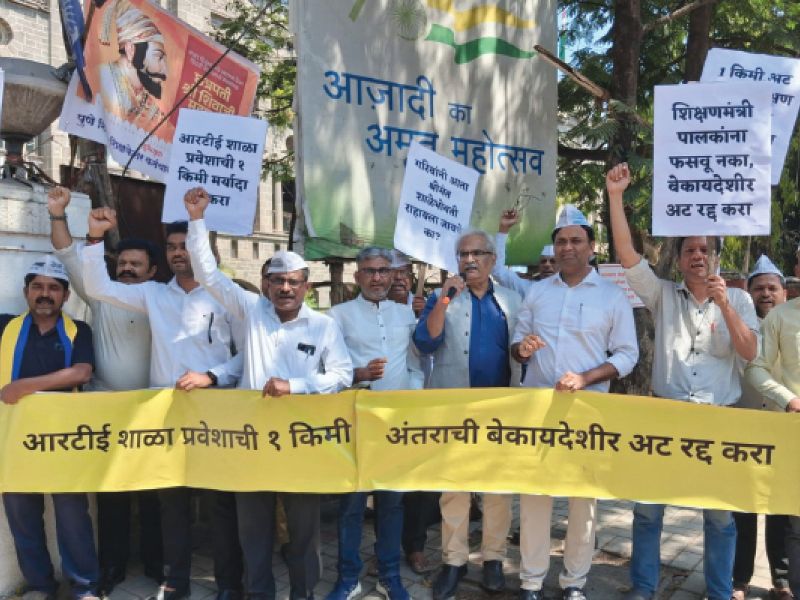
The state government is under fire from opposition political parties for its latest directive reducing the catchment area of poor neighbourhood children obliged to be admitted free-of-charge into private schools under s.12 (1) (c) of the Right of Children to Free & Compulsory Education (RTE) Act, 2009.
Under s.12 (1) (c), non-minority private and boarding schools are obliged to reserve 25 percent capacity in class I for poor neighbourhood children and retain them free-of-charge until class VIII. After the RTE Act became law on April 1, 2010, state governments notified Rules, which defined “poor” and “neighbourhood”. Inevitably — and perhaps unanticipated by framers of the RTE Act and Rules — these issues became contentious.
In Maharashtra, poor households eligible to apply for admission into non-minority private day schools are defined as those with annual income of less than Rs.1 lakh per year. Moreover, their homes should be sited within a 3 km radius of the private school of their choice. Now under a new GR (government resolution) dated February 12, the state’s BJP-Shiv Sena-NCP government has reduced the eligibility radius to 1 km.
Opposition parties say the government’s latest move is “illegal” as it disqualifies a large number of poor children aspiring for education in reputed private schools in their neighbourhood. On the other hand, private school associations accuse the government of turning a blind eye to the real issue of pending reimbursements under s.12 (2) — which stipulates that government will reimburse private schools costs of admitting poor children on the basis of government expense per child in public schools — and indulging in unnecessary, minor tinkering with the RTE Act.
The plain truth is that disappointed by poor educational standards and lack of infrastructure in state government (public) schools, there have been rising applications for admission under s.12 (1) (c) in private schools. In 2025-26, the number of applications were 3 lakh for a total 1 lakh seats available in private schools.
Of the total 88,182 children who were admitted into private schools after meeting prescribed s.12 (1) (c) criteria, 15,706 lived beyond the 1 km radius of schools of their choice. Mukund Kirdat, spokesperson of the Aam Aadmi Party (AAP), believes reducing the radius to 1 km will mean 15,706 or an even higher number of students will become ineligible for admission into private schools of their choice in the forthcoming academic year 2026-27.
“In cities and urban areas with high population density, the chances of poor children finding private schools within the 1 km radius are high. However, in rural and urban periphery areas, typically one private school will attract students from three-four villages in their neighbourhood. If this new GR is read with the state government’s earlier announcement of March 2024 to shutter government schools reporting less than 20 students, a large number of children in rural and peri-urban areas will be excluded from private schools because they are beyond the 1 km perimeter even as government schools in their neighbourhood are shut down due to paucity of students. This will result in undermining the prime objective of the RTE Act which is to provide elementary education to all children in the 6-14 age group,” argues Kirdat, who has written to the government to withdraw the GR immediately.
Meanwhile, private school managements have become disillusioned with the RTE Act. Despite the state government being liable under s.12 (2) to reimburse tuition fees of poor neighbourhood children admitted into class I and retained until class VIII, successive state governments have failed and neglected to discharge this reimbursement obligation. Pending dues of private independent (unaided) schools have aggregated to Rs.2,200 crore over the past seven years (2019-2026).
“Private schools can no longer afford to subsidise the education of children admitted under s.12 (1) (c) as it’s impacting our survival. If the government really cared about providing education to the state’s children, it would upgrade the quality of education in government schools and respect the mandate of s.12 (2) to clear our dues. Instead, it is making cosmetic changes to the existing policy,” says Sanjayrao Tayade Patil, Founder, Maharashtra English School Trustees Association (MESTA) which has 17,000 private English-medium school trustees as members.
When the RTE Act was enacted in 2009 by the Congress-led UPA-II government, it was an admission of failure of government to upgrade and raise standards of the country’s 1.10 million government schools. That’s why private schools were partly “nationalised through the backdoor”. Since then, by consistently failing to clear s.12 (2) dues of private schools, state governments seem intent upon levelling down private schools to government school standards.







Add comment