






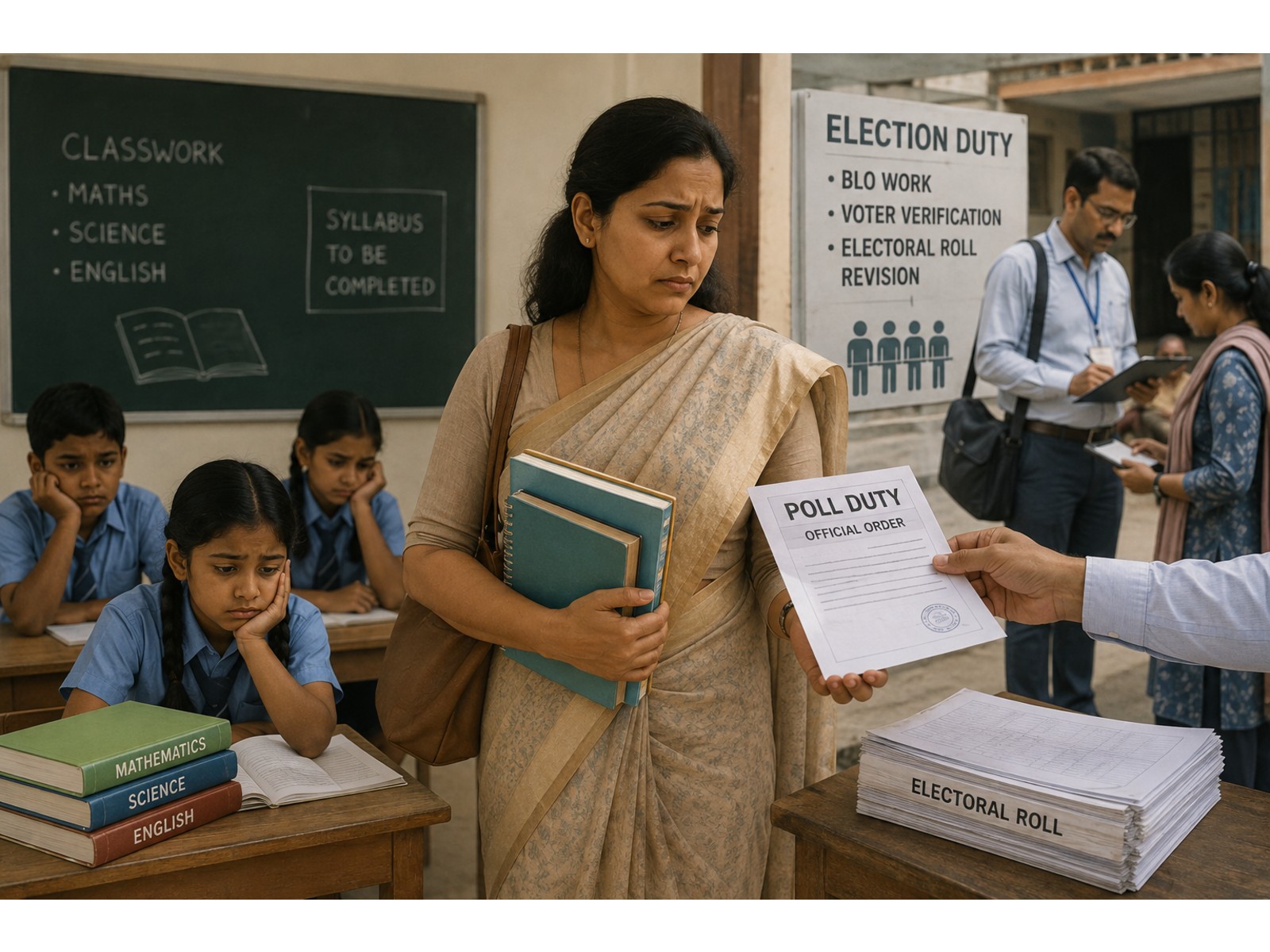
Maharashtra: Teachers Pulled Into Election Duties, Students Pay the Price
– Ronita Torcato
Teachers across Maharashtra are increasingly being pulled away from classrooms for election-related duties, including Booth Level Officer (BLO) work and electoral-roll revision, raising concerns about the impact on teaching time, curriculum completion and students’ learning.
Section 27 of the Right of Children to Free and Compulsory Education (RTE) Act, 2009, permits teachers to be deployed for only three categories of non-educational work: population census, disaster relief and duties related to local authority or parliamentary elections. Section 24 also requires teachers to complete the curriculum within the prescribed timeframe.
However, the use of teachers for election-related work has remained contentious. The Supreme Court, in Election Commission of India v St Mary’s School (2007), recorded the Election Commission of India’s (ECI) position that teaching staff should not ordinarily be deployed for election or electoral-roll revision duties during school working days and teaching hours.
More recently, on July 27, 2026, the Delhi High Court directed the ECI to ensure that schoolteachers deployed for the ongoing Special Intensive Revision (SIR) of electoral rolls are not subjected to an “unbearable” workload. The developments have renewed concerns among teachers, parents and education stakeholders over the growing non-academic burden on teachers.
In Mumbai, the scale of deployment has become a particular concern. In the recently concluded SIR exercise, out of approximately 10,000 BLOs engaged in voter verification across Mumbai, 3,000 were school teachers. In Ghatkopar East Assembly constituency, more than 65 percent of personnel deployed for door-to-door BLO duties were reportedly drawn from the education sector. At Poorna Prajna School in Dahisar, 24 of the school’s 34 teachers were assigned BLO duties, leaving the institution with a significantly depleted teaching workforce.
The issue has also reached the Bombay High Court. On May 22, 2026, Justice Gautam Ankhad issued notice to the Maharashtra government on a writ petition filed by an association representing more than 500 private unaided and private unaided minority schools in the state. The petition challenges government notices, appointment orders and other actions seeking to compulsorily deploy teachers and staff for census duties under the Census Act, 1948 and Census Rules, 1990.
Teachers say such assignments come on top of already demanding workloads, including lesson planning, assessments, corrections, parent meetings, extra classes and administrative responsibilities.
“Teachers are already juggling packed syllabi, extra classes, paperwork, parent meetings, and now door-to-door BLO work on top of it,” said Juliana, a senior teacher at St Xavier’s High School, Fort. She said the additional responsibilities ultimately take teachers away from their primary role and force them to compensate by working longer hours.
Historian and teacher Kranti Farias argued that the government could instead employ educated unemployed youth for election-related assignments, providing them with temporary employment and remuneration.
Classical musician and English teacher Marion Rodrigues described election duties as an additional burden on a profession that already demands substantial work beyond school hours, while environmentalist and parent Zinnia Khajotia warned that prolonged deployment could further disrupt classroom teaching, particularly in government schools.
With teachers already facing pressure to complete prescribed curricula, prolonged deployment for election and census-related duties risks widening the gap between instructional requirements and available teaching time.
Activist Aadil Desai suggested that educated people without permanent employment could instead be offered temporary, adequately paid assignments for election-related surveys and census work. Such a model, he argued, would allow teachers to remain in classrooms while providing short-term employment opportunities to others.
For parents and educators, the key question remains whether essential electoral and administrative duties should continue to rely so heavily on teachers when the immediate cost is borne by students through disrupted classes, delayed assessments and compromised learning time.











5 comments
Devendra Bhujbal
Election commission of India declared thst it has nothing to do with SIR ! It Govt. of India’s initiative. In this exercise not only teachers but staff of some other govt., semi govt.bodies is also involved. simultaneously citizens are also suffering unnecessarily. In my own case my wife’s and daughter’s name and all other details are existed but not mine! I am running from piller to pillar for getting my name included in voter’s list!
Suresh Devikar
Very nice
Suresh Devikar
Very vice
Sam
While a teacher does connect with the immediate society and therefore is more suited for verifying local records, the problem is:
the teachers’ electoral ward is often not where she/ he is teaching
As Aadil Desai has given a good suggestion – there are so many unemployed and educated people who can be given this work on an assignment basis with a respectable remuneration.
Joaquim Tellis
I fully agree with the above. A teacher’s duty is to teach in school and complete the syllabus. Besides, in many schools the number of teachers is much less than what is needed. How can teachers be absent when they teach more than the classes they are given? The Government does not fill vacancies of clerks, peons etc. in schools. How much must the Management of schools do?