






Media Education that Mirrors the Industry at MIC, Manipal
Manipal Academy of Higher Education (MAHE), an Institute of Eminence ranked #3 in NIRF 2025, is renowned for its unwavering commitment to experiential and interdisciplinary learning. Among its distinguished institutions, the Manipal Institute of Communication (MIC) stands out as a dynamic hub where media education moves beyond theory and is practised as a living, evolving discipline.
Founded in 1997, MIC has steadily grown over more than two decades into one of India’s premier destinations for aspiring media professionals. The institute offers a diverse portfolio of programmes, including BA and MA in Media and Communication, a BA in Graphic Design and Digital Marketing, a BSc in Animation, and a Postgraduate Diploma in Sports Communication. With nearly three decades of academic excellence, MIC continues to nurture industry-ready professionals equipped to thrive in the fast-paced and ever-evolving media landscape.
In an era defined by rapid transformation—where newsrooms evolve overnight, digital platforms multiply at unprecedented speed, and artificial intelligence reshapes content creation and distribution—MIC recognises that traditional, role-specific training is no longer sufficient. Instead, the institute prioritises adaptability, innovation, and critical thinking. Students are grounded in disciplines such as media psychology, brand planning, storytelling, digital marketing, artificial intelligence, advertising, public relations, broadcasting, and content marketing, which together form a flexible toolkit for solving real-world media challenges across platforms.
Hands-on learning lies at the heart of MIC’s educational philosophy. Students actively engage in initiatives such as MIC Check, a podcast available on Spotify; the management of a community radio station; contributions to the student-run publication AM Plus; and leadership roles in institutional social media teams. Signature events like Namma Angadi and Namma Sante provide immersive learning opportunities that test managerial, organisational, and creative skills. These are not short-term academic exercises but sustained, student-led ventures that demand strategic planning, technical expertise, teamwork, and audience engagement—mirroring professional media environments.
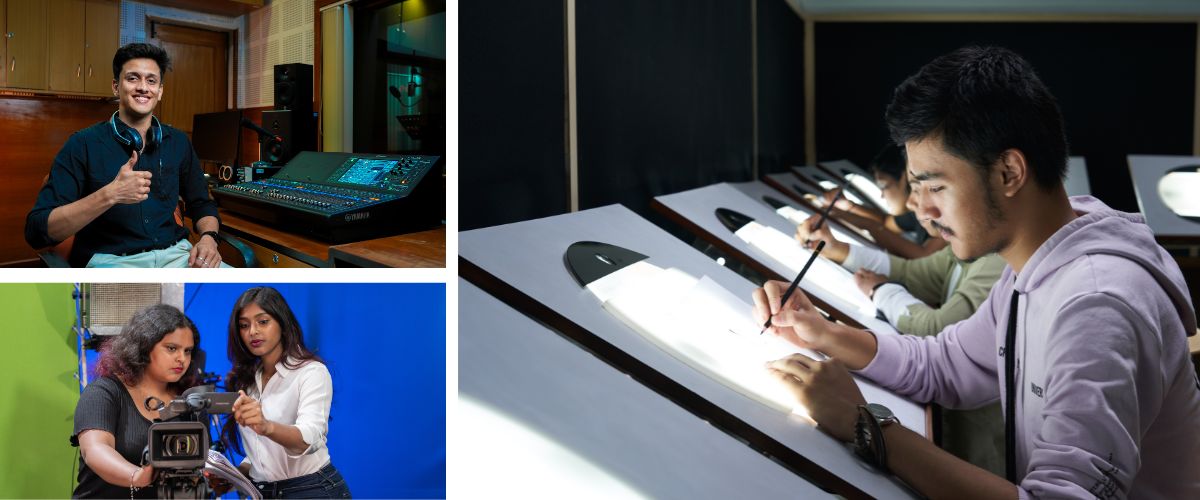
State-of-the-art studios, advanced multimedia laboratories, and professional radio facilities further enhance this experiential learning ecosystem. Students work in realistic, industry-like settings where meeting deadlines, managing workflows, and receiving constructive feedback are integral to the learning process.
Beyond classrooms and labs, MIC strengthens its curriculum through workshops, training sessions, and guest lectures led by accomplished industry professionals. These engagements offer insights into emerging trends, innovative practices, and contemporary challenges in the media industry. Regular networking events support internships, industry exposure, and placement opportunities. Flagship festivals such as Article 19, one of India’s largest media festivals, and Artifex, a major animation showcase, transform learning into large-scale professional experiences. Participation in these events demands creativity, leadership, budgeting skills, organisational acumen, and public relations expertise—preparing students for real-world professional demands.
A defining feature of MIC is its strong interdisciplinary ethos. Acknowledging that media intersects with journalism, advertising, politics, health, sports, design, and emerging technologies, the institute encourages students to engage deeply across domains. Whether crafting impactful health campaigns, broadcasting high-energy sports events, or developing innovative branding strategies, students learn to balance creativity with context.
MIC also emphasises India-centric perspectives while offering global exposure through collaborations with universities in Belgium, Norway, Australia, and beyond. Community radio initiatives and public engagement projects instil social responsibility, while international academic programmes broaden global awareness and foster cross-cultural understanding.
MIC graduates go on to build successful careers across the media spectrum, including corporate communication, digital marketing, advertising, broadcasting, audio production, film, animation, graphic design, media research, and journalism. Their strength lies in critical thinking, adaptability, and continuous innovation.
By seamlessly blending rigorous academic grounding with immersive, hands-on experience, MIC demonstrates that impactful media education flourishes not by studying the industry from a distance, but by actively engaging with it—through real-world challenges, collaborative projects, and meaningful industry partnerships.
Also Read: The Manipal–GOK Bioincubator: Powering the Next Wave of Biotech Innovation








Add comment