






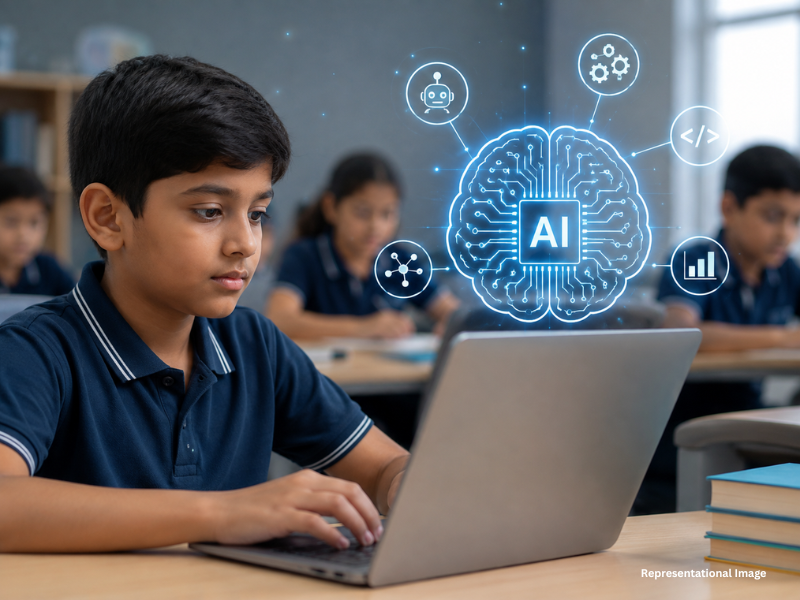
NCERT, CBSE introduce AI curriculum for Classes III-VIII
The Centre has said that a Computational Thinking and Artificial Intelligence (AI) curriculum has been introduced for students of Classes III to VIII from the 2026-27 academic session, while the curriculum for Classes IX to XII has been finalised.
Minister of State for Education Jayant Chaudhary said in the Rajya Sabha that the curriculum was developed by the National Council of Educational Research and Training (NCERT) in collaboration with the Central Board of Secondary Education (CBSE).
The curriculum covers logical reasoning, pattern recognition, algorithm design and data literacy, along with the responsible and ethical use of AI. Computational Thinking has been positioned as a foundation for age-appropriate AI learning across school grades.
Teacher handbooks and facilitator guides have also been prepared to support implementation and are available on the CBSE website. Schools offering AI as a subject are required to ensure infrastructure in accordance with CBSE curriculum and affiliation norms.
The government also highlighted the Skilling for AI Readiness (SOAR) initiative, which includes modules on AI fundamentals, generative AI, programming, ethics, cybersecurity and emerging career opportunities for students of Classes VI to XII.
The Centre said the initiatives are aligned with the National Education Policy (NEP) 2020 and the National Curriculum Framework for School Education (NCF-SE) 2023, which call for greater integration of computational thinking, AI and related subjects in school education.
Inputs from The Economic Times
Also Read: US student visas for Indians fall 62%; CIS report seeks end to OPT programme









Add comment