






Sarala Birla Academy – Times NIE Collaboration
From Classroom to Newsroom: Where Young Voices Find Print
There are moments in education when learning ceases to be an exercise and becomes a hands-on experience; when the written word sheds its academic enclosure and steps decisively into the public domain. The collaboration between Sarala Birla Academy, Bangalore and The Times of India’s NIE (Newspaper in Education) initiative was one such moment: not a run-of-the-mill field visit but a gentle crossing of thresholds.
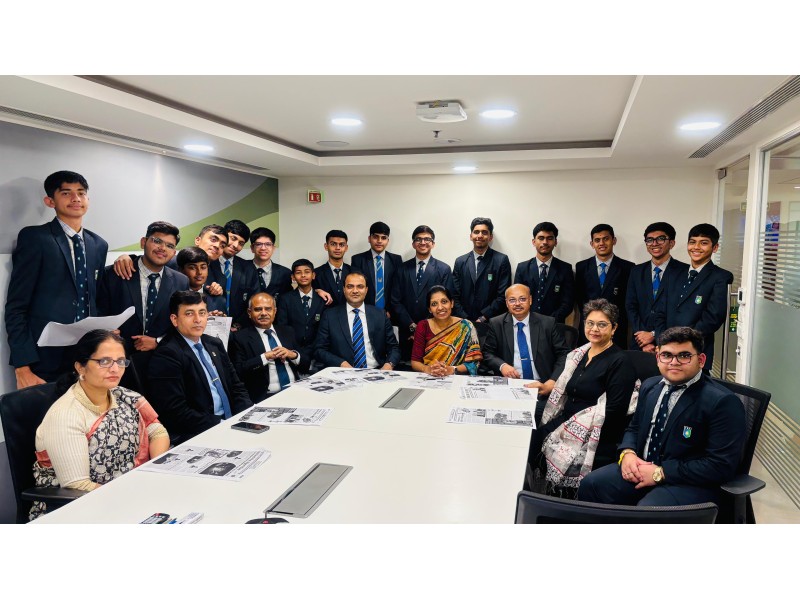
On a crisp January morning – January 20, 2026 – to be precise, a group of student editors and contributors from the Academy found themselves walking into the Times of India office at Chancery Pavilion. Yet, to describe them as visitors would be to misrepresent the spirit of the occasion. They entered, rather, as stakeholders in a process already underway, carrying with them drafts that were no longer tentative scribbles but manuscripts on the brink of print.
The School Special NIE Edition had taken shape within the school over weeks of discussion, disagreement, revision, and perseverance. Ideas had been argued over, sentences weighed, and paragraphs patiently recast. But it was in this newsroom that this labour would go on to acquire its exacting dimension. Here, the students encountered not the romance of journalism, but its discipline.
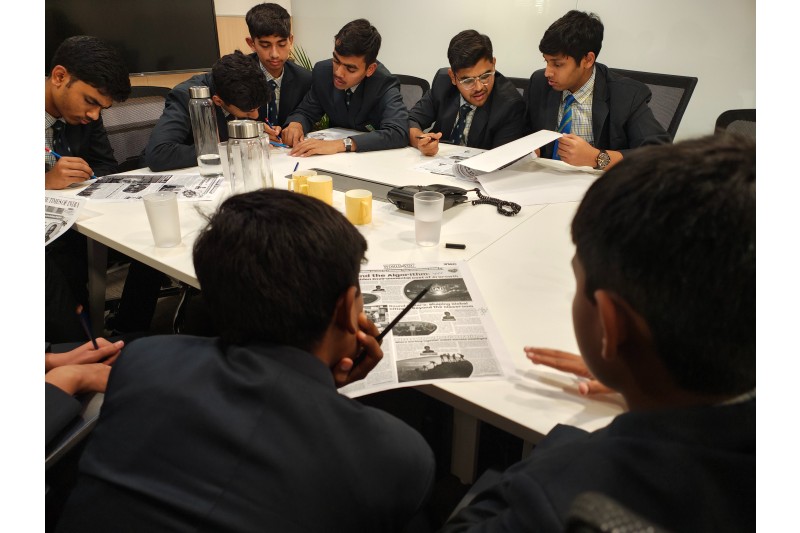
Under the attentive guidance of the editorial team, they engaged in the business of refinement. Proofreading, that most unglamorous yet indispensable craft, demanded a vigilance that admitted no complacency. Layouts were examined not merely for aesthetics but for clarity and coherence. Headlines were interrogated for precision; punctuation was no longer incidental but intentional. It was here that the realisation dawned, almost collectively, that writing for print is not an act of expression alone but also an act of responsibility.
The newsroom, in its unassuming choreography, revealed the unseen architecture of the printed page. There was no theatrical urgency, no raised voices- only a steady, purposeful rhythm in which each role, from writer to designer, contributed to a shared outcome. For students accustomed to the relative solitude of writing assignments, this collaborative ecosystem offered both insight and instruction.
More significantly, it altered their relationship with their own words. What had once been submitted for evaluation within the safe confines of a classroom now stood exposed to the exacting standards of publication. The shift was subtle yet profound. A sentence could no longer afford indulgence; it had to earn its place. An idea could not merely exist; it had to communicate. In that moment, language itself acquired a certain gravitas.
This, perhaps, is where the true value of the collaboration lay. Sarala Birla Academy has long espoused an educational philosophy that privileges experience alongside instruction, that seeks to bridge the gap between knowing and doing. The NIE initiative served as a natural extension of this vision, situating students within a professional context that demanded both rigour and reflection.
The ethical dimension of authorship, often abstract in academic settings, assumed a tangible presence. The students became acutely aware that their writing did not exist in isolation; it carried with it the imprint of their institution and the responsibility of representation. Every correction, every revision was a commitment to integrity.
Despite all its rigour, the experience was not devoid of exhilaration. There is something undeniably affirming about seeing one’s words take their place on a page that will travel beyond the familiar. It is a moment that transforms writing from a task into a voice and an exercise into a statement.
By the time the visit drew to its close, the newsroom had undergone a subtle redefinition in students’ minds. It was no longer a distant or mythical space where news simply appeared. It was instead, a site of disciplined craft, of patient iteration and collective endeavour.
In retrospect, the collaboration resists easy categorisation. It was, certainly, an educational initiative. It was also an exercise in skill-building, a lesson in precision, a rehearsal in responsibility. For the students of Sarala Birla Academy arrived as learners, curious and perhaps a little tentative; yet left as contributors, aware, if only faintly, of the power and permanence of their words.
If the enterprise found its fullest expression, it did so in the people who animated it. Anchored in the vision of the principal, Mr Santanu Das, and carried forward through the unwavering involvement of headmaster Mr Sudip Mukherjee, Ms Latha H.B., Dr K.K. Sharma, Mr Debdutta Nath, and Mrs Neelam Reddy, it became a rare space where mentorship dissolved into collaboration and aspiration found an authentic voice.
Authored by Neelam Reddy, a teacher at Sarala Birla Academy
Also read: Beyond Classrooms at The Emerald Heights International School: Nurturing Talent, Passion and Purpose








Add comment