






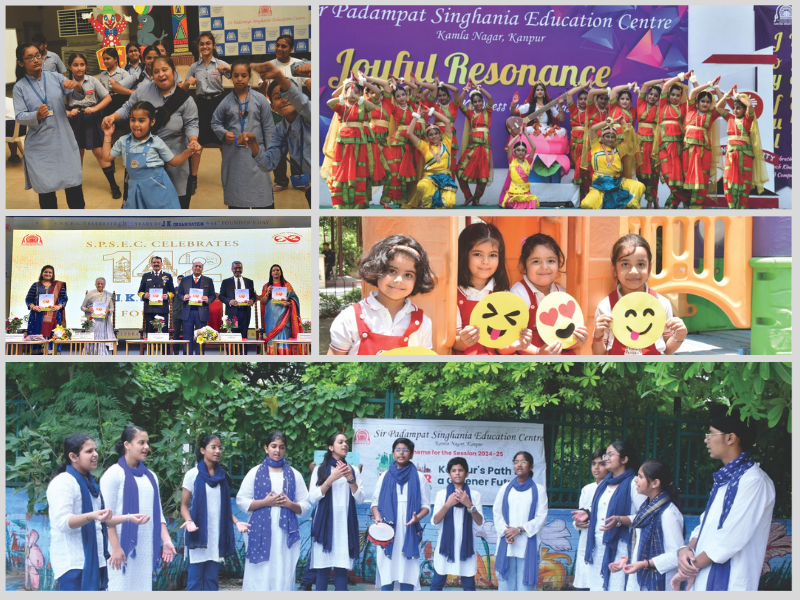
SENSE & SENSIBILITY – ‘Living with Compassion’ at Sir Padampat Singhania Education Centre, Kanpur
Sir Padampat Singhania Education Centre, Kanpur, transformed its annual theme into a lived educational experience through a year-long journey of reflection, empathy and responsible action.
In an increasingly fast-paced and complex world, education cannot stop at developing intelligent minds. It must also nurture individuals who can understand, empathise, reflect and respond responsibly. Guided by this belief, Sir Padampat Singhania Education Centre, Kanpur, adopted “Sense & Sensibility – Living with Compassion” as its annual theme for the academic session 2025–26.
At its heart was a simple proposition: sense meant thoughtful judgement, awareness, critical reflection and responsible decision-making, while sensibility represented empathy, emotional understanding, sensitivity towards others and humane action. Together, they create compassionate individuals who can think with clarity and act with humanity.
The theme did not remain confined to assemblies or lessons. It became a year-long educational lens, shaping classroom experiences, creative expression, community engagement and everyday interactions.
FROM A THEME TO A WAY OF LIFE
The school translated the theme into a structured Compassion Framework, encouraging students to repeatedly move through a cycle: REFLECT → UNDERSTAND → EMPATHISE → ACT → GROW.
The framework was adapted across age groups. In the Early Years and Primary classes, the focus was on recognising emotions and kindness through stories, gratitude journals, good deeds and sharing, helping develop values such as kindness, gratitude and care. In Middle School, students focused on understanding perspectives through discussions, debates, literature and presentations, fostering inclusion, respect and empathy. In Senior School, the emphasis shifted towards connecting thought with responsibility through ethical discussions, social issues and service learning, encouraging leadership, social responsibility and ethical decision-making.
The progression was intentional: from knowing what kindness means to understanding why it matters, and finally, choosing to act on it.
Learning Beyond the Classroom
Students, parents and faculty engaged with orphanages, centres for children with special needs and schools for the visually challenged, encountering diverse lived experiences. These interactions encouraged a shift: from sympathy to understanding, from observation to participation, from feeling for others to acting with others.
Involving 2400+ students through 8 charity drives and 11 community outreach programmes, the school fostered empathy, gratitude and social responsibility, encouraging students to become more compassionate, engaged citizens.
Through this service learning, students discovered that citizenship is not a distant adult responsibility — it can begin with something as simple as showing respect, offering support or taking responsibility for one’s surroundings.
COMPASSION FOR PEOPLE. COMPASSION FOR THE PLANET
Environmental responsibility became another expression of the same value: to care is to take responsibility. Students experienced sustainability through nature-based learning, waste and water conservation, and environmental campaigns. Younger learners connected with nature through gardening and storytelling, while senior students explored sustainability, climate awareness and the long-term consequences of human choices.
WHEN ART BECOMES A LANGUAGE OF EMPATHY
Art, literature and performance gave students another route into the theme, encouraged to interpret compassion, question it and give it their own voice through visual art, creative writing, storytelling, drama, dance, music and debate.
FEEL → QUESTION → EXPRESS → COMMUNICATE
Compassion thus moved beyond a value to become a creative and intellectual experience.
A CULTURE THAT EXTENDED BEYOND THE CHILD
The initiative was not designed as a student-only programme. Teachers reflected on becoming more mindful listeners and conscious role models, realising that ‘values are often learnt less through instruction and more through observation.’ Parents observed changes in their children’s communication, patience, gratitude, sensitivity towards others, emotional awareness and sense of responsibility. Conversations that began in school often continued at home, turning the initiative into a shared culture of care.
Aahana Tripathi of Grade III shared: ‘Good deeds have encouraged me to show kindness not only to people but also to nature… This has made me more patient and taught me that small acts of kindness can help things grow.’
Ms. Shruti Tiwari, mother of Akshaini Tiwari, Class V-B, said: ‘The school’s initiative to instil decision-making, self-control and care through this theme is truly commendable… Sense and sensibility are essential for personal growth and true happiness.’
Our Faculty Ms. Pamela Banerjee shared: ‘I adopted innovative classroom methods such as role play, reflective journaling, group discussions and creative writing to help students connect the text with real-life emotions and ethical choices… This initiative deepened students’ understanding of literature and helped groom essential life skills, reinforcing the true spirit of Sense and Sensibility beyond the classroom.’
FROM EXPERIENCE TO LEARNING OUTCOMES
The initiative supported learning across several dimensions. Emotionally, students developed greater awareness of feelings and perspectives. Socially, they developed respect, inclusion and collaboration. Ethically, they were encouraged to reflect before making decisions. Environmentally, they developed greater responsibility towards nature and resources. Civically, they developed participation, service and community consciousness.
The learning journey moved from Knowledge → Awareness → Empathy → Responsibility → Action.
Students were not simply asked to “be good.” They were encouraged to understand why their choices matter, recognise how those choices affect others, and develop the confidence to act responsibly.
EDUCATION FOR LIFE
“Sense & Sensibility – Living with Compassion” became more than an annual theme. It became a lens through which learning was experienced. From a child’s first understanding of sharing and kindness to a senior student’s reflection on leadership and ethical decision-making, the journey reinforced a fundamental belief: academic excellence and human values must grow together.








Add comment