






West Bengal: Rapid goodwill erosion
– Baishali Mukherjee (Kolkata)
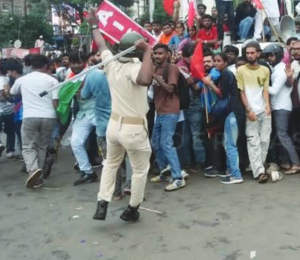
CJP Kolkata protest: heavy-handed police violence
On july 25, union education minister Dharmendra Pradhan was forced to resign following a historic 36-day Gen Z protest at New Delhi’s Jantar Mantar supplemented by a water-only 28-day fast by widely-respected educationist Sonam Wangchuk. On July 29, the Lok Sabha passed the Public Examinations (Prevention of Unfair Means) Amendment Bill, 2026, to tighten the public examinations system.
The Cockroach Janata Party (CJP) — a people’s movement founded online by Boston University postgrad Abhijit Dipke — contends that there have been 152 unpunished exam paper leaks (including NEET-UG 2024 and 2026 leaks) that have disrupted the lives of 75 million students between 2014 and 2026. By humbling the hitherto invincible BJP/NDA government, which has won three General Elections consecutively, India’s Gen Z (18-to-29-year-olds) led by the hurriedly formed CJP has belatedly delivered a stark message: neglecting the nation’s education system carries severe political consequences.
While Delhi witnessed an epic, historic success of youth defiance, Kolkata was not much behind — reaching its own volcanic inflection point on July 24. In Bengal, where nearly 100,000 students write NEET-UG every year and consistently rank among the nation’s best performers, cancellation of the exam on May 6 and holding it again nationwide on June 21 upended the plans of thousands of households who had invested years of effort and sacrifice in preparation, for this high stakes single paper exam. Unsurprisingly, more than 100,000 students and families flooded Kolkata’s streets in a massive rally organised by eight Left student organisations who were joined by the West Bengal unit of the CJP. As in Delhi, the peaceful march was greeted by heavy-handed police violence, complete with baton charges and several arrests.
This massive turnout within two months of the BJP having swept to power in Bengal by winning 208 of 294 legislative assembly seats, signals rapid erosion of goodwill for the newly constituted BJP government of West Bengal (pop.103 million). In the legislative assembly elections concluded on April 29, BJP had won a massive mandate on the back of promises of institutional integrity, meritocracy, and administrative efficiency.
In particular, a central plank of the BJP’s successful electoral campaign in Bengal was its successful appeal to young voters tired of repeated corruption in teacher recruitment tests and teacher appointments delays under the three-term (2011-2026) Trinamool Congress (TMC) party. According to monitors of Bengal’s fast-changing political landscape, the violent police crackdown on student protestors by the new government only sixty days into its tenure, has prompted a swift change in public sentiment.
Yet, targeting students and minorities under draconian laws is just one facet of the new government’s actions that has fueled public resentment. Since assuming office in Writers Block, Kolkata on May 4, the BJP administration has introduced a series of anti-child and youth measures. In May, it aroused public anger by removing eggs from school midday meals in Bengal. Next month its proposal to privatise 51 of 166 government Industrial Training Institutes (ITIs) statewide aroused the wrath of underprivileged students seeking affordable technical vocational education. This initiative aligns with a broader playbook of rapid privatisation of education in all BJP-ruled states, where essential learning infrastructure has increasingly been transferred to private operators.
At a time when Bengal’s education sector is reeling under the previous TMC government’s severe mismanagement — a multi-crore teacher recruitment scam, prolonged teacher appointment freezes, high dropout rates (nearly 50 percent for adolescent girls), 6,482 single-teacher schools, 17,000 teachers in schools with zero enrollment, 33.8 percent schools lacking functional girls’ toilets, closure of 173 student hostels — the BJP’s June 27 initiative to privatise ITIs has outraged the populace.
“When critical social safety nets like nutrition are rolled back alongside the commercialisation of technical education, the long-term impact for vulnerable communities is a stark, compound decline in basic literacy, skill retention, and economic mobility,” says Suman Sengupta, a political commentator and columnist of the best-selling daily Anand Bazar Patrika.
Within West Bengal’s predominantly leftist intelligentsia there is surprise that the newly elected BJP government has managed to so swiftly disappoint the pragmatic voters who turned to it to oust the Trinamool Congress. Bewildered citizens are wondering whether they have traded one government of chronic misrule for another.









Add comment