






From jugaad to disciplined frugal innovation
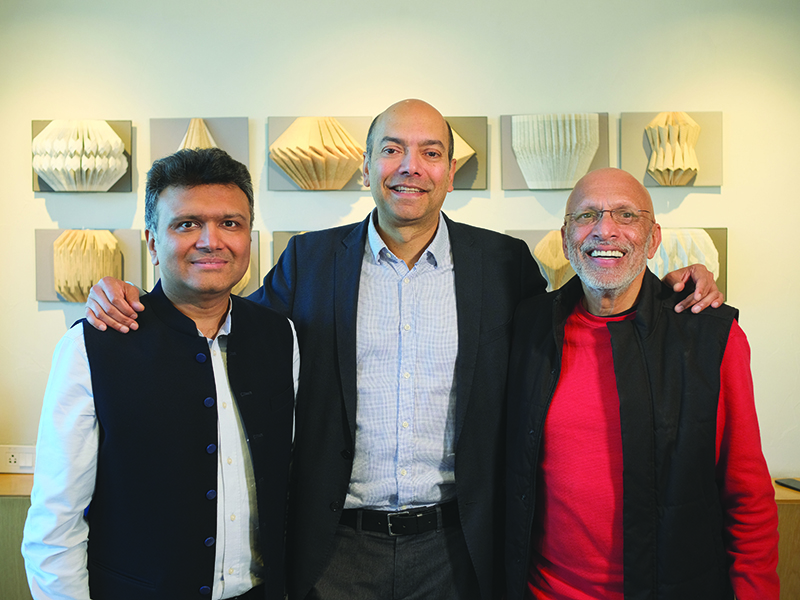
(L-R) mukesh sud, jaideep prabhu & priyank narayan
– Priyank Narayan is associate professor of practice, Department of Entrepreneurship, Ashoka University, Sonipat; Jaideep Prabhu is professor at Judge Business School, Cambridge University (UK) and Mukesh Sud is professor at IIM-Ahmedabad.
For decades, India’s ingenuity has been captured in a single word: jugaad. It conjures images of resourceful individuals fixing problems on the fly with whatever is at hand — a motorbike engine powering an irrigation pump, or a hacked-together vehicle ferrying people in rural areas. This spirit has been rightly celebrated as a survival skill in a low-resource environment. Yet it has also been criticised as a licence for corner-cutting, unsafe improvisation, and a culture of “adjusting” rather than building robust systems.
But India is now at an inflection point where it must move beyond ad hoc jugaad to a high-tech, frugal innovation model we describe as LeanSpark. India’s structural constraints — limited fiscal space, infrastructure gaps, low per-capita income, and increasing ecological stress — aren’t going away. Yet if they are approached with discipline and design, they can become engines of scalable innovation rather than permanent brakes on development.
At a time when India is building population-aligned systems at scale — from digital identity payments, logistics, health and welfare delivery — this hyperlocal model is inadequate. Jugaad ingenuity must move to robust, repeatable and ethical solutions at scale.
Some of India’s most notable policy and market successes of the past decade can be viewed through this lens.
Digital public infrastructure (DPI) — including Aadhaar, UPI, and related building blocks — has shown how frugality, standardisation and openness can result in world-class performance. The system was designed to be low-cost per transaction, technically interoperable, and open to a wide range of public and private innovators at the edges. This combination has enabled India to deliver billions of digital payments and identity-authenticated transactions at very low marginal cost, catalysing a vibrant fintech ecosystem.
A similar story is emerging in other domains. Low-cost satellite launches, indigenous EV (electric vehicle) platforms, AI models tuned to Indian languages, and frugal med-tech ventures in tier-2 and tier-3 cities. They showcase disciplined experimentation, sharp focus on user needs, and architecture that can be replicated across geographies without massive capital infusion.
Yet these success stories coexist with fragile experiments, stalled pilots, and brittle institutions. The question is how to make frugal innovation the norm rather than exception.
Obviously, resource and other constraints aren’t beneficial. But some constraints are productive for innovation. Constraints that sharpen problem definition — low remuneration capability, unreliable infrastructure, stringent ecology laws — can push innovators to design robust, low-footprint solutions. Awareness that a low-income farmer cannot afford a subscription, or that connectivity will be intermittent, forces a fundamentally different design than in resource-rich settings. Such constraints can nevertheless yield models that are affordable and exportable.
Conversely, constraints that undermine trust and capability — opaque regulation, policy uncertainty, weak contract enforcement, lack of basic skills — inhibit innovation. They deter long-term investment, encourage informality, and reinforce the very culture of short-term jugaad that India needs to transcend.
Policy therefore has a dual role: to maintain the productive pressure of resource constraints, while actively reducing the institutional infirmities that make experimentation risky and scaling difficult.
So what does a frugal innovation viewed through a LeanSpark lens imply for policymakers, investors, and practitioners?
Design for scale from day one. Pilots should be conceived not as end points but as learning stages towards scalable models. This requires early attendance to interoperability, governance, and incentives across sectors, not only to technical proof-of-concept.
Invest in enabling rails, not just apps. Public investment is most effective when it creates shared infrastructure — physical, digital, or regulatory — on top of which many frugal innovation ventures can operate. Digital Public Infrastructure is a prominent example.
Reward frugal outcomes, not frugal inputs. Frugality should be measured in terms of unit costs, inclusion, and environmental footprint, rather than crude spending cuts. Under-resourcing critical capabilities — such as safety, quality assurance, frontline training — is false frugality that undermines impact in the long run.
Strengthen feedback loops. Lean execution depends on data and learning. Building systems that generate timely, disaggregated information about how programmes and products are actually used.
If India can embed frugal innovation principles in industry, it has the opportunity to reshape its global reputation over the next decade. Instead of being valued as a pool of low-cost labour and clever but risky hacks, India could become the reference economy for capital-efficient, inclusive and sustainable innovation under constraints.
If India’s structural constraints are approached with discipline and design, they can become engines of scalable innovation rather than permanent breaks on development











Add comment