






India’s best Private Engineering & Technology Universities 2026-27
India’s best private engineering universities unencumbered by hostility towards private industry which is leading India’s charge towards Viksit Bharat, are well equipped to provide the soft infrastructure, i.e high productivity human resource, that the Indian economy urgently needs
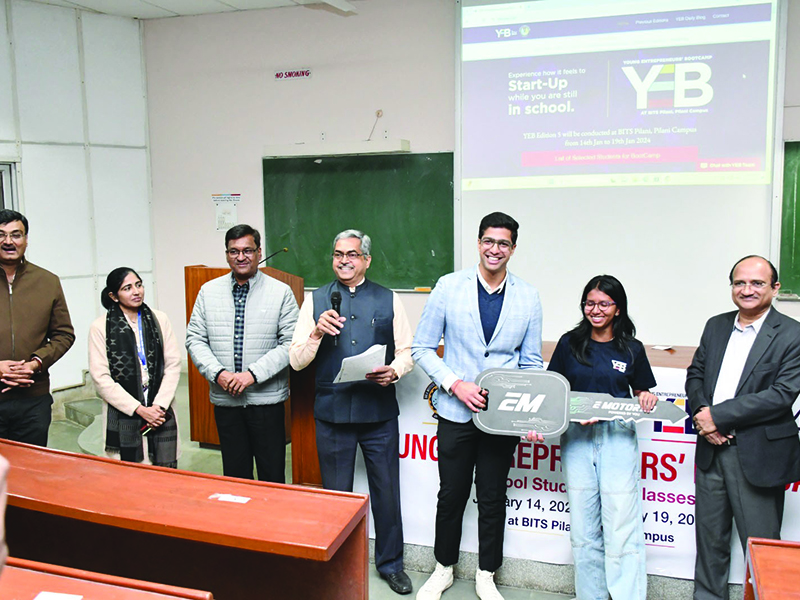
BITS-Pilani VC Prof. Ramgopal Rao (right): hard data endorsement
Now it’s proven beyond doubt. The astonishing rise within the past three decades of the People’s Republic of China into the world’s premier technology nation and manufacturing hub, is the outcome of its excellent engineering higher education institutions. Four of China’s top universities with strong STEM and digital technology curricula are ranked among the Top 100 league table of Times Higher Education and 25 in the QS Top 100. Against this, India’s top ranked universities are IIT-Delhi (#123) and Indian Institute of Science, Bangalore (#219).
The ongoing US/Israel-Iran war in West Asia has thoroughly exposed the vulnerability and weak engineering and technology base of the Indian economy. It’s impossible to believe that the continent-size Indian landmass doesn’t have adequate crude oil reserves. But the foolish policy decision to give the public sector ONGC monopoly over oil exploration rights has resulted in India having remained heavily dependent on foreign suppliers for the past several decades.
Likewise, heavy dependence on low-productivity public sector enterprises (PSEs) to build India’s industrial base and sinews has resulted in the country remaining heavily dependent upon imports of capital goods including defence equipment. Now that the sea lanes through which energy and weaponry imports were canalized into India are disrupted, the pathetic vulnerabilities of India Inc and the economy have been exposed.
Yet the blame for this condition of India Inc and the Indian economy in general can’t be entirely laid at the door of industry. India’s academy comprising 53,000 undergrad colleges and 1,338 universities — and especially engineering and technology education institutions — are also substantially to blame. Although the best among India’s 23 IITs (Indian Institutes of Technology) have achieved worldwide fame and recognition for the quality of graduates, it’s also true that over the past seven decades since IIT-Khargapur was established, none of them has succeeded in producing a revolutionary invention or brand. The plain truth is that government-promoted science, engineering and technology higher education institutions (HEIs) with their government culture and contempt — if not hostility — towards profit-driven corporate India, are unlikely to ideate groundbreaking products, such as the internet, smartphone, jet engine, combine harvester which can be commercialised into billion dollar products and services. At best, they can teach tried and tested knowledge and innovate improvements at the edges.
This is especially true of HEIs promoted by state governments that constitute the majority of the country’s 1,338 universities. These high wage islands are dominated by under-qualified kith and kin of loot-n-grab regional politicians who recruit them as faculty. At best, they can provide sub-standard tertiary education to the country’s youth. Hence the curious phenomenon of 40 percent unemployment within educated graduates.
In this connection, it should also be noted that communist China’s scientific and technological accomplishments are to a great extent attributable to the excellent high quality education dispensed by an estimated 1,500 HEIs offering engineering and technology programmes, as also to 11,000 vocational education and training institutions that have certified and graduated an estimated 55 million job-ready engineers since PRC famously “took the capitalist road” in 1978 under the diktat of Secretary-General Deng Xiaoping. Since then with its HEIs working in close alignment with industry, China has industrialised at furious pace to transform into the world’s premier “engineering state” driven by fantastic infrastructure and a wide range of innovative products and services (see Book Review p. 151).
Against this backdrop, India’s estimated 250 private engineering universities unencumbered by hostility towards private industry which is leading India’s charge towards Viksit Bharat and $30 trillion economy goals set for 2047, are best equipped to provide the soft infrastructure, i.e high productivity human resource, that the Indian economy urgently needs. Promoted by dynamic, highly educated and well-travelled entrepreneurs, the best private engineering universities offer globally benchmarked, enabling infrastructure and high-quality faculty that appreciates the importance of creating new knowledge and importance of commercializing it.
That’s why since the EducationWorld India Higher Education Rankings were initiated in 2013, the country’s government-promoted 23 IITs and 31 NITs (National Institutes of Technology) which are lodged in the public consciousness and routinely top collegiate/university ranking league tables published by mainstream publications, are omitted from the annual EWIHER, and government engineering universities are separately ranked inter se.
Curiously, despite our strenuous efforts to rate and rank India’s most evolved and modern private engineering and technology universities, for several years this league table has been topped by the vintage Birla Institute of Technology and Science-Pilani established in 1946 by the visionary and under-appreciated Indian industry pioneer G.D. Birla (1894-1983) who built the strong foundations of the flourishing (A.V.) Birla business conglomerate.
Although the judge, jury and executioners of the opaque official National Institutional Ranking Framework (NIRF) don’t share the high opinion of successive EW sample respondents and rank BITS-P #11 among Top 100 engineering colleges/universities in the latest NIRF, more cognizant monitors of higher education have ranked BITS-P India’s #1 engineering & technology university for the fifth year in succession. Mainly for its management’s capability to modernize.
This year’s 2,175 EW sample respondents have awarded BITS-P top scores under eight of the ten parameters of engineering and technology education excellence including faculty competence, research & innovation, curriculum and pedagogy and career readiness/placements.
Prof. Ram Gopal Rao, an alum of IIT-Bombay and Universitat der Bundeswehr, Munich (Germany) and former Director of IIT-Delhi who was appointed Vice Chancellor of BITS-Pilani in 2022, is pleased but unsurprised this deemed university has remained high in the esteem of the informed public.
“There is ample hard data to endorse the high regard that your sample respondents have for BITS-Pilani. Last year, we received 242,000 admission applications from across the country for our 3,500 seats. Moreover, we had no problem at all in placing all our graduates last year at an average annual remuneration package of Rs.21 lakh. Our pioneer practice school programme under which all students spend 7.5 months acquiring experiential education under the country’s top-ranked companies with stipends of Rs.50,000-1.2 lakh per month has been operational for 40 years, and explains our top scores under the parameters of curriculum and pedagogy, and placements. Now with the dawn of the new AI age, we are ahead of the curve and all set to introduce a new B.E Artificial Intelligence program this year,” says Rao, who calls for greater academy-industry research collaboration so that India graduates from a “users to inventors nation”.
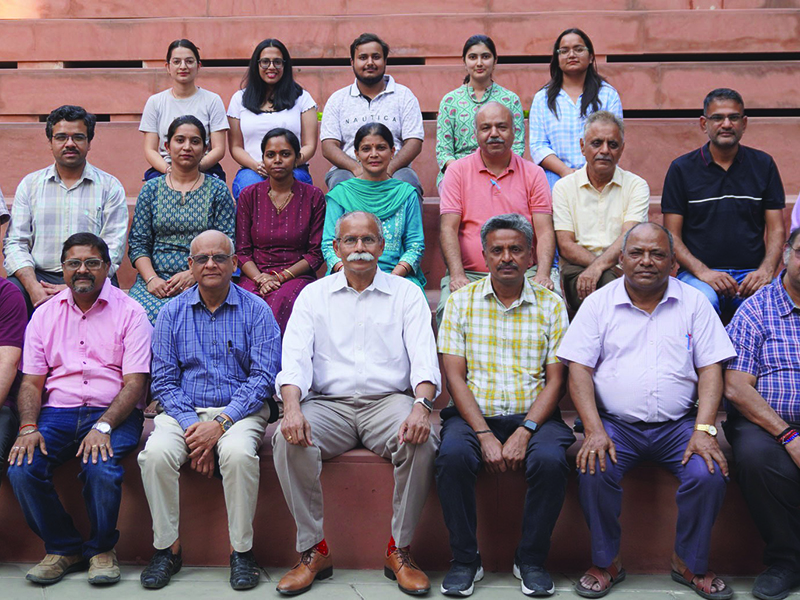
Thapar Institute, Patiala Director Prof. Padmakumar Nair (centre): consistent top table seat
Chaired by BITS-Pilani, the 2026-27 top table comprises the highly-respected but inaccessible, Vellore Institute of Technology which retains its #2 rank. International Institute of Information Technology, Hyderabad promoted to #3 (from #4 in 2025-26); Thapar Institute of Engineering & Technology, Patiala at #4 (3) jointly ranked with Lovely Professional University, Phagwara (Punjab) with BML Munjal, Gurugram #5 (5) co-ranked with SRM Institute of Science and Technology, Chennai (6) complete top table.
Further down the Top 10 table, there’s a minor rearrangement of the pecking order this year. SASTRA Deemed University, Thanjavur is promoted to #6 (8); Dhirubhai Ambani Institute of Technology, Gandhinagar (Gujarat) retains its #7 rank; Birla Institute of Technology, Mesra (Jharkhand) has inched up to #8 (9); Hindustan Institute of Technology & Science, Chennai to #9 (10) with SRM University, Sonipat given a substantial promotion to #10 (13) by this year’s sample respondents.
Aman Mittal, the go-getting Vice President of Lovely Professional University, Phagwara (LPU, estb.2005) is pleased with the steady progress of this new genre private university — in which over the past 21 years enrolment has reached a staggering number of 40,000 students, of whom 4,000 are from 65 foreign countries — in the annual EW league table of India’s best private engineering universities. He is especially satisfied with LPU’s above-rank scores under the parameters of research, internationalism and range and diversity of programmes.
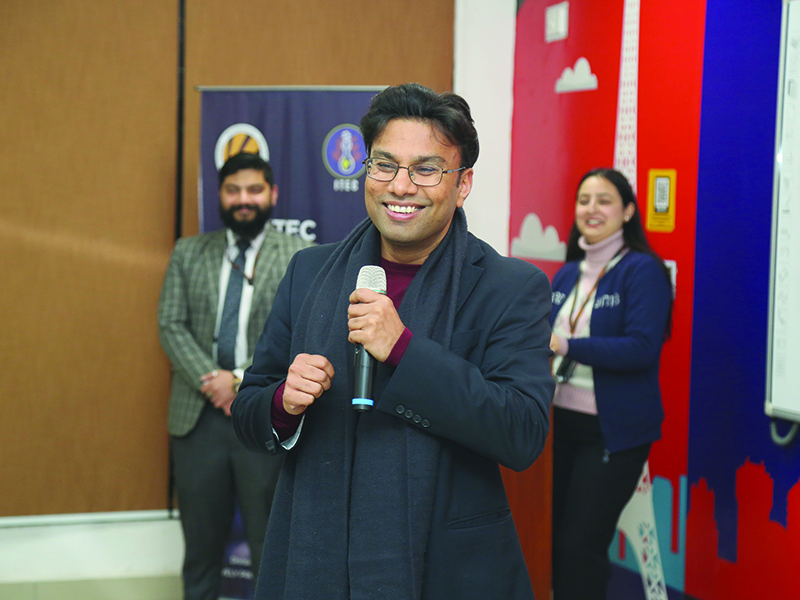
LPU’s Aman Mittal: happy learning objective
“Despite Phagwara being a small non-metro town, it attracts students from across India and 65 foreign countries. But since we are off the beaten track, it’s not so well-known that our USP is that our excellent faculty not only provides world-class education, it enables our students to build careers. Our curriculums are built around practicals and well-designed internship programmes which ensure that students spend 50 percent of their time out of classrooms in paid internships that often enable them to pay the entire cost of their education here. Moreover, advanced R&D is a focus area in LPU. Over the past 21 years, our faculty has published 29,000 papers in Scopus-indexed publications and last year, we received research grants totaling Rs.8 crore from industry, NGOs and government agencies. We have invested heavily in providing excellent infrastructure — as indicated by our high score under this parameter — on our 600-acre green environmentally-friendly campus to enable students from across the country and abroad to come here and learn well and happily,” says Mittal, an alumnus of Thapar Institute of Engineering, Patiala and Southampton University (UK) who came aboard the family-promoted LPU in 2006.
Beyond the Top 10, several other private technical universities are rising in the esteem of the informed public. Among them, the Noida-based Jaypee Institute of Information Technology ranked #1 in the populous state of Uttar Pradesh (India #13) deserves coverage. However, repeated attempts to rouse its Vice Chancellor Dr. S.C. Saxena proved infructuous, leading to speculation that it is a victim rather than shaper of this Hindi heartland state’s culture. Among other private engineering universities that have moved up the Top 20 league table are the high-potential, but poorly marketed Plaksha University, Mohali to #16 (19); Dayalbagh Educational Institute, Agra #18 (20) and the Sir Padampat Singhania University, Udaipur to #19 (23).
While studying the league table of India’s best private engineering and technology universities which tend to be more workplace aligned and market savvy than their government-managed counterparts, parents and students should bear in mind our usual caveat — that institutions modestly ranked nationally may well be formidable heavyweights in their host states. For instance, the Jaypee Institute of Information Technology alluded to above, is ranked #13 nationally but #1 in Uttar Pradesh (pop.246 million); SRM University ranked India #15 is top-ranked in Andhra Pradesh (53 million); NIIT University India #17 is #2 in Rajasthan (85 million) and UEM, Kolkata ranked India #27 is numero uno in West Bengal (105 million).








Add comment