






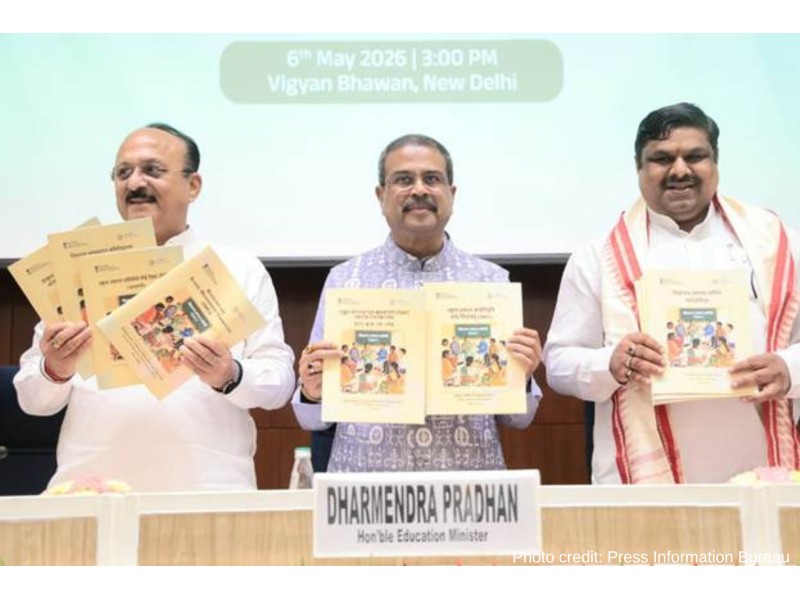
Pradhan launches School Management Committee Guidelines 2026
Union education minister Dharmendra Pradhan on Wednesday launched the School Management Committee (SMC) Guidelines 2026, stressing the need for stronger community participation, improved school infrastructure and updated pedagogy aligned with the National Education Policy (NEP) 2020.
Speaking at the launch event attended by education ministers from several states and senior officials, Pradhan said SMCs remain central to improving school governance and learning outcomes. He said the focus during the current academic cycle is on strengthening teaching methods, improving student competencies and preparing schools for the coming academic year.
Pradhan noted that NEP 2020 will soon complete six years of implementation and said the National Council of Educational Research and Training (NCERT) has introduced new textbooks up to Class 9, with textbooks for Classes 10, 11 and 12 to follow in the coming years.
He said the revised curriculum introduces new pedagogy, updated examples and a greater emphasis on computational thinking and basic artificial intelligence from Class 3 onwards.
Describing SMCs as a bridge between schools and society, the minister said the success of NEP 2020 depends on greater public participation in education. He added that government efforts alone are insufficient and that SMCs must provide additional support to strengthen the education system.
Pradhan also highlighted the need for better support for children with special needs and said awareness of changing skill demands is important as technology continues to reshape employment opportunities.
Referring to recent examinations, he said India’s education and examination systems have become more robust, citing the conduct of the NEET-UG exam for over 22 lakh students across more than 5,400 centres nationwide. He added that technological advancements now allow real-time monitoring of large-scale examinations and educational processes.
The minister said the government aims to strengthen digital governance in education and plans to monitor nearly 25 crore students through digital platforms in the coming years.
The SMC Guidelines 2026 introduce a single committee structure for classes from Balvatika to Class 12 to improve continuity in school governance. The framework defines the responsibilities of SMCs and member secretaries, with provisions for accountability, transparency and financial oversight.
The guidelines also focus on monitoring student attendance and teacher engagement, while promoting school development planning and social audit mechanisms to improve community participation.
Other initiatives incorporated into the framework include Vidyanjali, Eco-Clubs, Understanding of Lifelong Learning for All in Society (ULLAS), the PRASHAST App, school infrastructure safety and disaster preparedness programmes.
Under the guidelines, every school must constitute an SMC within one month of the start of the academic year, with elections to be conducted in a democratic, transparent and inclusive manner.
The number of committee members will depend on student enrolment, ranging from 12 to 25 members. The guidelines mandate that 75 per cent of members must be parents or guardians, while half of the committee members must be women. Representation has also been mandated for socio-economically disadvantaged groups and children with special needs.
SMC members will serve a two-year term, although committees may continue until a new body is constituted.
On financial management, the guidelines state that all civil works costing up to Rs 30 lakh may be executed by the SMC. All committee funds must be maintained in a separate joint bank account operated by the chairperson and member secretary.
Please click the link below to access the detailed School Management Committee (SMC) Guidelines https://dsel.education.gov.in/sites/default/files/guidelines/School_Management_Committee_Guidelines.pdf
Inputs from PTI
Also read: NEET UG 2026 records 96.92% attendance; results expected in June








Add comment