






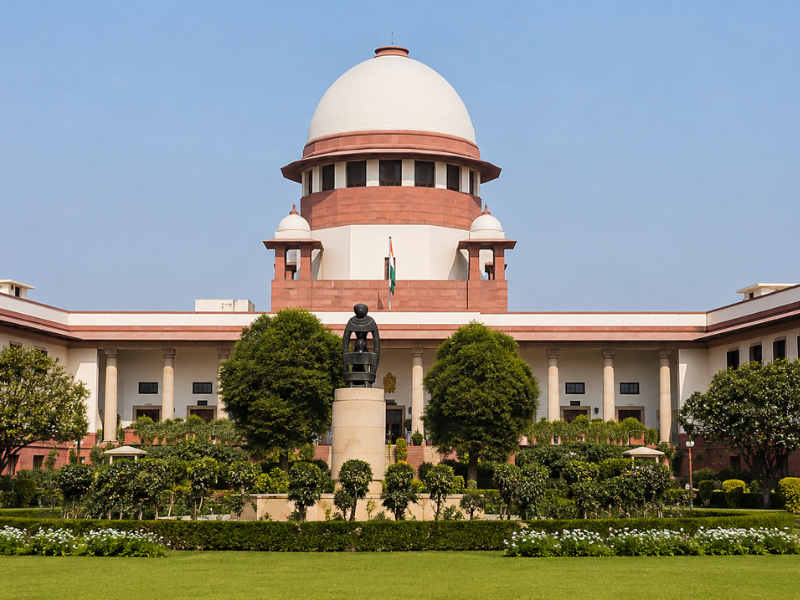
CBSE three-language policy challenged in Supreme Court
The Supreme Court on Thursday sought responses from the Union Government, the Central Board of Secondary Education (CBSE) and the National Council of Educational Research and Training (NCERT) on a petition challenging the implementation of the three-language policy for students in Classes 6 to 9.
The policy, introduced through a CBSE circular issued on May 15, mandates that students study three languages, including at least two Indian languages, from the 2026 academic session in line with the National Education Policy (NEP) 2020 and the National Curriculum Framework for School Education (NCFSE) 2023.
A bench comprising Chief Justice of India Surya Kant and Justice Joymalya Bagchi issued notices to the authorities and observed that the implementation of the policy could involve logistical challenges.
“Let us have a comprehensive reply. We can hear on June 15. There will be logistical issues,” the bench observed, according to Bar and Bench.
The petition has been filed by parents and teachers from different parts of the country. The petitioners argued that introducing the policy at this stage would increase the academic burden on students and disrupt preparations for future board examinations.
They also raised concerns over regional disparities, the absence of clarity on evaluation methods for the additional language and the lack of infrastructure required for implementation.
Appearing for the petitioners, senior advocate Mukul Rohatgi submitted that the revised framework could alter existing language combinations followed by students. He said students currently studying combinations such as Tamil, English and French may be required to add another Indian language under the new system. He also argued that passing the additional language could become necessary for final certification.
Senior advocate Kapil Sibal raised constitutional concerns regarding federalism and individual choice in language education. “There are Constitutional issues of federalism and of choices… language is a matter of choice,” he said.
Justice Bagchi, however, said the court was not examining the federalism issue at this stage and noted that practical concerns such as the availability of teachers and textbooks would need to be addressed.
Representing CBSE, Additional Solicitor General Aishwarya Bhati informed the court that the board was ready to file its response and stated that the implementation would remain subject to the court’s directions.
The bench also suggested that the authorities submit a status report detailing their preparedness for implementing the policy. The matter has been posted for further hearing on July 15 or 16 after the court’s summer vacation.
Inputs from cnbctv18
Also Read: Russia seeks to expand education cooperation with India








Add comment