






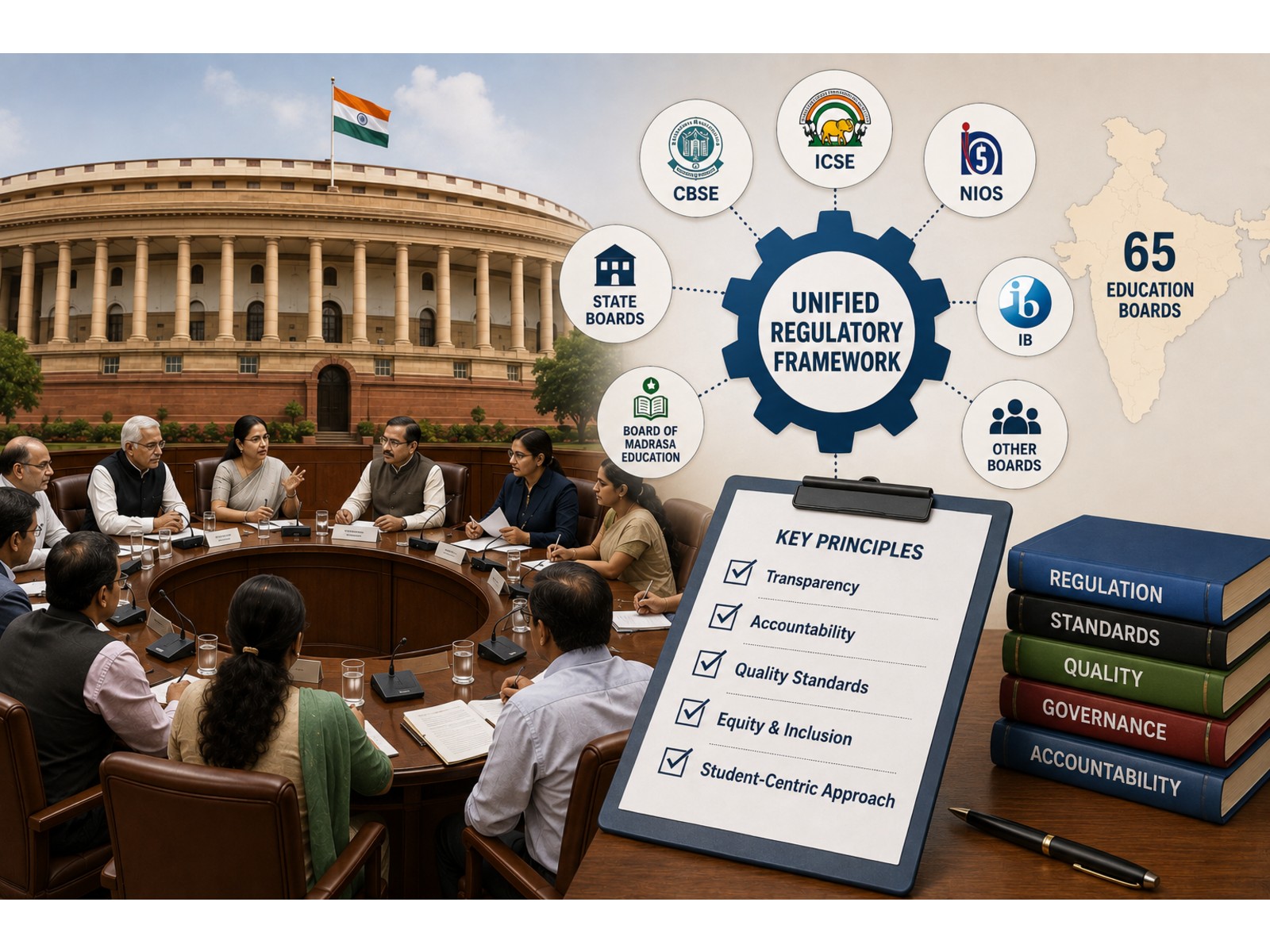
Parliamentary panel seeks unified regulatory framework for all 65 education boards
A parliamentary panel has recommended a unified national regulatory framework to standardise the functioning, evaluation criteria and curriculum of all 65 school education boards in India in line with the National Education Policy (NEP) 2020.
The recommendation was made in the Tenth Report of the Eighteenth Lok Sabha’s Committee on Estimates (2026-27), titled “Budget and Policy aspects for providing Affordable and Quality Education in the Country including Review of Central Board of Secondary Education”, which was presented in the Lok Sabha on Wednesday.
The committee noted that 65 school education boards are currently functional in India, comprising national, state and open school boards. The major national boards include the Central Board of Secondary Education (CBSE), with more than 27,000 schools; the Council for the Indian School Certificate Examinations (CISCE), with more than 2,300 schools; and the National Institute of Open Schooling (NIOS). International boards such as the International Baccalaureate (IB) and Cambridge Assessment International Education (CAIE) also operate in India.
The panel noted that while major central boards such as CBSE and CISCE have quality-control mechanisms, several state and open schooling systems operate with different evaluation methods, curriculum standards and levels of operational efficiency.
It also highlighted the absence of a regulatory mechanism governing the establishment and expansion of private education boards, warning that the lack of oversight could affect students and lead to differences in secondary education standards.
The committee said such differences could create disparities in students’ knowledge and affect those competing for seats in universities and professional education institutions.
It recommended that the Ministry of Education establish a unified national regulatory framework covering the functioning, evaluation criteria and common curriculum of all 65 education boards in line with NEP 2020.
To address the proliferation of unauthorised private school institutions and boards, the panel also recommended a strict single-window clearance system before any new board is authorised.
The committee further recommended that the ministry create a public digital repository containing details of all recognised national, state and international boards to help students and families identify recognised institutions and avoid unrecognised boards.
Also Read: Supreme Court raps FSSAI over delay in labelling high-sugar, salt and fat foods








Add comment