






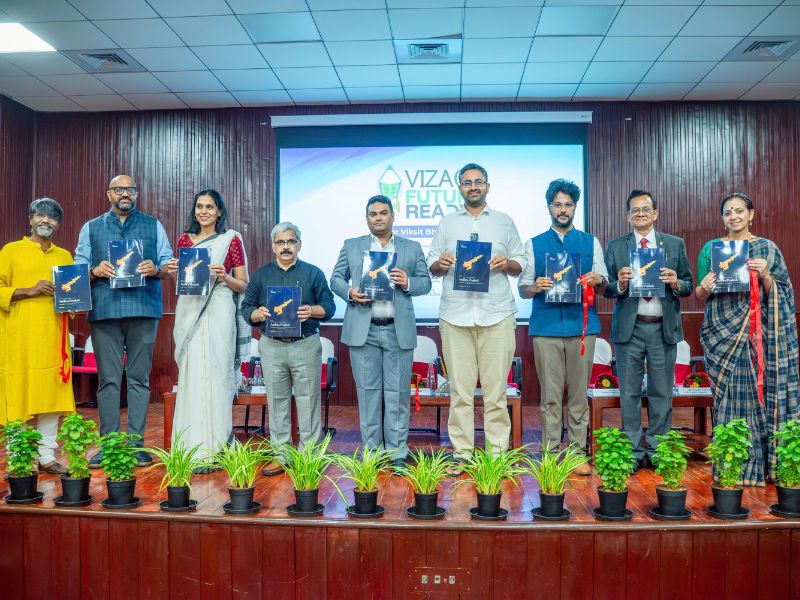
Andhra Pradesh youth opportunity handbook launched at GITAM
The Future of India Foundation has launched the Andhra Pradesh State Handbook of Youth Opportunity at GITAM Visakhapatnam, presenting district-level data on youth education, employment, skills and participation across all 26 districts.
The handbook is based on YouthPOWER.in, which brings together nearly 180 indicators from 27 government databases across five pillars — Participation, Opportunity, Work, Education and Readiness (Skilling). Andhra Pradesh recorded an overall YouthPOWER score of 45.3, with Education emerging as the strongest pillar at 57, followed by Readiness at 41 and Work at 37.
The state has 12.3 million young people, of whom 46.4 percent are in the labour force. Youth unemployment stands at 16.2 percent, while 28.4 percent are not in employment, education or training. Young women’s labour-force participation is 29.7 percent.
The handbook notes that Andhra Pradesh has made gains in access to education, banking and digital connectivity, but faces challenges in translating these gains into workforce participation, secure employment and higher-value jobs. Youth employment has also shifted over the past eight years from agriculture towards services, trade, hospitality and construction.
Visakhapatnam recorded the highest district YouthPOWER score in the state at 55. The district has a higher share of workers in regular salaried employment, at 60 percent, compared with 21 percent in the typical district. Value added per worker stands at approximately ₹0.179 million, compared with ₹0.142 million in the typical district.
On education, 15 percent of young women aged 15–21 in Visakhapatnam are out of education, compared with 33 percent in the typical district. Meanwhile, 41 percent of Class 9 students reach grade level in mathematics, compared with 35 percent in the typical district.
Sribharat, Member of Parliament from Visakhapatnam and President, GITAM, said there was a need to strengthen the link between education, skills and employment by improving information-sharing between universities, skilling institutions and employers.
The handbook recommends a three-pronged agenda of supporting enterprise and local job creation, preparing young people for work and enterprise, and prioritising youth outcomes in district governance. It also calls for stronger coordination between employers, educational and skilling institutions and district administrations.
The report identifies ports, logistics, aquaculture, tourism and hospitality as sectors where Andhra Pradesh could build higher-value employment opportunities. It also recommends connecting local enterprises with credit, markets, skills and talent through district-level data.
The event also featured a demonstration of Yellow Dots, an open and interoperable digital public infrastructure designed to connect students, educators, skilling providers, employers and startups with opportunities in learning, internships, jobs, mentoring and entrepreneurship.
The programme included a panel discussion on the Vizag and Andhra Pradesh YouthPOWER and FutureReadiness Roadmap, with representatives from Andhra University, SEEDAP, GITAM, Centurion University, EkStep Foundation and Career Launcher/TalEvate.
Also Read: JBCN Education Celebrates Outstanding IGCSE May-June 2026 Results









Add comment