






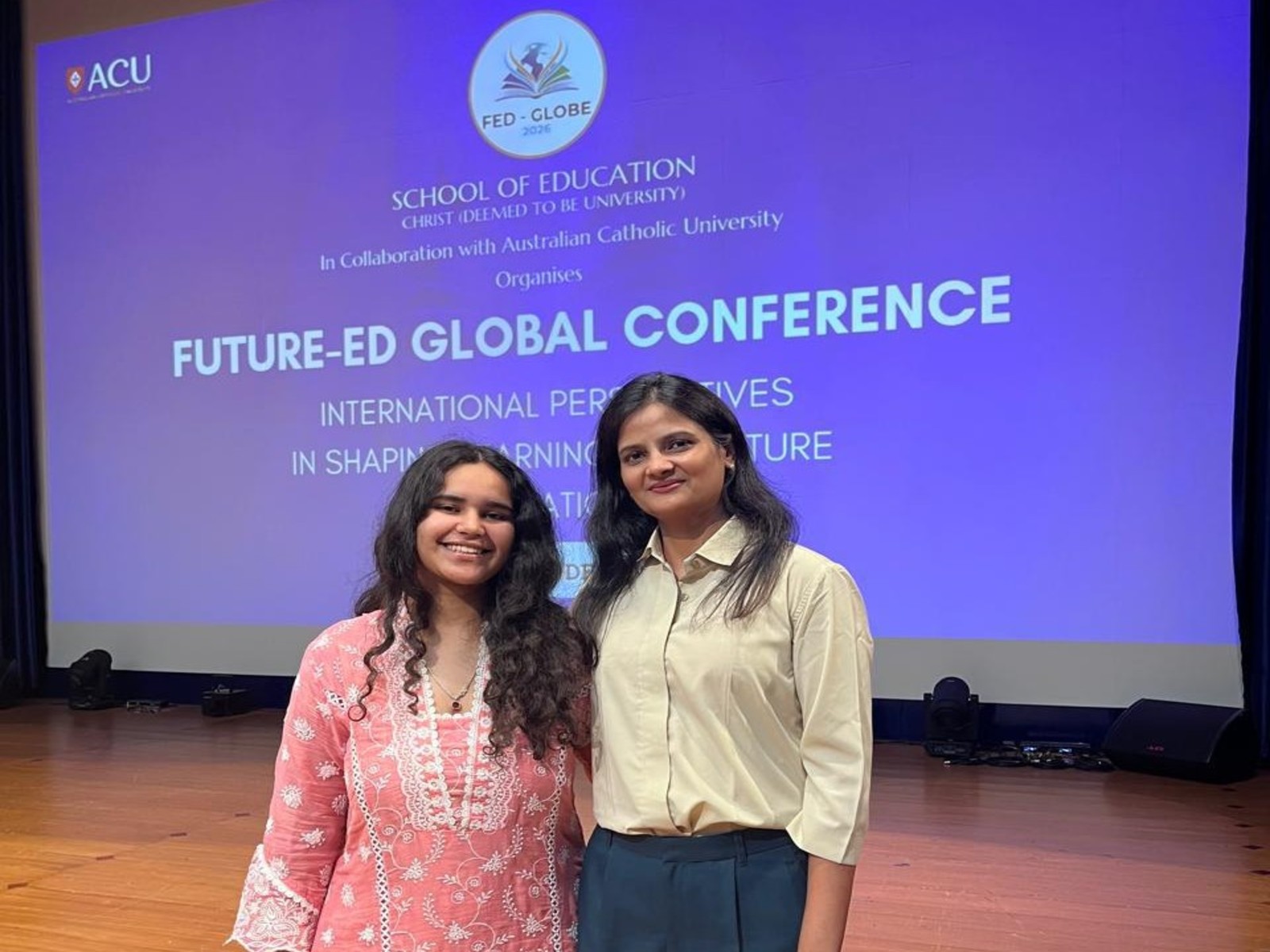
SKV showcases future-ready education at FED Globe Conference
The future of education cannot be written by code alone. This was the resonant takeaway from the prestigious FED Globe Conference, hosted by CHRIST (Deemed to be University) in collaboration with the Australian Catholic University. Gathering global academics, policy-makers, and elite educators, the international symposium served as a critical platform to address a defining question: How do we harness digital technology to shape the next generation without losing our human core?
At the forefront of this global dialogue was Scindia Kanya Vidyalaya (SKV).
Representing the pinnacle of forward-thinking Indian schooling, IT Department Faculty Dr. Neha Tomar and Head Girl Shruti Chaturvedi were invited as panelists to present an immersive, real-world case study on student-led tech innovation.
From the Classroom to the Canvas: The Story of Sasha
Dr. Tomar and Shruti anchored their session, “Role of Digital Technology in Shaping Educational Narratives of NewGen,” around Sasha—a cutting-edge robot designed entirely within SKV’s ecosystem.
Shruti captivated the audience by peeling back the layers of Sasha’s developmental journey. She spoke candidly about the creative sparks, the daunting technical hurdles, and the multi-stakeholder support system—spanning parents, educators, and peers—required to turn a school lab concept into a working robotic reality.
Complementing the student perspective, Dr. Neha Tomar shared the institutional blueprint for nurturing such genius. She highlighted how schools must actively cultivate learning environments that celebrate failure, foster critical thinking, and provide the infrastructure necessary for future-readiness.Technology, as demonstrated by SKV, should not be a passive subject to study, but a dynamic sandbox for creation.
Confronting the Paradox: AI-Assisted vs. AI-Dependent
As global thought leaders mapped out the educational landscape of Education 2040, the conference continuously returned to a profound paradox: the digital divide vs. AI over-dependence.
While international voices like Professor Rohan D’souza (Kyoto University) and Dr. Vijayan Karippal (World Peace University) discussed “Inclusive Innovation,” the SKV-led interactive sessions tackled the darker psychological realities facing today’s youth.
Panels featuring IPS Officer Nithin Raj and Professor Manoj Kumar unpacked the growing crisis of digital addiction through the lens of the 5 C’s:
Control Loss: Unintentional, endless screen scrolling.
Craving: Persistent mental preoccupation when offline.
Coping: Using applications as shields against boredom or stress.
Conflict: Allowing screen time to disrupt real-world relationships and academics.
Constancy of Mood Shifts: Anxiety and irritability during digital disconnection.
The collective antidote proposed during the two days was shifting from unmonitored consumption to supervised learning models. Educators argued that AI must strictly remain an assistant to human judgment rather than its replacement.
Elite frameworks like the SIFT method (Stop, Investigate the source, Find better coverage, Trace claims) were championed to teach students to fact-check AI outputs against primary sources. Furthermore, workshops led by experts like Professor Vinay M emphasized teaching prompt engineering—moving students away from superficial queries and towards deep, research-backed intellectual co-creation.
The Renaissance: Looking Back to Leap Forward
Perhaps the most philosophical pivot of the conference came from the keynote address by Prof. J. B. G. Tilak, who called for a sweeping Indianisation of modern education. He noted a collective cultural amnesia: Western models are frequently imported to structure modern universities, while India’s rich history of world-class, ancient higher learning institutions is overlooked.
The conference highlighted that true educational resilience lies in blending modern tech with timeless pedagogical practices rooted in Indian heritage:
Vādu & Shastrartha: Structured, public philosophical debates that acted as the ancient world’s oral peer-review systems.
Guru-shishya Parampara: Long-term, non-standardised mentorship that mirrors modern high-end masterclasses.
Mnemonic Precision: The rigorous oral preservation of massive texts, showcasing ultimate cognitive discipline long before digital storage existed.
The Verdict
As the valedictory ceremony concluded, the international summit, the overarching mandate for elite school stakeholders became perfectly clear. The future of education will not be measured by the sheer volume of devices in a classroom, but by the ethical boundaries and human intentionality we wrap around them. By championing both technological brilliance and human-centred consciousness, institutions like Scindia Kanya Vidyalaya are not merely preparing students for the future – they are actively authoring it.
Also read: Shri Ram Global School: Celebrating Students’ Journey From Greater Noida West to CERN







Add comment