






Andamans, Before Autumn: Of Seas, Ruins, and Memory
– Neelam Reddy, teacher at Sarala Birla Academy
Travel, at its most meaningful, is not an escape but a recalibration of the self. For us at Sarala Birla Academy, this journey to the Andamans unfolded not as a departure from learning, but as its quiet expansion – where the page gave way to the horizon and knowledge was encountered rather than assigned. What began as a carefully arranged itinerary, dissolved gradually and almost imperceptibly, into something more immersive: a passage shaped by rain, by sea, and by histories that refused to remain distant.
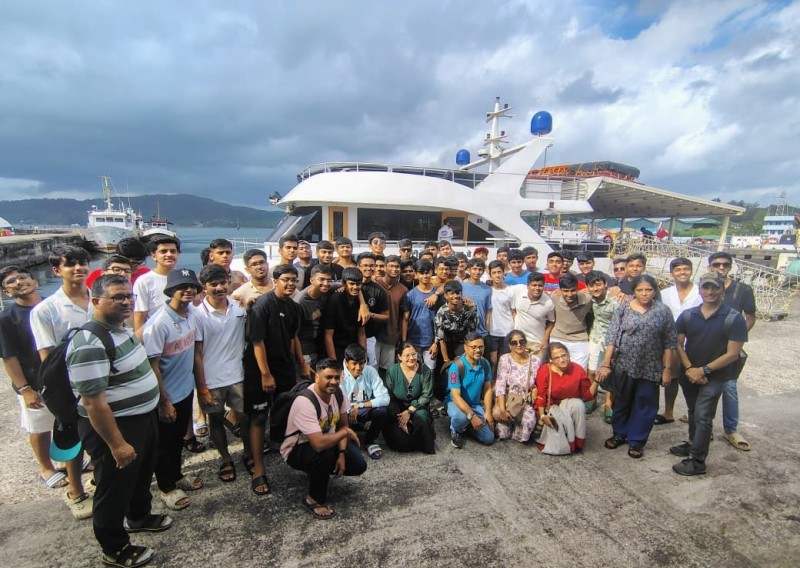
We arrived in Port Blair (Sri Vijayapuram) not as solitary travellers, but as a heady collective of Grade XI in full strength and eight energetic escort teachers momentarily out-of-sync with the island’s unhurried cadence. Under a sky that seemed perpetually on the verge of rain, the air was dense, salt-laden and restless; showers came and went with little ceremony, as though the islands had no interest in clear, uninterrupted days.
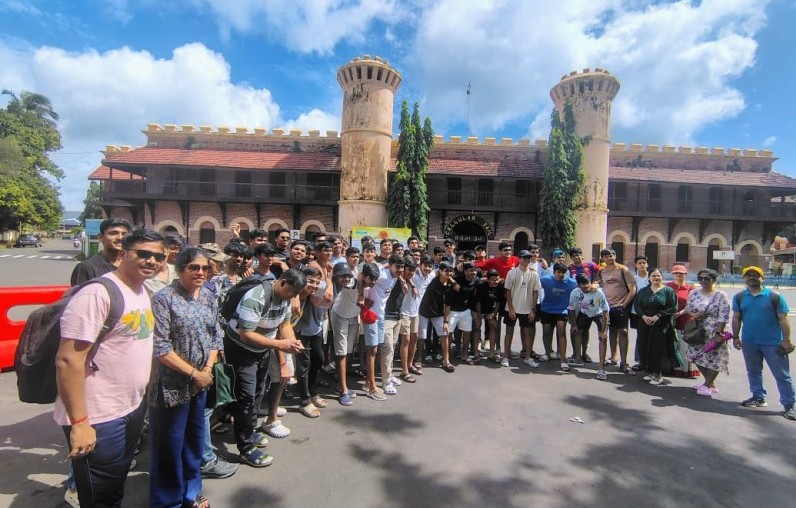
The journey began with promise, as we settled into a comfortable abode, greeted by delicious meals that set the tone for the days to come. An hour later, we set off toward our first destination, ready to dive into the experience awaiting us. The vibrant Corbyn’s Cove Beach, teeming with life, led us to change course, seeking refuge at the quiet Waterfront Marina before heading to the imposing Cellular Jail. This grim relic of the British colonial era stands as a chilling symbol of oppression, designed not only to isolate, but to suffocate the very notion of self. It was here that the British sought to crush the spirit of India’s independence, locking away its dream of freedom to break its will, only for it to rise again, unbroken, beyond these walls. As evening fell, the light-and-sound programme unfolded with deliberate restraint, voices emerging from darkness, light tracing memory that flipped history from abstraction into presence.
The following day bore us a place once known as The Paris of the East. Ross Island (now renamed Netaji Subhash Chandra Bose Island), is where the narrative shifted yet again. Once the British administrative headquarters in the Andamans, it now lingers in elegant disrepair; its crumbling facades of bakeries and ballrooms composing a quiet afterword to empire. Structures persist but only just… Roots thread through walls, branches lay claim to rooftops, and masonry yields- slowly but surely. Surprisingly, what defines the island is not ruin, but life. Deer-innumerable and unhurried, move with quiet assurance, as if heirs to a past they never knew.
The scars left by its abandonment after the 1941 earthquake, along with the brief shadow of Japanese occupation, have long since faded into distant echoes. Remnants of bunkers and bastions still stand silent witnesses to an era when the island’s history was carved in both suffering and dominance, now composed under the watchful gaze of the Indian Navy.
And so, we left Ross Island with a sense of deliberate incompletion; as though the place resists any final understanding.
We then enjoyed a meal aboard the cruise before proceeding to the Anthropological Museum -where the journey turned inward, from terrain to testimony. The galleries brought us face to face with representations of the indigenous communities of the Andaman Islands. The Great Andamanese, Onge, Jarawa, and Sentinelese- among the oldest continuous cultures in the region, their histories extending across millennia…
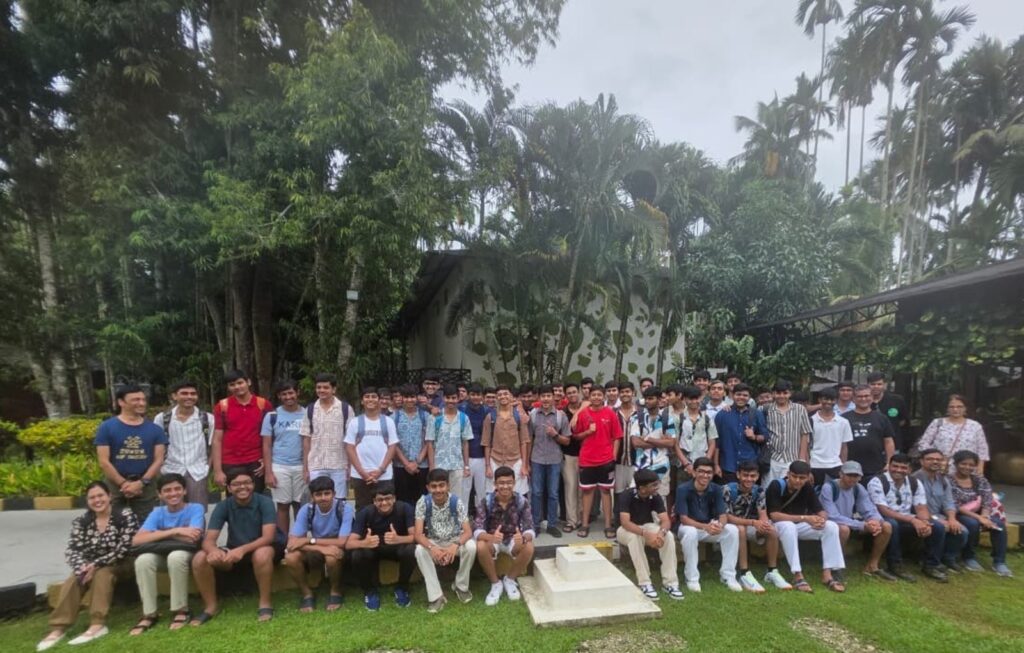
What unfolded within those walls was both factual and tad disquieting. Some of these communities have, over time, been drawn into the structures of the modern state; others, (most notably the Sentinelese), have resisted all contact with unwavering defiance. The exhibits present artefacts, photographs, and recorded accounts traced lives shaped by isolation, resilience, and, in many cases, profound disruption. Yet the museum does not (and cannot) fully contain what it seeks to represent. It gestures toward worlds that remain beyond easy comprehension, reminding us that documentation has its limits, that not every story can be translated without loss. Not everything can be translated. Not everything should be…
And as one leaves, a question lingers, echoing beyond the Andamans, toward the distant Nicobar Islands: in our urge to understand, to document, to reach, how often do we risk unravelling the very worlds we seek to know?
The journey to Havelock Island (officially Swaraj Dweep) on day three, marked a perceptible shift not only in geography but in sensibility. The crossing, undertaken in a high-speed catamaran, unfolded over choppy seas that allowed no illusion of control. The vessel pitched and heaved with mechanical regularity, its hull cutting through restless water, each rise and fall shaped by wind and tide. It was not discomforting, but insistently real, a reminder that these waters were neither passive nor ornamental.
At Radhanagar Beach, the landscape required no embellishment. The shoreline stretched wide and uninterrupted, the sand fine-grained and pale, and the sea advanced in long, measured gradients rather than abrupt breaks. Rain persisted in soft intervals, never dramatic, always present, diffusing light, enriching colour, and softening the horizon into a muted continuum.
And yet, one of its quiet marvels remained just beyond reach. On certain nights, the waters of Radhanagar are known to glow with bioluminescence (microscopic organisms responding to movement with brief, electric bursts of blue) – an ephemeral spectacle, contingent on conditions and timing !
Alas! on this visit, it eluded us entirely…
Not far away, at Elephant Beach, the world shifted once more; this time beneath the surface. Snorkelling revealed an ecosystem that was not vast but intricately composed. The Andaman waters, part of the Indo-Pacific biogeographic region, supported coral assemblages alive with precise, interdependent motion. Reef fish flickered through branching corals, while light fractured across the seabed in shifting lattices. It was not spectacle but system, a delicate equilibrium sustained through balance, where even the slightest disturbance carried consequence.
For our students, it became a moment not just of observation, but of discovery, with a living system that demanded attention, patience, and a newfound respect for the fragile complexity it held.
In the final stretch of our journey, beyond aquamarine waters and painted sunsets, the islands demanded something different. It was no longer about drifting along the coast, but about cutting through equatorial rainforest, into terrain that resisted the easy gaze. Thus, our penultimate day, began in the grey- blue hush before dawn. We left behind a magnificent cottage resort poised above the ocean, its vast, breathing darkness slowly giving way to first light. Departure felt less like movement, more like quiet severance. Movement along the Andaman Trunk Road was not chosen but ordained; convoys advancing in regulated intervals, the forest pressing close on either side, time itself governed by passage.
Here, the Jarawa appeared only in passing, a brief presence at the forest’s edge. Of slight build, with tightly curled hair and traces of red ornament, they moved with a quiet certainty, as though belonging wholly to the rhythm of the land.
They were neither spectacle nor subject, but a boundary, clear and undisturbed. The moment did not invite curiosity; it called for restraint. One moved through with lowered gaze, aware less of what was seen than of what must remain untouched, a fleeting encounter with the limits of perception.
Baratang altered the scale entirely, and the approach unfolded in measured layers. Under bursts of torrential, momentary rain, the journey began with a vehicle ferry cutting across opaque waters, engines straining against the downpour. From there, a narrow motorboat drove into mangrove creeks, slicing through still, brackish channels where roots rose in dense, interlocked formations, holding land and water in a delicate balance. Rain struck hard, then vanished just as quickly, leaving behind a suspended quiet.
The limestone caves, formed over millennia through the gradual deposition of calcium carbonate revealed themselves in cool, dim restraint. Inside, the air shifted, light thinned and structure emerged with precision. Stalactites descended, stalagmites rose, each formation shaped not by force but by time itself. Emerging from this mineral stillness, the return to the surface felt immediate. Rain lingered, the forest closed-in once again and the day resolved into something simple- delectable hot meals, warmth and a brief pause, after a journey that had traversed both the inner and outer expanse.
We navigated back the same way we came, heading toward India’s only active mud volcano, now almost dormant. Without spectacle, small pools of grey earth stirred faintly, releasing slow, intermittent bubbles – a reminder of forces once urgent? Yes. Only, there was no drama here, just geology in its most restrained form.
The journey back was a quiet descent, each moment more like a soft unfolding than a conclusion. As evening drew near, the ocean’s waves lapped at the shore, steady and constant. One final night in Port Blair didn’t mark an end; it was a stillness before the world outside resumed its pace. The echoes of the sea lingered, a silent reminder of the time we had, before the mainland’s rush would reclaim us.
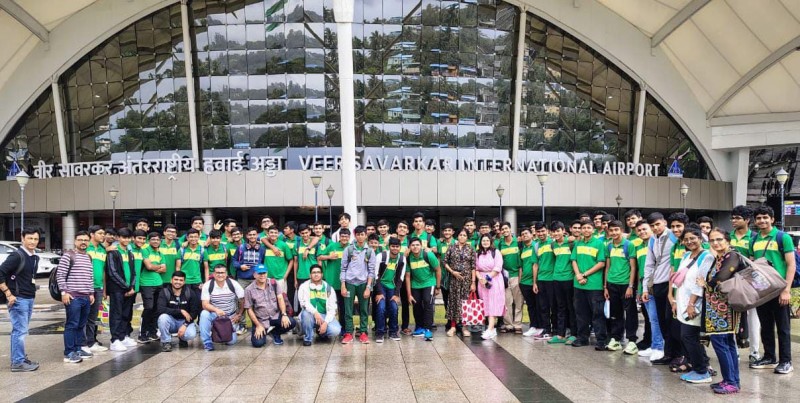
We did not leave as we had arrived. A week had been enough to disturb the familiar, to adjust our sense of pace and proportion, to leave behind a version of ourselves that no longer quite fit.
The Andamans do not resolve into moments; they gather slowly, almost imperceptibly. In rain that never quite withdraws. In histories that persist without display. In landscapes that do not seek admiration, yet hold it with authority.
What endured, then, was not a catalogue of places, but a set of impressions that settled deeper than memory. The Cellular Jail gave our history- weight and proximity. The Anthropological Museum, along with that brief, wordless passage along the Andaman Trunk Road, introduced a more difficult lesson: that there are boundaries which understanding does not cross, and that restraint is not absence, but awareness.
The sea required adjustment, its rhythms indifferent to expectation. The caves revealed time as accumulation, patient and unhurried. The rain, constant and unassuming, became a study in endurance.
For our SBA group, this journey had transcended mere geography – it became a collective odyssey. Moving as a huge ‘family’ demanded an unspoken harmony, a delicate calibration of pace and patience. Waiting, adjusting, anticipating each other’s needs; these were not disruptions, but integral threads woven into the fabric of the experience. And long after the journey’s end, a question lingers, unresolved:
When a place reshapes the way you see the world, can you ever truly return to who you were?
Or does something in you remain forever altered?
Also read: Shemrock Leadership Conclave MUN 2025: A Celebration of Vision, Voice and the Leaders of Tomorrow










Add comment