






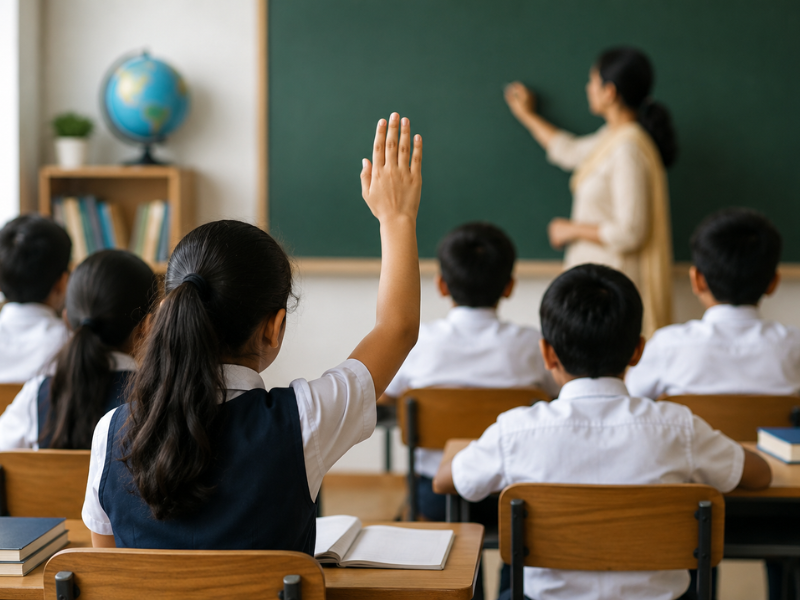
CBSE clarifies rollout of three-language policy, exempts current Class 10 students
The Central Board of Secondary Education (CBSE) has issued detailed guidelines for implementing the three-language policy under the National Education Policy (NEP) 2020, clarifying that current students will not be required to make abrupt changes to their language choices.
The guidelines, effective from the 2026-27 academic session, confirm that the existing Class 10 batch will continue under the current two-language system and will not be required to study or appear for a Board examination in a third language.
Union Education Minister Dharmendra Pradhan had earlier said students already studying two foreign languages would not be forced to switch midway through their schooling. Following the clarification, CBSE has confirmed that the revised policy will be introduced gradually, beginning with students entering Class VI, while transitional relaxations will apply to existing batches.
Under the new framework, students in Class IX will study three languages, with at least two being Indian languages. Students already studying two Indian languages may choose either an Indian or foreign language as the third language. Those studying one Indian language and one foreign language must add another Indian language.
CBSE has also granted a one-time relaxation for students currently studying two foreign languages, allowing them to continue both languages while adding one Indian language as the third subject. The third language will be assessed internally by schools, and when these students reach Class X, they will not be required to appear for a CBSE Board examination in the third language.
The same transition will apply to the current batches in Classes VII and VIII when they move to secondary school. Students already studying two foreign languages will be permitted to retain both while adding an Indian language, with the third language continuing to be assessed through internal school evaluation rather than the Board examination.
Students entering Class VI in the 2026-27 academic session will be the first cohort to implement the policy in full. They will study three languages, including two Indian languages, without transitional exemptions. When they reach Class X, they will become the first batch required to appear for the CBSE Board examination in the third language. NCERT has prepared textbooks for the third language in 22 scheduled Indian languages for this cohort.
Pradhan said nearly 90 per cent of India’s school students already study three languages, while around 99 per cent of CBSE students study two Indian languages. Only about 1.3 per cent of CBSE students currently study two foreign languages.
The Board has also announced exemptions for children with special needs in accordance with the Rights of Persons with Disabilities Act, 2016. CBSE-affiliated schools outside India and foreign students returning to India will also be exempt from the requirement to study an Indian language as the third language.
To support students whose families relocate between states, schools will be required to accommodate the language combinations chosen during the middle stage and provide the necessary academic support.
Acknowledging possible shortages of language teachers, CBSE has permitted schools to use teachers with functional proficiency in the required language, engage retired teachers and postgraduate language experts, share resources through Sahodaya school clusters, and adopt virtual or hybrid teaching where necessary.
The guidelines also reiterate that foreign languages will continue to be offered under the policy. A fourth language will remain optional, while vocational education will be introduced alongside the language reforms in accordance with the NEP framework.
Also Read: New NCERT Class 9 textbook highlights judiciary’s role in safeguarding constitutional rights








Add comment