






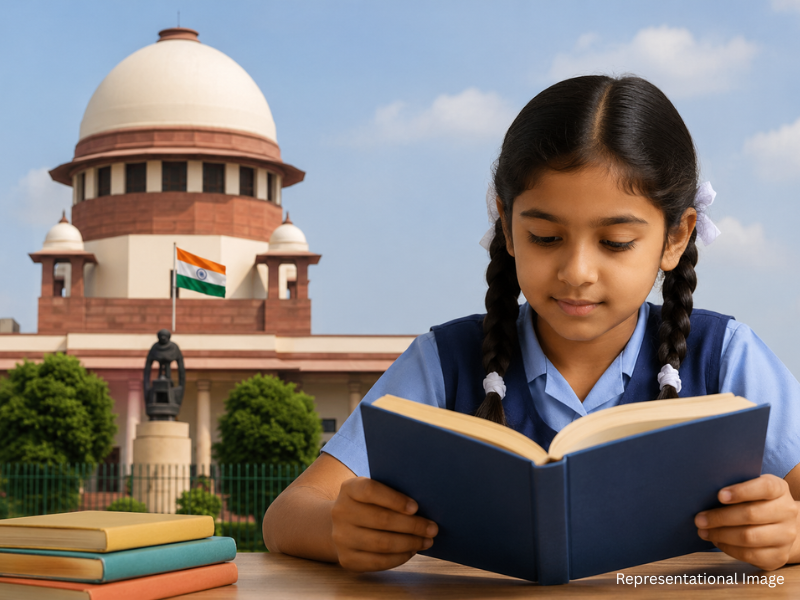
Child has fundamental right to receive education in mother tongue: Supreme Court
The Supreme Court has held that a child has a fundamental right under Article 19(1)(a) of the Constitution to receive primary education in a language of their choice, including their mother tongue.
A bench of Justices Vikram Nath and Sandeep Mehta made the observation while directing the State of Rajasthan to introduce Rajasthani as a subject in schools and facilitate its use as a medium of instruction.
The court stated that the right to freedom of speech and expression includes the right to receive information in a form that is meaningful and comprehensible. It noted that education, as a primary means of knowledge transmission, should be imparted in a language best understood by the child to ensure effective learning and comprehension.
The bench said that instruction in the mother tongue strengthens conceptual clarity and enables deeper cognitive engagement, thereby supporting meaningful access to knowledge.
Referring to State of Karnataka v. Associated Management of English Medium Primary & Secondary Schools, the court reiterated that Article 19(1)(a) grants children the freedom to choose the medium of instruction at the primary level. It added that the State cannot impose a particular language, even if it considers it beneficial.
The court also observed that the Centre’s policy supports education in a language of choice or the regional language and criticised the Rajasthan government for not taking adequate steps to implement this approach.
It held that failure to provide instruction in a comprehensible language risks infringing fundamental rights under Part III of the Constitution.
The court directed the State of Rajasthan to take necessary steps to introduce Rajasthani as a subject in all government and private schools and to facilitate its use as a medium of instruction.
Inputs from Livelaw
Also Read: Over 85% clear CBSE Class 12 exams; pass rate declines








Add comment