






Delhi: 3 languages formula Pandora’s box
– Autar Nehru (Delhi)
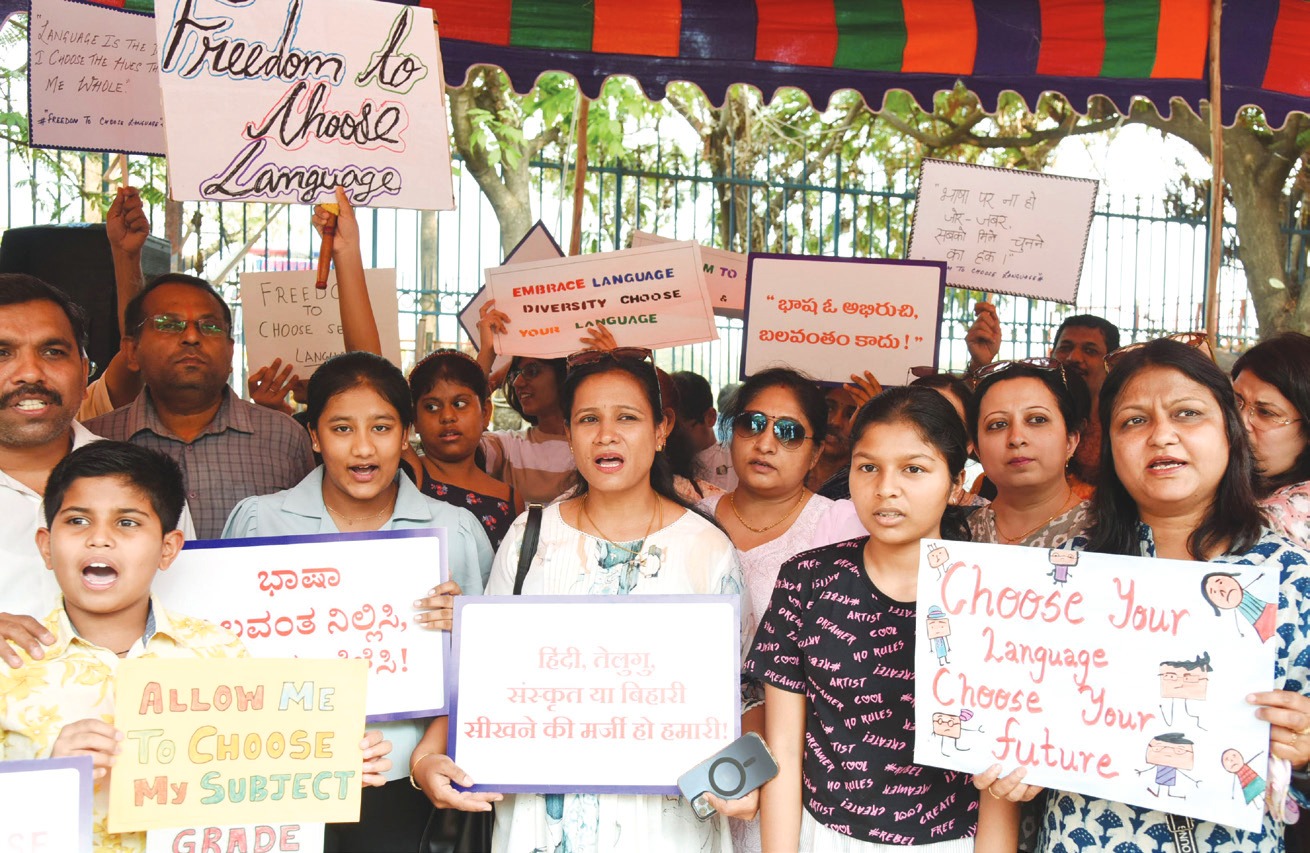
Karnataka protest against three language formula: backdoor smuggling fear
More than 33,000 schools affiliated with the Central Board of Secondary Education (CBSE) — India’s largest national school-leaving examination board — which were mandated to implement the three-languages learning directive of the Union education ministry for class IX children countrywide from July 1, were granted relief by the Supreme Court on August 20. Hearing a batch of writ petitions contesting the three-languages learning formula, the apex court directed CBSE to “go back to the drawing board” and consider whether the policy could be introduced into the curriculum from earlier classes, giving students and schools “some elbow space”.
The history of India’s languages-learning wars dates back over 60 years. Under the Constitution adopted by Parliament on January 26, 1950, Hindi, the lingua franca of the populous states of North India, was decreed the national language of India. However, English was also permitted to be used as the national language for 15 years to ease the transition. But when the transition period ended in 1965, adoption of Hindi as India’s sole official language was fiercely opposed by the Dravidian states of peninsular (south) India, which claimed that this would give native Hindi speakers a natural advantage in bagging Central government, defence forces, Indian Railways etc jobs. Peninsular Indian states wanted English to continue as a parallel national language to create a level playing field.
With Hindi language zealots continuing to press for Hindi as the sole national language, protest riots broke out all over the south and at one time, there was a real possibility of the state of Tamil Nadu seceding from the Indian Union of states. However, an agreement was negotiated under which all children would learn three languages in school. The agreement was that children in the south would learn Hindi and north Indian children would learn a peninsular language, and all children would also learn English which was retained as ‘Associate national language,’ the link language between states, and language of the upper judiciary. In practice, the three-language formula was a flop as the Northern states never seriously taught children Dravidian languages, although Hindi made some ground in the south because of popular Bollywood (Hindi language) cinema.
This uneasy compromise endured for over a half century until 2014 when the Hindu nationalist Bharatiya Janata Party (BJP) swept to power at the Centre and in the Hindi heartland state of Uttar Pradesh (pop.240 million) on a ‘Hindu, hindutva and Hindi’ platform.
In 2020, the BJP/NDA government at the Centre reopened the Pandora’s Box of the three-language policy with the 62-page National Education Policy (NEP) 2020. S.4.2 of NEP 2020 inter alia reaffirms that all children should learn three languages “so long as at least two of the three languages are native to India”. Under NEP 2020, English, the Associate national language, is implicitly regarded as a foreign language.
Down south, re-introduction of the three-language formula is widely interpreted as a backdoor manoeuvre to smuggle Hindi into school curriculums as any prudent parent would choose Hindi as second language after the state language.
It’s pertinent to note that the three-language formula has never been accepted by any Tamil Nadu government since the 1970s. Only Tamil, the state’s language and English, the national Associate language, are prescribed for the state’s 37,500 government schools.
Meanwhile even as the apex court is hearing a batch of petitions against CBSE’s three-languages learning mandate, the three-judge bench observed that whether English/Inglish is a native language is a “debatable issue, but a larger one that can be taken up later”.
“The tragedy of Indian education is that our children don’t learn any language well. The Annual Status of Education Report (ASER) of the Pratham Education Foundation has consistently highlighted that over 50 percent of class VII rural children can’t read class III texts in their own vernacular languages. Therefore expecting them to learn another two languages is expecting too much. Instead, the state government should focus on training/teaching two languages, one of which should be English for national integration purposes. Therefore, the government needs to focus on training teachers to at least teach two languages well,” says Gurcharan Das, public intellectual, author and former CEO and managing director of Procter & Gamble India. Das contends that instead of adding another language to the curriculum, schools need greater support to learn English well through language laboratories, learning tools and technology. “Our teachers, who themselves lack proficiency in most cases, need handholding,” he says.
A highly respected public intellectual, Das is a rational voice in the confusing babble of the highly politicised and endless three languages policy debate. His viewpoint deserves deep consideration by the powers that be. A multiple languages policy that affects millions of students requires trained teachers, appropriate learning material and adequate time for schools and households to adjust.
Without such preparation, the likelihood is that rollout of NEP 2020 through CBSE notifications and guidelines will perpetuate the cycle of court challenges, student and parental anxiety, and implementation pressure on schools.









Add comment