






Maharashtra: Forced remedial action
– Dipta Joshi (Mumbai)
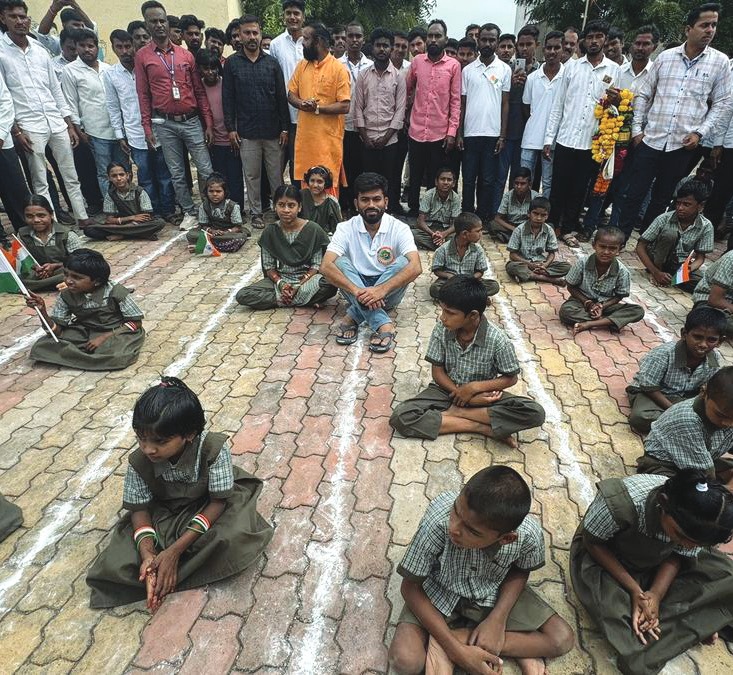
CJP’s Dipke (centre): immediate impact
The newly-formed cockroach Janata Party (CJP) born out of ill-advised obiter dicta of the Chief Justice of India who reportedly equated unemployed youth with “cockroaches,” is now a force to reckon with. The insult was quickly owned by Abhijeet Dipke, a public relations student in Boston. In early July, Dipke launched CJP online and within two weeks it acquired an Instagram following of 22 million mainly Gen Z youth, who forced the resignation of Union education minister Dharmendra Pradhan on July 25 and extracted an amnesty for allegedly riotous students from the Supreme Court.
Dipke and CJP have since focused national attention on the casual neglect of India’s dilapidated education system — especially government schools — to emerge a national hero. Dipke is a native-born citizen of Aurangabad (now renamed Chhatrapati Sambhajinagar) in Maharashtra (pop.129 million). The ruling BJP/NDA government at the Centre aside, these developments have spooked the tri-party BJP, Eknath Shinde’s Shiv Sena and Ajit Pawar’s Nationlist Congress Party splinter coalition government that has been ruling Maharashtra — India’s most industrialised state — for over three years.
Dipke/CJP, who forced Pradhan’s resignation for presiding over the issues of exam paper leakages in the fiercely competitive NEET-UG examination written countrywide by 2.2 million school-leavers aspiring for admission into India’s much-too-few 823 medical and 329 dental colleges, have chosen ‘School Thik Karo’ (Mend schools) as its new national campaign. Launched on Independence Day (August 15), it highlights the pathetic condition of government schools countrywide.
According to a recently (May 6) released report of NITI Aayog — the Central government’s own in-house think tank — of the country’s 1.4 million primary-secondary schools, 98,542 — mainly government schools — lack functional girls’ toilets; 61,540 have no usable toilets at all; 59,829 have no handwash facilities; 119,000 are bereft of electricity; 518,910 don’t have computers and 536,550 don’t have internet connectivity. The report also highlights “significant shortfalls in teacher availability” stating that 7 percent of all schools — 104,000 — are served by only one teacher.
To its credit the new-born CJP has accorded high importance to this foundational flaw of post-independence India’s national development effort, glossed over by 12 five-year Planning Commissions, several of them chaired and staffed by economists of global renown.
The first stop for CJP’s ‘School Thik Karo’ campaign in Maharashtra was Dipke’s own childhood school where he documented the condition of classrooms, toilets, drinking water, use of expired food for students’ mid-day meals and other basic facilities. “Government primary schools form the base layer of our education system, where a majority of children in India receive their education. Yet, successive governments have systematically neglected them. In my own village in Hingoli, classrooms lack benches. Toilets are in such disgusting conditions that children — especially, girls — are forced to go back home just to use the bathroom,” says Dipke. The audit of Dipke’s alma mater by the CJP team led by Dipke made immediate impact — not only was repair work commenced but the school has received new benches for students and its first-ever computer.
Not that it has been all smooth sailing. The education department of the Bombay Municipal Corporation (BMC) prohibited CJP audit teams from inspecting BMC schools because they “lacked prior permission”. In Latur, a formal FIR (first information report) was lodged against Dipke for unauthorised entry, disruption of classes and threats to teachers. However, CJP’s government schools audit has received massive social media support — more than 20,000 citizens in districts, cities and villages have uploaded reels depicting infrastructure deficiencies on Instagram.
Reacting, Chief Minister Devendra Fadnavis has directed district guardian ministers and legislators to monitor school repair work being undertaken; Deputy CM Eknath Shinde announced a 10 percent increase (from 5-15 percent) in District Planning and Development Committee (DPDC) funds utilised for schools repairs. Moreover, rural development minister Jaykumar Gore has green-lighted the use of Gram Panchayat funds for installing basic facilities such as water and toilets in village schools and Mumbai suburban guardian minister Ashish Shelar called for filling vacant education-inspector posts for auditing physical facilities in government and municipal schools.
Dipke says CJP will compile the nationwide audit data before formally releasing its demands for changes in education policies. “Basic infrastructure, cleanliness and safety may not guarantee quality learning on their own, but they are necessary conditions for children to attend school,” he adds (see interview p.184).
Maharashtra’s 2026-27 budget allocation for education, sports, arts and culture department is Rs.1.09 lakh crore, equivalent to 14.4 percent of the total budget — among the highest countrywide. Yet 80 percent of it is allocated towards fixed expenses such as teacher and staff salaries, pensions in government and state schools, leaving little for infrastructure development in the state’s 64,884 government schools.
In light of the sudden unusual burst of activity of the hitherto indifferent state government, it is clear the CJP’s ‘School Thik Karo’ campaign has achieved more than mere exposure of inadequate public school infrastructure. It has forced Maharashtra’s political and administrative establishment to address the issue of greater resource mobilisation for education. Whether it will succeed is a moot point.









Add comment