






Delhi: Compromised regulatory system
– Autar Nehru (Delhi)
 Under the constitution of India, education is a concurrent list subject empowering the Central and state governments to enact legislation on education issues. However, until the liberalisation and deregulation of the country’s Soviet-inspired socialist economy in 1991, state governments tended to focus on the K-12 education sector, allowing the Centre to promote and regulate higher education.
But after 1991, perhaps inspired by the example of America’s top ranked globally admired private universities, private sector edupreneurs began establishing universities aided and enabled by state governments.
Sikkim Manipal University (SMU) was promoted as India’s first private state government legislated university established under the Sikkim Manipal University of Health, Medical and Sciences Act, 1995. Since then, 436 private universities — including the top-ranked Amity (estb. 2005), Jindal Global (2009) and Ashoka (2014) universities have been established by special state legislation.
Inevitably, rapid multiplication of private universities birthed by state legislation has created quality problems. The majority of private universities established under state government legislation and promoted by influential politicians and get-rich-quick entrepreneurs, licensed by corrupt education ministry officials at the Centre and in the states, tend to be of indifferent quality. Indeed, most Central government regulatory agencies such as the University Grants Commission (UGC), AICTE, NAAC and NBA mandated to supervise higher education institutions and ensure they meet specified quality standards have acquired bad reputation for greenlighting dozens of private universities that lack basic infrastructure, teachers and administrators, enabling them to enroll gullible students for faux, sub-standard higher education at substantial fees.
Perhaps the most blatant example of state governments recklessly licensing private universities was provided by the Chhattisgarh Private Universities Act, 2002. It outraged academia because immediately after it was enacted, more than 100 private universities without basic infrastructure, mushroomed statewide and were allowed to operate until 2005 when the Act was struck down by the Supreme Court. Later, in 2009, the Tandon Committee found 44 private ‘deemed’ universities certified as such by UGC and the Union education ministry unfit for autonomous status.
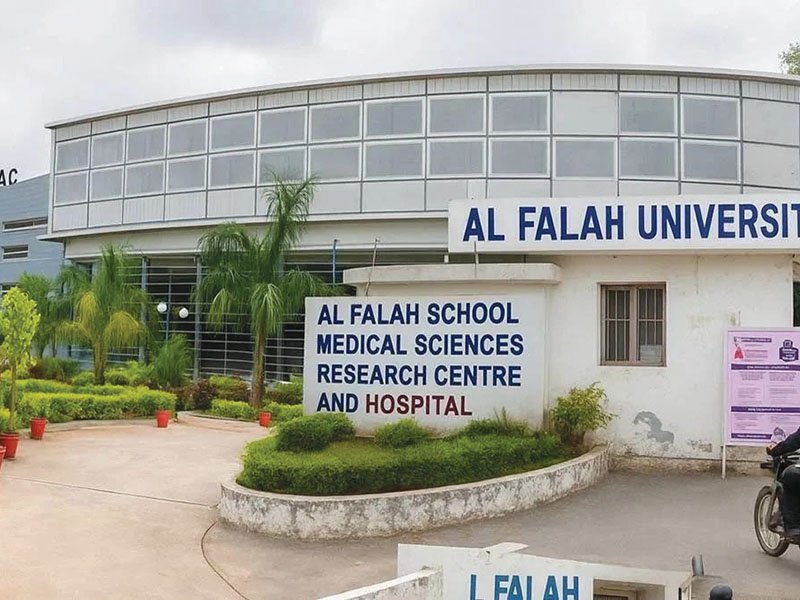
Against this backdrop the latest scandal to shake the country’s higher education licensing system is provided by Al-Falah University (AFU), Faridabad.
On November 8 after police searched AFU premises for explosives, four duly qualified medical practitioners teaching/practicing in the university were arrested and charged under the Unlawful Activities (Prevention) Act, 1967. They are accused of conspiring to set off bombs and explosions in Delhi and several cities across the country, and also linked to the November 10 Red Fort suicide blast in Delhi that killed 15 people and injured over 20.
Promoted by the Delhi-based Al-Falah Charitable Trust (estb.1995), the university was established under the Haryana Private Universities (Amendment) Act, 2014. Spread across a 70-acre campus, the institution began as an engineering college in 1997. It added a medical college in 2016 and admitted its first batch of 200 MBBS and MD students in 2019. Admissions are conducted through the Department of Medical Education and Research (DMER). The university also operates schools of humanities, teacher training, and social sciences, serving 2,000 students.
Investigations have revealed severe flaws in the system under which Al-Falah University was licensed and certified. Jawad Ahmad Siddiqui — the university’s chancellor and managing director of the Al-Falah Group — is a convicted fraudster now belatedly arrested by the Enforcement Directorate (ED) under the Prevention of Money Laundering Act, 2000. During the period 2018-25, Al-Falah collected over Rs.415 crore from students, much of which was diverted through affiliated entities for non-educational purposes.
Following the arrest of the four accused medical practitioners for terrorist activities including the deadly November 10 blast, almost all Central and state regulators — including the UGC, National Medical Commission (NMC), NAAC, Association of Indian Universities (AIU), National Commission for Minority Educational Institutions (NCMEI), and the Haryana Education Department — have gone into overdrive to ascertain how despite being a convict, Siddiqui was permitted to register his engineering college and expand its operations to provide highly prized medical education and receive university status..
At bottom, the arrest of the four — more are likely to be arrested — Al-Falah University medical practitioners has exposed deep corruption and misgovernance of the higher education system. All the alphabet soup of regulatory commissions and organisations are evidently deeply compromised. And tragically, rather than confer autonomy and accountability upon higher education institutions, NEP 2020 has multiplied the number of regulatory agencies.









Add comment