





– Autar Nehru (Delhi)
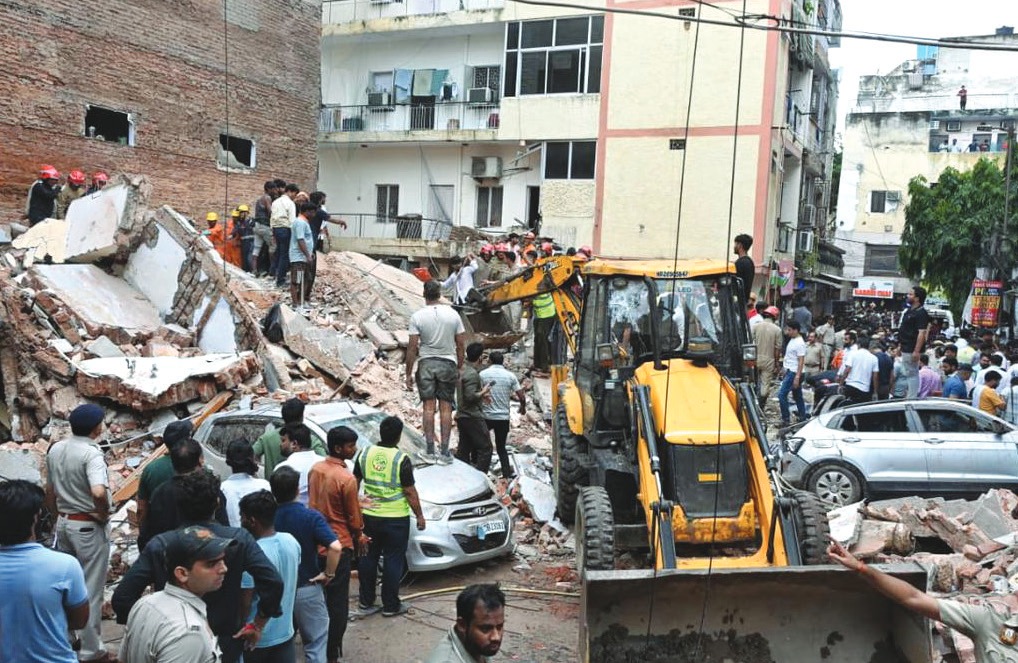
Ruins of Satya Niketan building: student housing crisis spotlight
India’s national capital – a major higher education hub — is waking up to a long-standing student housing crisis following the collapse on September 6 of Satya Niketan, a five-storey building used as a private hostel in South-West Delhi. Seven people, including five students, were killed in the tragedy. The incident has brought renewed attention to the acute shortage of institutional accommodation, rapid expansion of private paying-guest (PG) facilities around university campuses and regulatory gaps surrounding them.
The scale of the student housing crisis as revealed in the aftermath of this tragic incident, is particularly large at the University of Delhi (DU). While DU has an enrolment of 7.26 lakh students if its conventional, professional and open-learning programmes are aggregated, the university has only 7,224 official hostel beds — 3,688 in college hostels for undergraduates and 3,536 for postgraduate students. An additional 863 beds are expected from hostels under construction at Hindu, Hansraj, Ramjas and Kalindi colleges. Against this, more than half of DU’s students are estimated to come from outside Delhi and require accommodation. The outcome is a vast private students-rental market concentrated around North and South Campus and other education hubs.
For students who don’t secure institutional accommodation, the private housing market is a necessity created by the huge shortage. Students are pushed into cramped subdivided flats, rooftop rooms and densely occupied PGs in neighbourhoods surrounding campuses and are obliged to pay rents ranging from Rs.8,000-35,000 per month. Kitchens and cooking facilities are rarely provided with students obliged to patronise local eateries providing unhygienic and often adulterated meals.
The Satya Niketan building collapse has brought the long-neglected issue of student housing into sharp focus, and became a major issue in the recent Delhi University Students Union (DUSU) elections prompting the Delhi state government to initiate action. Lt. Governor Taranjit Singh Sandhu appointed a high-powered 18-member committee headed by Education and Urban Development Minister Ashish Sood to examine the availability, safety and regulation of student accommodation in the national capital. The committee has been given 60 days to submit its recommendations.
The committee will also examine measures to encourage universities and education institutions to provide safe, affordable and regulated hostel facilities. One proposal is a centralised database of student accommodation, covering institutional hostels and, where feasible, registered PG facilities.
Deficiency of acceptable standard residential accommodation for students in higher education is a nationwide phenomenon. With the total number of students in tertiary education — including 48,000 undergrad colleges and 1,435 universities — having risen to 43 million, most higher education institutions (HEIs) especially in metro cities, are unable to provide hostel accommodation, leaving the great majority of students to the mercy of the ‘market’, usually lumpen bourgeois household owners who charge exorbitant rents for cramped PG accommodation.
Thus, despite half century of Central planning, HEI students’ accommodation presents a highly inegalitarian lop-sided picture. Students in public university hostels including IITs, Delhi University and JNU pay rock-bottom hostel fees for relatively high-quality residential accommodation. Those unlucky not to get institutional accommodation are left to the mercy of the ‘market’.
In Delhi, a draft Paying Guest Accommodation Regulation and Safety Bill, 2026 has been prepared to bring the sector under a formal regulatory framework. The proposal envisages mandatory registration/licensing of PGs, safety and security requirements, rent-related provisions, grievance redressal and a verified database of accommodation.
Against this backdrop, India is witnessing the emergence of an organised Purpose-Built Student Accommodation (PBSA) sector — professionally managed residences specifically designed for students in higher education. This sector is attracting substantial institutional investment. Among major PBSA companies are Elevate Campuses, Stanza Living, Your Space and Good Host Spaces. If they are not interfered with by government or subsidies-addicted public university student unions, they could drive exploitative PG accommodation rentiers out of business.
“If India aspires to become a global education destination, student housing will have to be reimagined to make it more organised and comparable internationally,” says Saurabh Arora, founder-CEO of Living Universe, a Noida-based company providing verified housing near universities in popular education destinations abroad.
Delhi’s student housing crisis has been years in the making, with the expansion of higher education enrolment far outpacing the availability of safe and adequate institutional accommodation. The Satya Niketan collapse has brought this long-neglected issue sharply into focus. Educationists in Delhi are keeping their fingers crossed that the debate and measures triggered by the tragedy will go beyond an immediate fire-fighting response and catalyse a comprehensive student-housing framework that addresses not merely the shortage of accommodation, but also the larger questions of building safety, regulatory oversight, institutional responsibility and student welfare.









Add comment