







Education Costs Soar: Schooling a Child in India Can Cost Up to Rs 61.2 Lakh, Far Outpacing Household Incomes
A new report by 1 Finance has highlighted a widening financial strain on Indian families, revealing that the cost of schooling a child from Nursery to Class XII can range from Rs 7.9 lakh to as high as Rs 61.2 lakh in cities like Mumbai.
The study, part of the Global Economic Outlook 2026, points to a growing mismatch between rising education expenses and stagnant household incomes.
According to the findings, affordable private schooling costs around Rs 7.9 lakh over 14 years, while mid-range institutions cost approximately Rs 17.3 lakh. Elite schools, however, can push the total expenditure to Rs 61.2 lakh—excluding additional expenses such as transport, books, uniforms, and admission fees. Researchers note that annual fee hikes of 10–12% are now common, with some schools recording increases as steep as 42% in a single year.
Data from multiple cities underscores the trend. In Mumbai, schools like Nalanda Public School and Pawar Public School have raised fees by nearly 18% year-on-year. Similar increases have been reported in Delhi, Pune, Hyderabad, and Bengaluru, with some institutions such as D.A.V. Public School in Pune and The Gaudium School in Hyderabad witnessing hikes of 42% and 34% respectively.
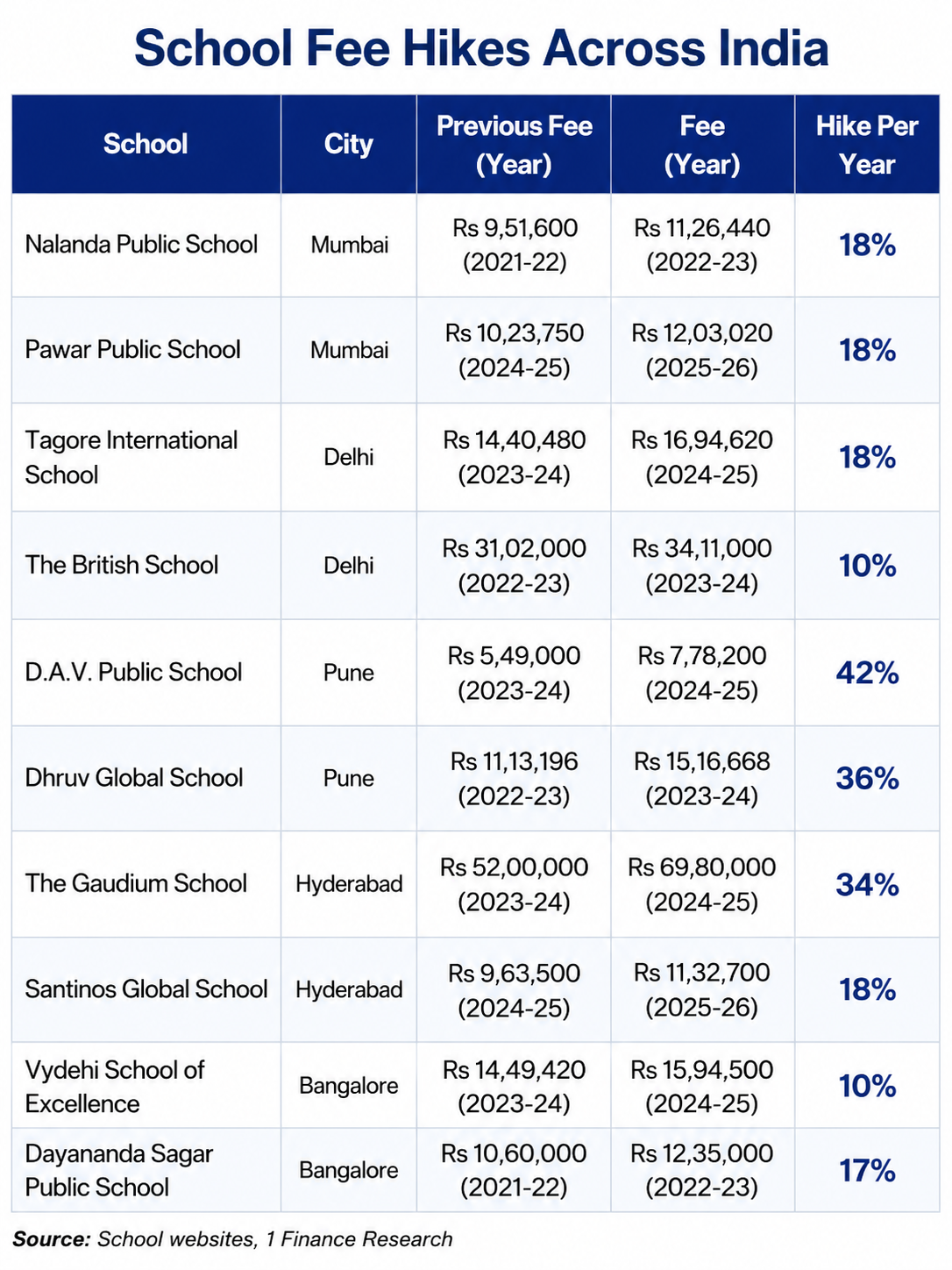
The report contrasts these rising costs with income data, revealing the depth of the financial burden. An average urban couple in Maharashtra earns about Rs 5.4 lakh annually, or roughly Rs 45,000 per month. In comparison, nursery fees alone in a mid-range Mumbai school can exceed Rs 1.13 lakh per year—accounting for over 20% of a family’s yearly income. Over time, the total cost of schooling in a mid-tier institution can exceed three times a couple’s annual earnings.
Experts warn that official inflation metrics significantly understate the issue. While government data places education inflation at 3–6%, actual fee increases suggest a much higher rate. “There is a silent financial drain happening,” said Animesh Hardia, SVP – Quantitative Research at 1 Finance. “Parents rarely question rising fees, and schools continue to increase them knowing families are reluctant to disrupt their children’s education.”
The report concludes that India’s education cost crisis is structural rather than temporary. With fees rising steadily, incomes lagging behind, and uncertain returns in terms of employment outcomes, families are increasingly forced to dip into savings or take on debt to fund education. It advises parents to approach education spending with the same scrutiny as any major financial investment, emphasizing the need to balance institutional reputation with actual skill outcomes.
The findings underscore a growing concern across urban India: quality education is becoming an increasingly expensive and potentially unsustainable aspiration for middle-class families.










Add comment