






Gateway House think tank promoter
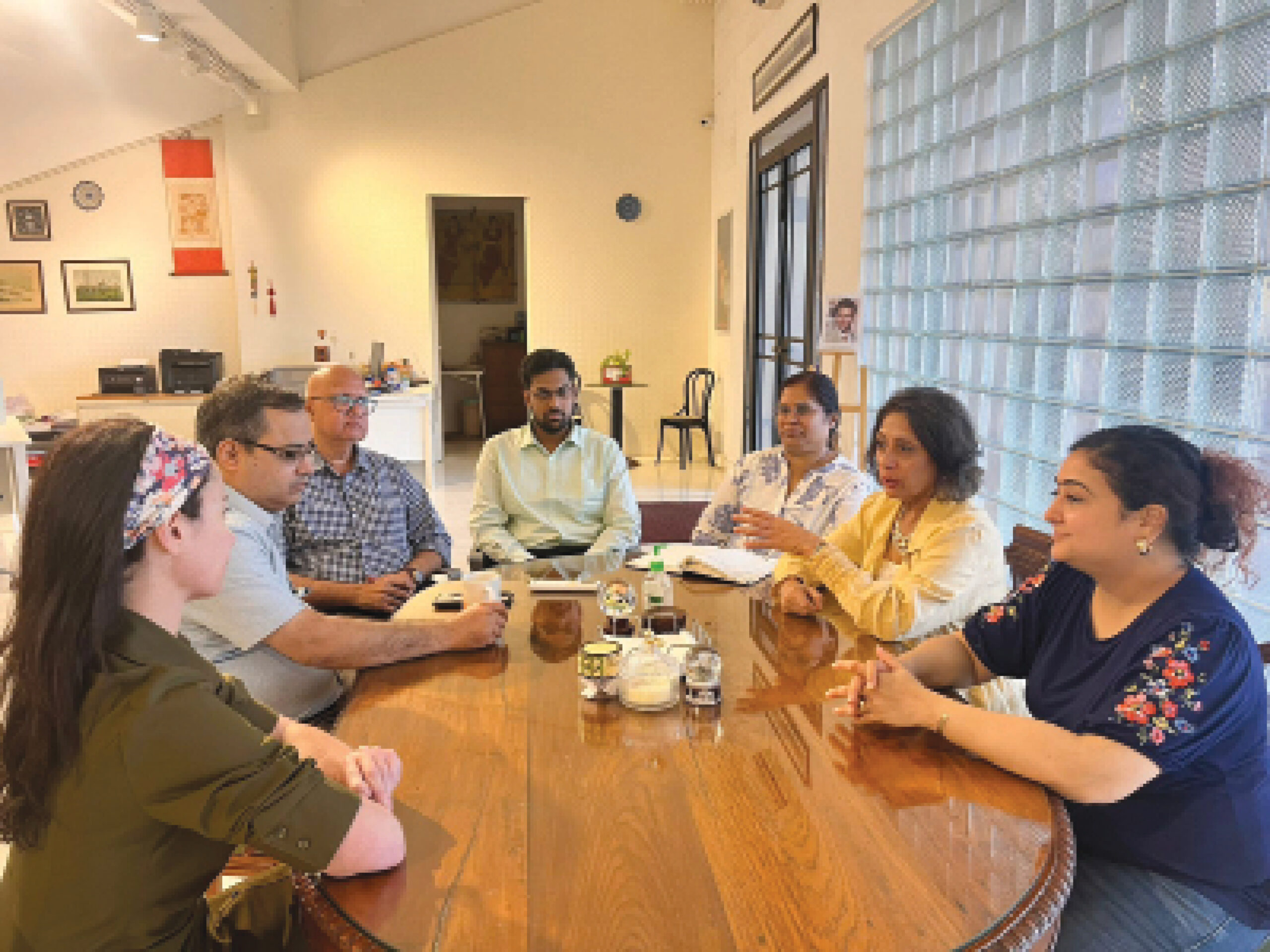
Kripalani (second right & inset): foreign policy scholarship & debate focus
Manjeet Kripalani is Co-founder and Executive Director of Gateway House (GH, estb.2009), a Mumbai-based foreign policy think tank. Over the past 16 years, the “independent, non-partisan and membership-based” GH has evolved into an internationally respected India-focused foreign policy think tank. Its 12 scholars and fellows have published over 100 research papers, over 2,200 articles, 100 infographics covering geopolitics, global trade and investment, energy security, connectivity and international space, science and technology, several of which have won international recognition and moved the needle of public opinion. In the University of Pennsylvania’s annual global think tank rankings, GH is ranked among the Top 100 (#95) globally and #26 in Asia.
Newspeg. On March 11, Gateway House celebrated its 17th anniversary.
History. An English and law graduate of Elphinstone College and Government Law College, Mumbai, Kripalani pressed on to acquire a Master’s in international affairs from the top-ranked Columbia University, New York. After practising law for two years in Mumbai, she switched to business reporting. This started a 25-year distinguished career in journalism during which she served with BusinessWorld (India) and the US-based business magazines Worth, Forbes and BusinessWeek, serving with the latter as India Bureau chief for 14 years (1996-2009). While working with Forbes in 1995-96, she also served as deputy press sec-retary to American publisher-businessman Steve Forbes when he made his first run for the White House. In 2006, while she was Bureau chief of BusinessWeek, she was awarded the Edward R. Murrow Press Fellowship by the Council on Foreign Relations, New York.
“A fellowship at the Council on Foreign Relations re-ignited my interest in global geopolitics, strategic affairs, and the role of independent think tanks in shaping India’s foreign policy. This was the inspiration behind the establishment of Gateway House with the mission statement: “to engage India’s leading corporations, financial institutions and individuals in debate and scholarship on India’s foreign policy and expand the nation’s role in global affairs,” says Kripalani, who acknowledges initial funding support provided by the Mahindra Group and business leaders Mohandas Pai, Venu Srinivasan and Rakesh Jhunjhunwala to kickstart GH operations.
According to Kripalani, GH is perhaps the sole foreign policy think tank worldwide started by two women — Neelam Deo, former Indian Ambassador to Denmark, and herself and the only foreign policy think tank in India not based in Delhi.
Direct talk. “Since commencing operations in a donor’s parking lot in Mumbai, Gateway House has come a long way. It is now globally respected as one of India’s leading think tanks for its thematic research in geoeconomics, global financial governance, energy, climate change, space, terrorism, non-conventional security including data and cyber, legal and regulatory research and geographic focus on Asia and Africa. In education specifically, our scholars have made a case for India to introduce post-study work visas for foreign students on completion of higher study programmes in India. This is important because foreign graduates who work in India will develop connections and contacts in Indian industry, transform into India’s ambassadors when they return home and boost India’s foreign trade,” says Kripalani.
Future plans. With GH having established its credentials as one of India’s most respected foreign policy think tanks, Kripalani is optimistic about expanding its global impact. “We will continue to convene and host Track 1.5 dialogues, bringing together government representatives in their professional capacities and inde-pendent experts to explore policy solutions in informal yet policy-relevant settings. Now we intend to focus our research substantially on Asia — South, East, West, Central — and ASEAN nations. Improved relations with our neighbours is critical for India’s strategic, economic, and geopolitical interests,” says Kripalani.
Wind beneath your wings!











Add comment