






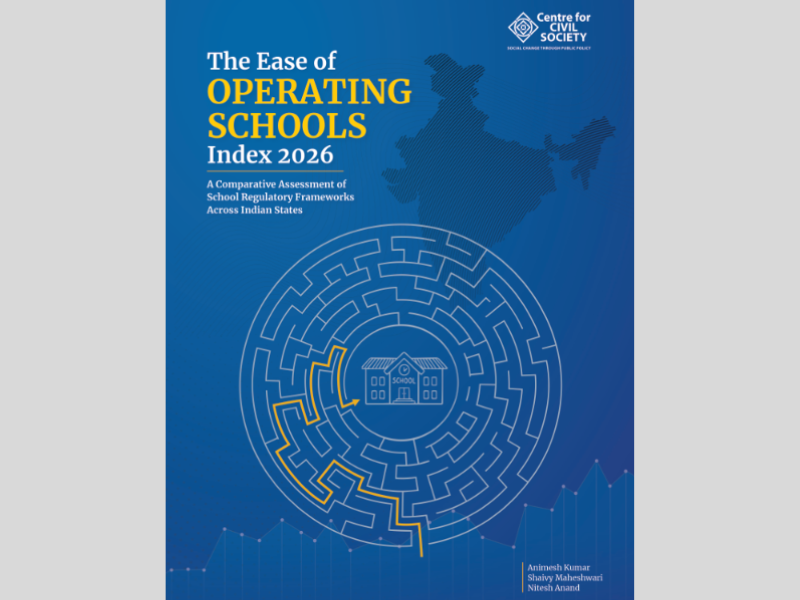
India’s first Ease of Operating Schools Index highlights regulatory gaps
A new report by the Centre for Civil Society has introduced the Ease of Operating Schools (EoOS) Index 2026, the first comparative assessment of the regulatory environment governing private unaided schools across 28 states and two Union Territories.
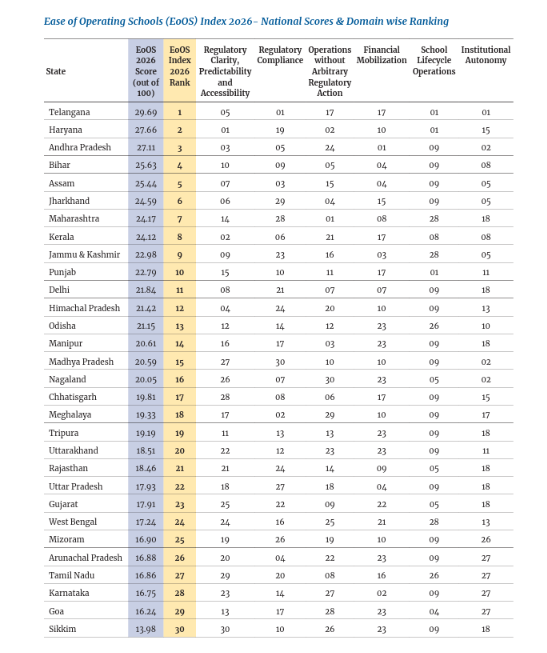
The Index evaluates six areas of school governance, including regulatory clarity, compliance, financial sustainability, institutional autonomy, school lifecycle operations, and protection against arbitrary regulatory action. Rather than measuring educational outcomes, it examines the regulatory conditions under which schools operate.
The report finds that while many states have improved regulatory clarity and formalised procedures, significant gaps remain in financial sustainability, institutional adaptability and school autonomy. It notes that regulatory systems are generally stronger in enforcing compliance than enabling schools to respond to changing educational needs.
The report identifies three key challenges: limited support for financial sustainability, weak mechanisms for institutional adaptation, and restricted decision-making autonomy despite increasing accountability requirements.
It recommends reforms that prioritise regulatory clarity, predictability, transparency, neutrality and long-term sustainability. The report states that these principles are consistent with the National Education Policy 2020, which advocates transparent governance and “light but tight” regulation.
Also Read: Government schools lose 86 lakh students as private school enrolment rises: UDISE Report








Add comment