






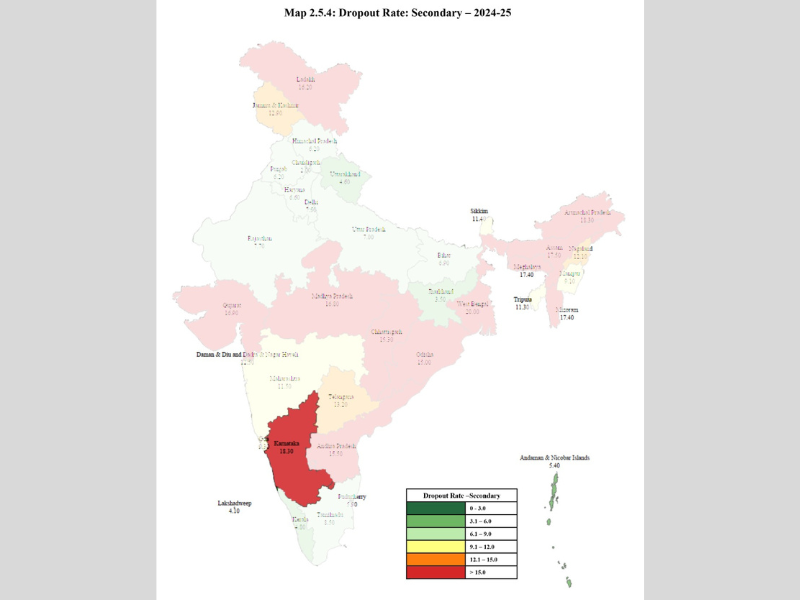
UDISE+ report: Karnataka has the highest dropout rate in secondary education in India
– Reshma Ravishanker
Karnataka has topped the list of states with the highest dropout rates in secondary education in the country according to the Unified District Information System for Education Plus (UDISE+) reports for 2025-26, which was released on Wednesday.
Karnataka reports a dropout rate of 18.1 in the Secondary education grades (grades 9-10), a rate that is nearly twice that of the national average at 9.5. Incidentally, against common belief that girl students discontinue education early, the dropout rates is higher among boys at 22 as against 13.9 among girls.
The UDISE+ report, however, indicates that there are zero dropouts in primary grades between classes 1 and 5. This increases to 1.2 in upper primary (lower than a national average at 3.6). However, the sudden decline happens in secondary grades.

The report indicates that states which are usually considered educationally backward such as Bihar (9.0), Madhya Pradesh (13.0), Rajasthan (8.8) and Uttar Pradesh (8.4) have outperformed Karnataka.
Even as per the UDISE+ report of 2024-25, Karnataka has topped the list at a dropout rate at secondary education of 18.3. National average was lower at 11.5.
“Declining enrolment is also a demographic phenomenon, particularly at the secondary level. One important reason is that once children turn 14, employers are no longer penalised for hiring them, as the Child Labour Act primarily covers the 6–14 age group. One important reason is that after children turn 14, they can legally be employed in many non-hazardous occupations, as the Child and Adolescent Labour Act prohibits employment below 14 years but allows adolescents (14–18 years) to work in non-hazardous sectors. This creates a greater risk of adolescents leaving school for work, particularly in small businesses and the retail sector. If we are serious about universalizing secondary education, we need to extend these protections and policy focus at least up to the age of 16,” said Prof A S Seetharamu, former professor of education, Institute of Social & Economic Change, Bengaluru.
Nagasimha G Rao, a Bengaluru-based child rights activist said, “This is a serious concern. One of the main reasons for dropouts is that the 25% RTE quota ends, after which many families cannot afford school fees. There is also no clear government notification extending RTE support for SC/ST students to Classes 9 and 10. Schools lack counsellors to address adolescents’ psychological needs at a stage when many are drawn towards earning alongside their peers. There is also inadequate access to sports and extracurricular activities that promote physical and mental well-being. NGOs are not sufficiently involved in bringing dropouts back, with the education department working largely in isolation. The lack of residential facilities and transport makes it difficult for children to attend distant government schools. Finally, poverty has become normalised after the COVID-19 pandemic, and there is no effective system to track migrant children and ensure they continue their education.”
Also Read: Government schools lose 86 lakh students as private school enrolment rises: UDISE Report











Add comment