






Karnataka: Smartphone ban proposal
– Reshma Ravishanker (Bengaluru)
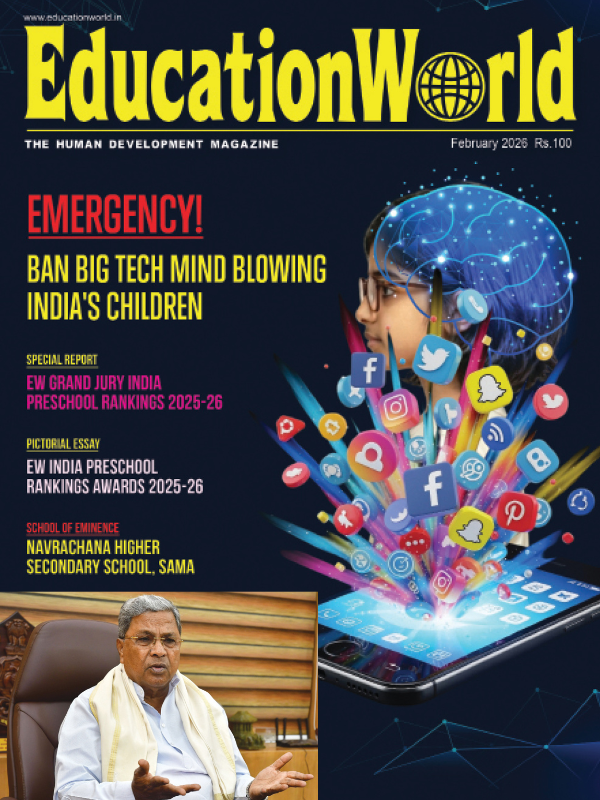
Days after the economic survey 2025-26, released on January 31 by the Union finance ministry, warned of rising “digital addiction undermining children’s cognitive and social development,” and EducationWorld published a cover titled ‘Emergency! Ban Big Tech from mind-blowing India’s children’ (February), the Karnataka state government has announced intention to constitute an expert committee to frame a policy to regulate children’s digital screen usage. The committee’s brief is to assess the feasibility of banning mobile phone use by children under-16 years and/or restricting their access to social media platforms and inappropriate online content.
Addressing a meeting of university vice chancellors on February 22, Chief Minister Siddaramaiah sought their opinion about imposing a blanket ban on mobile phone usage by children and early teens. A day later, Deputy Chief Minister D.K. Shivakumar affirmed that the state government is seriously weighing a ban on mobile phone use by school students, because of its adverse impact on students’ academic performance and mental well-being and “sustained pressure from parents”.
In 2024, Australia became 21st century’s first nation to enact legislation banning social media access by children below 16 years. Its Online Safety Amendment (Social Media Minimum Age) Act, 2024 imposes a legal obligation on social media corporations including Meta, Google, X (formerly Twitter), Snap Inc, Byte Dance among others, which own and operate Internet enabled instant connectivity social media platforms including Reddit, X, Facebook, Instagram, Snapchat, Kick, Threads, YouTube, Twitch and TikTok, to ensure that children below age 16 are denied access to them. Companies that fail to prevent under-16s from starting accounts are liable for penalties of up to Australian $49.5 million (Rs.318 crore). Following Australia, several other countries, including France and Spain, have approved similar legislation.
As detailed in EducationWorld’s February cover feature, there’s a wealth of evidence indicating that distracting children and teens from academic studies apart, social media addiction is exposing them to cyberbullying, grooming/online predation, harassment, and harmful or age-inappropriate content, negatively impacting their mental health and wellbeing, triggering anxiety, depression, sleep disruption, and body image issues.
Currently, the “bringing and use of mobile phones by children” is banned in all the state’s 56,319 government and aided schools during school hours. Ditto, in the overwhelming majority of private schools, with some international schools being exceptions. Although private school associations in the state have welcomed the government’s proposal restricting mobile phone usage by children, they believe that an outright ban is not feasible, as it will be difficult to enforce at home beyond school hours.
“Mobile phone usage by children is not allowed in government and most private schools during school hours. The real problem is regulating children’s digital screen time at home. Announcing a ban is useless unless we make it legally binding on social media companies to ensure children don’t access their apps,” says D. Shashi Kumar, general secretary of the Associated Managements of Primary and Secondary Schools (KAMS).
According to Kumar, KAMS has submitted a proposal to the state government to “regulate” instead of “ban” mobile phone usage by children. “According to Pratham’s Annual Status of Education Report 2024, 82 percent of children aged 14-16 have access to smartphones. Therefore, it’s not feasible to totally ban them as digital access has become integral to education and governance. We have suggested to the government to introduce government-regulated student internet packs that limit online access to educational content during school hours and a full ban on smartphones within school premises while permitting basic phones for safety. However the onus of ensuring that children and teens don’t access social media must shift from schools and parents to multinational corporations that own and operate social media platforms,” says Kumar.
In our cover story last month, your editors made a strong case for India enforcing an Australia-like ban on social media access by children below 16 years, contending that the onus of compliance should be upon big tech corporations legally mandated to use robust latter-day technologies such as age estimation face scans and ID checks before permitting individuals to sign up as subscribers. India’s recently enacted Digital Personal Data Protection (DPDP) Act, 2023 does not adequately regulate social media usage by children.
The Karnataka government’s initiative to protect children against social media addiction is a belated step in the right direction. But it’s a moot point when the step will break into a run.










Add comment