






Karnataka: Vanishing faith
– Reshma Ravishanker (Bangalore)
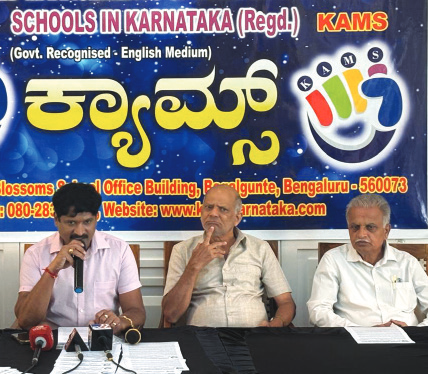
Shashi Kumar (left): indirect Hindi imposition
In mid-May, the delhi-based central Board of Secondary Education (CBSE), India’s largest national school exams board which has 30,000 affiliated schools countrywide including 1,300 in Karnataka, generated panic when it directed all affiliated schools to implement a new three language policy. Under this policy, all class IX and X students must study three languages, two of which have to be “native Indian languages”.
This out-of-the-blue circular to be implemented from the start of this academic year (July) has prompted anxiety within school managements, parents and students because it compels many students already studying foreign languages such as French or Spanish to switch midstream to learning an Indian language instead. This has generated academic disruption, timetable challenges, teacher shortage and a scramble for Indian language textbooks. Unsurprisingly the directive has been promptly challenged in the Supreme Court, which is currently hearing petitions against its implementation.
Even as the state’s 1,300 CBSE affiliated schools are grappling with implementation of the board’s new three languages learning diktat, publication of a new class VI textbook in Kannada — the official language of Karnataka — by the Delhi-based National Council of Educational Research and Training (NCERT), promptly prescribed by CBSE, has sparked a major controversy. Educationists in the state are objecting to its title and content.
The Kannada language textbook, released in June under NCERT’s National Education Policy (NEP) 2020 curriculum rollout, has raised the hackles of education activists in Karnataka because according to them, the title ‘Krishna’ is driven by ideological and religious intent. The state’s People’s Alliance for the Fundamental Right to Education (PAFRE) has accused CBSE of prescribing a textbook propagating hindutva in a secular country.
In this context, it’s pertinent to note that NCERT and CBSE are subsidiaries — “willing handmaidens” — of the Union education ministry ruled by Dharmendra Pradhan, a former pracharak of the Rashtriya Swayamsevak Sangh (RSS), the ideological mentor of the BJP/NDA government. Over the past decade, the BJP government has already prompted NCERT to infuse school textbooks with hindutva ideology and mythology. NCERT has reportedly made 1,334 corrections in 182 textbooks excluding all reference to the Mughal dynasty which ruled over the Indian subcontinent for over two centuries (1526-1757). This tampering with history and infusion of hindutva ideology and mythology into school and official texts has been continuously criticised by the opposition left-of-centre Congress party. Since 2023 Karnataka has been a Congress-ruled state.
Criticism of the class VI textbook extends beyond its title, alleged to be inspired by Hindu god Krishna. A chapter on healthy diet has also come under scrutiny for describing a balanced diet as comprising solely of milk, fruits, vegetables, greens and nuts, and omitting references to non-vegetarian proteins such as eggs, fish and meat. Critics allege this recommendation ignores the diverse food traditions of Karnataka, where non-vegetarian diets are common across many communities. Left liberal activists have also criticised the text for ignoring the culture, folklore, literature and traditions of coastal Karnataka, Malnad, north Karnataka and old Mysore region.
NCERT responded to the criticism with a public statement posted on X: “NCERT has named its language textbooks after rivers of India. The name “Krishna” is named after the river Krishna. The Hindi textbook has been named ‘Ganga’, the English textbook has been named Kaveri, and the Urdu textbook has been named ‘Jamuna’ (Yamuna).”
Beyond the ‘inappropriate’ textbook content, CBSE-affiliated school leaders — who unquestioningly prescribe NCERT textbooks — in Karnataka are confused about prescribing NCERT’s new Kannada textbook as a third language text as it clashes with the state government’s language policy. Under Section 3 of the Kannada Language Learning Act, 2015, Kannada has to be offered as either the first or second language from classes I-X in all government and private schools statewide — including CBSE and CISCE schools. “Kannada cannot be the third language in Karnataka. It has to be the first or second language as mandated by state legislation. Moreover, CBSE’s new language policy is unscientific. Earlier, students had the flexibility to choose languages. Now, two Indian languages have been made compulsory, reducing that flexibility. Since English is being considered a foreign language by CBSE, students cannot learn any other foreign language. The new CBSE language framework restricts students’ choices and indirectly imposes Hindi upon them,” says D. Shashi Kumar, General Secretary of Associated Management of Primary and Secondary Schools in Karnataka (KAMS) which has over 5,000 member schools.
As we go to press, CBSE has issued a clarification that students currently enrolled in classes IX-X can continue with their existing language choices, while the revised three-language policy will apply to students from class VI onwards. This clarification has done little to assuage students and parents’ anxiety in CBSE-affiliated schools. They contend that the board’s hastily implemented three language policy is inherently flawed. Since the massive OSM (On-Screen Marking) scam, parents’ faith in capability of CBSE to smoothly, fairly and transparently implement new initiatives is rapidly eroding.








Add comment