






West Bengal: Frying pan to fire
– Baishali Mukherjee (Kolkata)
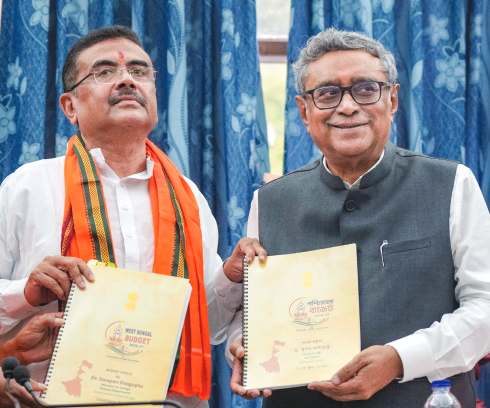
Swapan Dasgupta (right) with CM Suvendu Adhikari
The political landscape of west Bengal experienced a historic shift on May 4, when the Bharatiya Janata Party (BJP) won 207 seats in the state’s 294-member Legislative Assembly. This sweeping electoral verdict has transferred power to a right wing party for the first time in West Bengal (pop.102 million) which hitherto had a nationwide reputation for secular left-of-centre liberal values.
Starkly reminiscent of 2011 when the Trinamool Congress party ended 34 years of leftist rule led by the Communist Party of India-Marxist (CPM) with the promise of radical poriborton (change), West Bengal’s first-ever BJP government has started its innings with a flurry of populist promises. In its very first Rs.4.38 lakh crore budget presented to the assembly on June 26 by the Oxford-educated Swapan Dasgupta — arguably the most articulate defender of the BJP government at the Centre — the government has made a provision of Rs.55,376 crore for education. The department of school education is allocated Rs.44,948 crore, equivalent to 10.26 percent of the total expenditure budget. This represents an 11 percent increase over the allocation for education by the previous TMC government (Rs.49,999 crore).
With this modestly larger (after adjusting for inflation) education budget, Dasgupta promises to fill 50,000 vacant posts of teachers and education staff in 84,000 government schools, reserving 33 percent of these seats for women; promote a greenfield Indian Institute of Technology (IIT) and Indian Institute of Management (IIM) in North Bengal; upgrade Jadavpur University into an ‘Institute of Excellence,’ with the Union government contributing Rs.1,000 crore and the state Rs.250 crore.
Yet even as monitors of the education sector in Bengal welcome the seemingly serious intent of the state’s first BJP government to put the education system, ruined by repeated teacher recruitment, exam papers leakage and other scams in K-12 education back on track, there’s a current of apprehension sparked by the well-known proclivity of BJP administrations at the Centre and BJP-ruled states to silence dissent, target academics and opposition voices. On May 12, Garga Chatterjee, a Harvard educated professor at the Indian Statistical Institute, Kolkata, and founder of Bangla Pokkho, a Bengali Nationalistic Organisation, was arrested for social media posts challenging accuracy of electronic voting machines. Likewise, two young YouTubers from Murshidabad’s Domkal area were apprehended on May 17 for uploading videos criticising the new state government, and two online content creators were arrested on May 13 for allegedly uploading a critical video clip targeting new Chief Minister Suvendu Adhikari.
Moreover in accordance with hindutva tenets, the new government has removed eggs from the free-of-charge mid-day meal scheme for children in government nurseries and primary schools. In a predominantly non-vegetarian state, the contract for mid-day meals provision to 1,800 schools in Kolkata has been given to ISKCON, which provides satvik vegetarian meals.
With the state’s education system having suffered continuous infiltration of under-qualified party apparatchiks during 34 years of Communist rule followed by teacher recruitment scams during 15 years of Trinamool Congress when the multi-crore School Service Commission “cash-for-jobs” scam resulted in the eventual judicial scrapping of 25,735 teacher appointments, the government school system in Bengal is broken. The number of single-teacher primary schools has rocketed to 6,845, and 1,362 upper primary schools have shut down due to zero or low enrollment.
In higher education, the negligence of predecessor governments has also triggered a crisis. Due to prolonged administrative delays, glitch-prone centralised portals, and unresolved caste reservation disputes, a staggering 70 percent of seats in undergrad colleges were vacant in 2025, with even prestigious institutions like Jadavpur University seeing application numbers plunge by half.
Instead of addressing this structural crisis, the new BJP government has prioritised policing school menus and introduced the draconian Public Safety Act 2026 to silence criticism.
Comments New York-based educationist and human rights activist Dr. Partha Banerjee, who frequently visits Bengal: “This systematic assault reveals that the BJP offers zero sanctuary for a population that values liberal thought and academic capital. Look at BJP-ruled Uttar Pradesh, where aggressive school mergers and closures have effectively privatised public education, pricing out poor, rural children. For West Bengal, this is an ominous warning. When centralised authoritarianism collides with rosy budget promises, the ultimate burden will be shifted onto the public education system, deepening the state’s generational collapse.”
For West Bengal, which until the mid-1960s was an intellectual powerhouse widely admired for its progressive education system, the arrival on the scene of a new BJP government doesn’t augur well for human capital development.









Add comment