






Madhya Pradesh: Shocking neglect
– Nitin Konde (Bhopal)
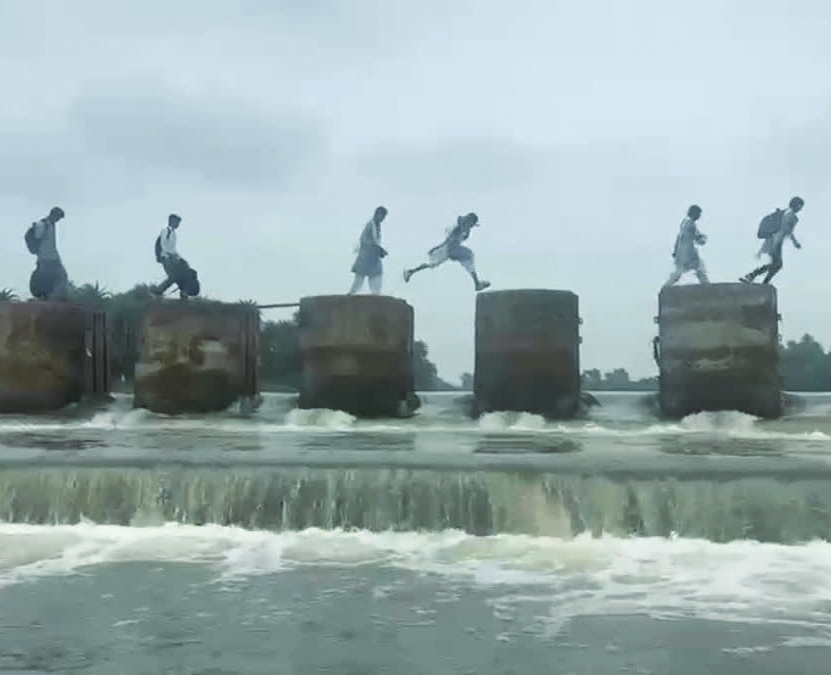
Children accessing school: seared conscience
Barely a few days after india celebrated its Independence Day, photographs and social media video reels of tiny primary school girls and boys leaping from the remaining pillars of a destroyed bridge over the surging River Betwa, a mere 60 km from Bhopal, the admin capital of the central India state of Madhya Pradesh (MP, pop. 72.6 million as per census in 2011) to attend school outraged and seared the conscience of the nation. It also gave legitimacy to the newly-born Cockroach Janata Party (CJP) which forced the resignation of Union education minister Dharmendra Pradhan on July 25 for languidly presiding over public examination question paper leaks and other scandals. Currently, CJP is orchestrating a national ‘School Thik Karo’ (Mend Schools) campaign (see p.184).
According to residents of the Kirmichi Bandhera, Jiwajipur, and Mundra Harisingh villages, primary children have been using the dangerous Betwa crossing for over five years as their only practical route to a working primary school. The alternative road route requires a 8-10 km journey on a rickety, unreliable public transport system. The bravery of tiny children and their determination to acquire foundational education has dramatically exposed the neglect of public (government) school education in Madhya Pradesh — India’s largest state by territorial size (308,245 sq. km).
“The fundamental duty of government is not only to establish schools but also to ensure that every child has a safe route to reach it. In rural India, I have witnessed how geography, poverty, inadequate infrastructure limits children’s education. Weak foundational learning accumulates over time, making it difficult for children to understand higher-level concepts in mathematics, science, and language. Therefore, there is no option other than government to enhance its budgetary outlay for school education to make good the infrastructure deficiencies that make accessing school a life-threatening adventure for little children. The photograph of children jumping from pillar to pillar of an unrepaired bridge is a national disgrace and has gravely damaged MP’s and India’s reputation,” says Dr. Chandan Kumar, an agro-scientist at the Krishi Vidya Kendra, an ICAR-linked extension centre in Jhabua, MP.
These horrifying photographs/reels of children risking their lives to access schooling is the consequence of successive Congress and BJP state governments dominated by traditional rural gentry having severely neglected rural primary-secondary education for the past eight decades. The Annual Status of Education Report (ASER) 2024 (the latest rural schools learning outcomes report) of the independent Pratham Education Foundation which tests children’s learning outcomes at home (not in classrooms) reports that 57 percent of class V children in MP’s rural schools cannot read class II textbooks, and only 21.7 percent can solve simple division sums. Even in class VIII, only 38 percent of children can solve elementary division sums. Unsurprisingly, in the newly introduced SEDI (School Education Development Index) 2025-26 painstakingly compiled by Prof. Arun C. Mehta, former professor at the Delhi-based National Institute of Educational Planning & Administration (NIEPA), MP is ranked #25 (of 29 states) for primary education and #28 for secondary.
Although MP’s finance minister Jagdish Devda took great pride in announcing that in the state’s budget 2025-26, the outlay for education crossed the Rs.4 lakh crore mark for the first time at Rs.44,826 crore, it adds up to barely 10.65 percent of the total budget of Rs.421,032 crore cf. the 14.5 percent average for all states.
“The Madhya Pradesh government’s outlay for education infrastructure development has consistently been too meagre for a population of 80 million. Most of taxpayers’ money is wasted as revenue expenditure. That’s why the phenomenon of little girls risking their lives every day to access schooling. The grim reality is that even after they get to school at risk of life and limb, they have to suffer multi-grade classrooms, poor quality teaching and rock bottom learning outcomes. All state governments should immediately raise their annual education outlays to 20 percent of budget as is the norm in most developed countries,” says Prof. R. Govinda, former Director of the NIEPA.
The state’s BJP government now in its third five-year term likes to proclaim record GSDP growth and a ‘Developed Madhya Pradesh 2047’ vision in expensive full-page ads in national dailies. Yet photographs of tiny children timing their jumps between slippery dam pillars is a stark rebuttal of the official narrative. The government’s swift damage-control response — bicycles, a promised bridge, an upgraded school — shows the solutions are neither expensive nor complicated. The harder question is why it so often takes a video going viral, rather than an ordinary budget line or a district survey, to get them implemented.









Add comment