






West Bengal: JU under siege
– Baishali Mukherjee (Kolkata)
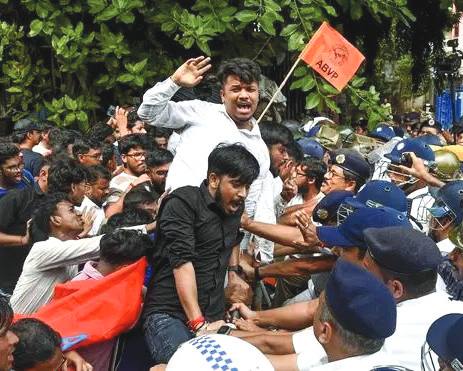
Stand-off at Jadavpur University: no charges filed
Far from rescuing the revered Jadavpur University (JU, estb.1955), already compromised by decades of political interference and corruption, West Bengal’s newly-elected BJP (May 4) government has added fuel to its simmering fires.
On the night of August 19, following a dispute over a late-night Faculty of Engineering Students Union (FEISU) General Body Meeting — which the Akhil Bharatiya Vidyarthi Parishad (ABVP), the students’ wing of the BJP, opposed due to long-overdue union elections, but student organisers defended as legitimate — a mob of 100 people, mainly ABVP activists and local right-wing supporters, rioted on campus desecrating Jadavpur University’s prized Shatadal emblem — crafted by Nandalal Bose, the artist who illustrated India’s Constitution — terrorised students and vandalised JU’s 58-acre campus. Police controlled by Chief and Home Minister Suvendu Adhikari arrived the next morning. A few ABVP and Left union students were detained and soon released. No charges were filed.
“JU’s legacy of fiercely independent dissent makes it a target for authoritarian control. The violent midnight assault — defined by physical brutality and desecration of the iconic emblem — was an attempt to shatter the university’s soul. This was no local clash; it was a calculated assault by ABVP outfits to terrorize political opposition, dismantle academic autonomy, and force even the nation’s top institutions into submission,” says Srijan Bhattacharyya, state secretary of the CPM (Communist Party of India-Marxist)-affiliated Students Federation of India.
Alarmed educationists in Kolkata opine that destruction of JU’s academic autonomy, and curbing its tradition of free speech and debate on campus was a long-running project of the previous three-term (2011-2026) Trinamool Congress (TMC) government, whose Chhatra Parishad wing also did its darndest to upend the elected, officially recognised SFI which has been representing JU students since 1971. Despite the state government-funded JU being the best of a bad lot on West Bengal’s chaotic higher education scene, ruined under 34 years rule (1977-2011) of the CPM-led Left Front government which infiltrated the academy with ill-qualified party comrades, and subsequently by the TMC government (2011-2026), it has demonstrated resilience and academic excellence. In the EW India Higher Education Rankings 2026-27, JU is ranked #3 among all government multi-disciplinary universities countrywide. In the Union government’s NIRF, JU is ranked India’s #1 state university and in the QS World University Rankings 2026, JU is ranked in the 721-730 band.
Yet because of TMC neglect and BJP hostility, JU faces crippling budget deficits, crumbling infrastructure, and frozen development plans. The crisis is the outcome of a protracted funding deadlock between successive Central and West Bengal governments. The single largest financial blow to JU’s growth plans was formal loss of the Institute of Eminence (IoE) status in March 2025, which would have entitled it to a Rs.1,000 crore Central grant over five years and also greater academic autonomy. The university lost its IOE status because the state (TMC) government failed to guarantee matching grants. Moreover, the inflow of annual RUSA 2.0 grants to JU has been severely disrupted with a nearly four-year funding delay because of Central-state friction over utilisation certificates and disbursement channels.
Yet some of the wounds of JU are self-inflicted. Neither faculty nor students admit resource mobilisation failure by way of research grants, or students’ fees. The latter have remained nominal for several decades at Rs.1,500-2,400 per year and contribute less than 5 percent of the university’s budget cf. the global norm of 20 percent. As a result, nearly 35-40 percent of teaching and non-teaching posts are vacant.
“The endgame is clear: brand a world-class university as “anarchic,” starve its labs, freeze its governance, and unleash violence to transform a centre of critical thinking into a compliant degree factory. Institutions like JU attract right-wing wrath precisely because their resistance is intellectual, democratic, and unyielding. By questioning authority and defending pluralism, our students refuse to let state propaganda replace education,” says Manas Ghosh, Assistant Professor, Film Studies, at JU.
Ultimately, the convergence of physical intimidation, financial starvation, and structural paralysis reveals a total war on West Bengal’s higher education institutions. From the murder of a village elder demanding functional primary classrooms to mob violence tearing through the corridors of Jadavpur University, the objective is unmistakable: to replace public accountability with fear and transform theatres of debate and critical thinking into compliant, ideologically subservient institutions. Yet, this strategy miscalculates the resilience of the state’s intellectual heritage. The battle for Bengal’s classrooms and universities is not merely a struggle for infrastructure or grants, but a fight for the soul of institutions that have historically refused to surrender intellectual legacy to marauding hordes.









Add comment