






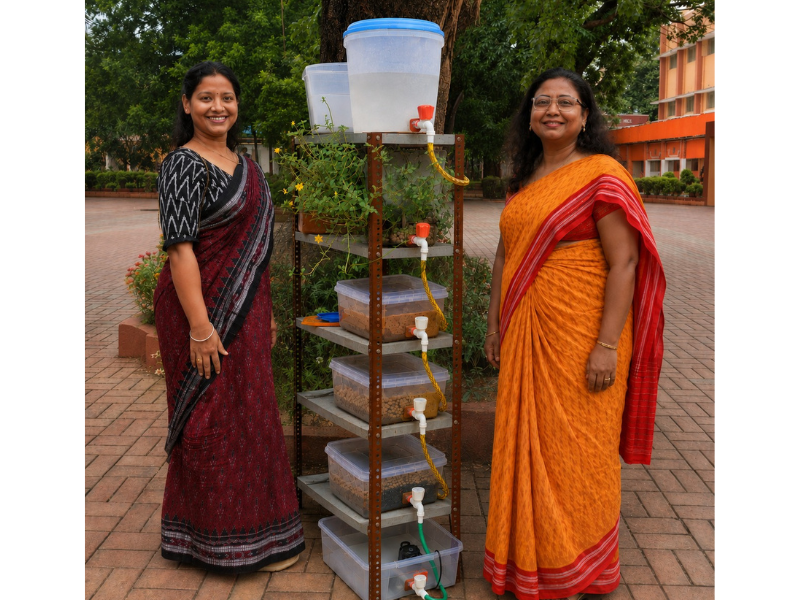
NIT Rourkela Women Scientists Secure Patent for a Low-Cost Dairy Wastewater Treatment System
Researchers from the Department of Civil Engineering at National Institute of Technology Rourkela have developed and patented an innovative low-cost system for treating dairy wastewater using a combination of earthworms, aquatic plants, microbial activity and hydroponic filtration. The sustainable treatment setup, designed by Prof. Kakoli Karar Paul and research graduate Dr. Pragyan Das, offers an eco-friendly alternative to conventional wastewater treatment systems, which often suffer from clogging and high operational costs.
The Indian dairy industry generates billions of litres of wastewater every day during the production of products such as cheese, paneer and yogurt. This wastewater contains high levels of fats, proteins and carbohydrates, resulting in elevated Chemical Oxygen Demand (COD), which can severely impact aquatic ecosystems if discharged untreated.
To address this challenge, the NIT Rourkela team developed a multi-layered treatment process integrating vermi-filtration, sand filtration, fly ash adsorption, gravel-based microbial purification and hydroponic treatment.
Speaking about the innovation, Prof. Kakoli Karar Paul said, “In a lab-scale setup, the developed system costs about Rs. 10,000 and is capable of treating 30 litres of dairy wastewater per day, which can be further increased as per requirement.” The treated water was found suitable for irrigation as it retains useful phosphate nutrients beneficial for agriculture.
Highlighting the wider impact of the system, Dr. Pragyan Das said, “We have developed an affordable wastewater treatment solution that can be easily used in regions where access to large-scale treatment infrastructure is either unavailable or limited.” He added that the treated wastewater can be reused for agriculture, promoting sustainable and resource-efficient waste management practices.
The researchers have secured a patent titled “Method and System for Treating Dairy Wastewater” and are now working on scaling up the technology while exploring industry collaborations for real-world deployment.
Also Read: Prayoga launches Anveshana 2026 research programme for school students











Add comment