






Nordic Region: Back to books and pens
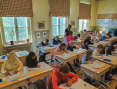
Swedish school children: dialing down digital education
When Cecilia Rosenbaum saw a book-spine staircase where the vertical part of each step was adorned with colourful stickers showing Peter Pan, Charlie and the Chocolate Factory and other titles of beloved children’s books, she decided to copy it for her school. The principal of Montessori Mondial Kungsholmen, a grundskola (mandatory nine-year comprehensive school), is on a mission to get her charges to read more. During break, books are brought out to the park in front of the school. Each day starts with 15 minutes of reading in class. One day a week the teacher reads aloud for everyone.
Once the country with the world’s highest literacy rate, Sweden’s reading standards have declined of late. In 2022 (latest available data) Sweden’s reading score in PISA, a worldwide study of 15-year-olds’ literacy and other skills, had fallen by 19 points over four years to 487. That compared with 516 for Ireland and 543 for Singapore, the top performer. “Around 25 percent of Swedish pupils struggle to read properly,” says Lotta Edholm, the higher-education minister. In her view this is “linked to an overreliance on digital tools without sufficient evidence of their effectiveness”.
Edholm is determined to dial down digital education. “Från skärm till pärm” (from screen to binder) is her centre-right government’s slogan for its “back to basics” policy to reduce the use of computers and tablets in favour of handwriting and old-school textbooks. In August this year mobile phones will be banned at all grundskolor. In 2023 the government launched an ambitious investment programme to reach its goal of providing one textbook per pupil per subject. So far, it has spent over SKr2 billion (Rs.2,058 crore) to bring back books and it will continue to invest in offline reading, handwriting and numeracy.
Others in Europe and America are engaged in a return to books and pens in schools, but none as quickly as Denmark, Sweden and Finland, countries that are otherwise enthusiastic adopters of digital technologies. Last year Finland, home of Nokia, one of the world’s mobile-phone pioneers, introduced strict restrictions for the use of mobile phones during school lessons for children aged 7-16. Denmark will follow this year with a law mandating a ban on phones and private tablets for folkeskole, primary and lower-secondary schools, up to the age of 16.
“It’s expensive to go back to books,” says Merete Riisager, a former Danish education minister. Denmark pioneered tablets at school from 2011, but provided teachers with little training. “Our teachers were at sea,” says Kara Barker-Astrom, the principal of Stockholm’s VRG Campus Viktor Rydberg, an upper-secondary school. The country has since come to regret its digital drive. Riisager reckons that tablets played a role in the deterioration of reading and maths skills of Danish pupils.
Barker-Astrom welcomes many of Edholm’s policies but warns against the pendulum swinging too far. Children older than 16 need to be able to use phones and laptops as the material they are studying becomes more complex and to prepare them with the digital skills that are required in university and the workplace. Even so, her school still switches off the internet during exams: the temptation to cheat, or scroll, is just too strong.











Add comment