






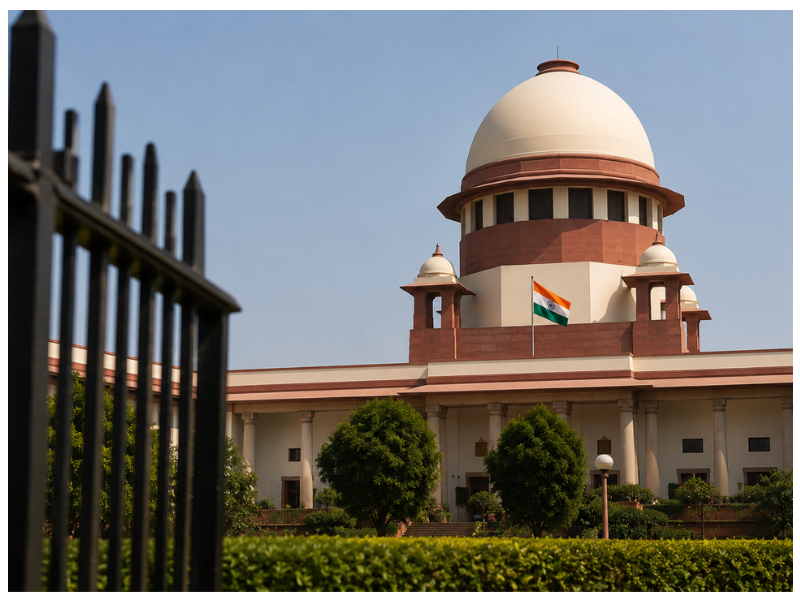
Supreme Court seeks accountability in NEET paper leak case
The Supreme Court on Friday stressed the need for accountability in the conduct of the National Eligibility cum Entrance Test (Undergraduate) (NEET-UG), observing that recurring issues would not end until responsibility was clearly fixed on individuals and institutions.
The court was hearing a batch of petitions, including one seeking the restructuring or replacement of the National Testing Agency (NTA), which conducts the medical entrance examination, with an autonomous body.
A bench comprising Justices P.S. Narasimha and Alok Aradhe said that incidents such as question paper leaks were traumatic not only for students but also for their families, who invest significant time and effort in the examination process.
“The real problem won’t stop till actual accountability arises,” the bench observed, adding that accountability becomes effective only when responsibility can be traced to specific individuals.
Solicitor General Tushar Mehta, appearing for the Centre, told the court that the government was taking the concerns of students seriously and had introduced new mechanisms for the NEET-UG re-examination scheduled for June 21. He said details of the measures could not be disclosed publicly as doing so might compromise their effectiveness.
Mehta informed the court that the examination process was being monitored at the highest level and said Prime Minister Narendra Modi was personally supervising efforts to ensure that there were no gaps in the system.
The bench cited the example of the Union Public Service Commission (UPSC), noting that examinations conducted by the commission had not faced similar paper leak controversies. It observed that institutions should be strengthened so that their functioning does not depend solely on individual officers.
The court said institutional capability, continuity of expertise and specialised personnel were essential to prevent such incidents from recurring. It also noted that many public institutions continued to function in an ad hoc manner.
Referring to affidavits filed before the court, the bench said it would continue monitoring the matter. The NTA’s Director (Legal) has submitted an affidavit in compliance with an earlier court order, while former Indian Space Research Organisation (ISRO) chairman K. Radhakrishnan, who heads the high-powered steering committee on NTA reforms, has also outlined the implementation of reform measures and future plans.
The court directed the Centre to file a detailed affidavit within six weeks explaining how examinations would be conducted and concluded in future years. It also sought details on measures to build institutional memory, maintain continuity of human resources and strengthen expertise within the NTA.
The bench said the objective was to ensure that the agency possessed the necessary physical and intellectual resources to prevent incidents similar to those witnessed in 2024 and 2026.
During the hearing, the court questioned how the latest failure had occurred despite recommendations made by the high-powered committee. It asked whether shortcomings in the original recommendations had prevented authorities from anticipating such a situation.
Responding to the court, Radhakrishnan said several recommendations had already been implemented. He added that the 2025 NEET-UG examination had been conducted largely without major issues, apart from isolated incidents such as power failures at some centres.
The NTA cancelled the NEET-UG examination conducted on May 3 following allegations of a paper leak and scheduled a fresh examination for June 21. The allegations are currently being investigated by the Central Bureau of Investigation (CBI).
The matter has been listed for further hearing in the second week of July.
Also Read: NEET-UG to be computer based from 2027, NTA tells SC









Add comment