






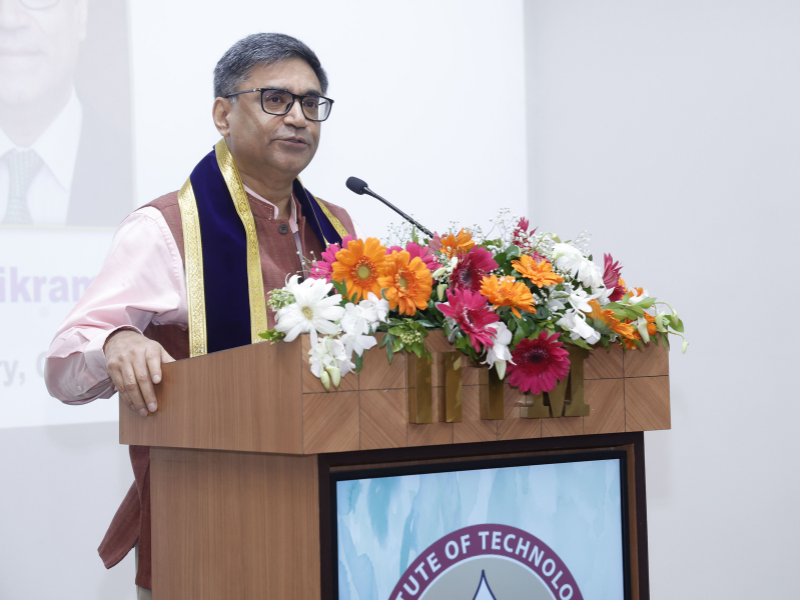
The world is waiting for you to innovate: Foreign secretary tells IIT students
India’s Foreign Secretary Vikram Misri on Thursday urged international graduates of the Indian Institute of Technology Madras (IIT-M) to play a leading role in shaping a rapidly changing and increasingly multipolar world, saying they hold “both the pen and the power” to redraw the global map of innovation and influence.
Addressing international students from the 2024 graduating batch during a degree distribution programme at IIT Madras, Misri said the pace of change in fields such as artificial intelligence, robotics, space systems and sustainable infrastructure was accelerating exponentially.
“The world is multipolar. It is no longer going back and forth between two poles. It is definitely young, and you represent that feature of the world,” he told the graduates. “The map of who got to shape the future was drawn in a few and limited set of rooms with a limited set of personalities participating. That map of the world is being redrawn. And you are among the people who hold both the pen and the power to redraw that map.”
Highlighting the emergence of new centres of technological innovation, Misri noted that fast-growing technology ecosystems were no longer concentrated in traditional hubs alone. “Nairobi has a technology hub that they call the ‘Silicon Savannah’. Bengaluru is one of the world’s foremost centres of software talent. Lagos, Accra, Cairo and Colombo are generating startups, patents, products and solutions at a pace that was unimaginable just two decades ago. The world is waiting for you to innovate,” he said.
A total of 46 international students from 12 countries received degrees across programmes including M.Tech, I2MP M.Tech, M.A., M.Sc., JMP KU-IITM M.Tech and IITM Zanzibar M.Tech. The graduating cohort included students from Nepal, Tanzania, Ethiopia, Somalia, Sudan, Uganda, Afghanistan, Rwanda, Liberia, Cameroon, the United States and India.
The graduates represented a broad range of disciplines, including Civil Engineering, Ocean Engineering, Mechanical Engineering, Chemical Engineering, Computer Science and Engineering, Aerospace Engineering, Physics, Chemistry, Humanities and Social Sciences, Data Science and Artificial Intelligence, and Energy Systems.
Speaking at the event, IIT Madras Director V. Kamakoti said the graduates would serve as ambassadors of collaboration between India and their home countries. “Unless we work together and forge strong partnerships among nations with the motto ‘One Earth, One Future, One Family’, the world cannot survive without collaboration and inter-dependence,” he said.
Kamakoti also highlighted the emphasis on internationalisation under the National Education Policy (NEP), saying students graduating from the institute would help strengthen global partnerships.
Dean (Global Engagement) Preeti Aghalayam said IIT Madras was steadily expanding its international footprint in line with its strategic plan and the goals of NEP 2020. She noted that around 150 students from 17 countries had been selected for Master’s and PhD programmes at the institute during the current academic year, while four students from IIT Madras Zanzibar were among those graduating.
The degree distribution programme was attended by faculty members, students, parents and representatives of the Office of Global Engagement, which oversees IIT Madras’ international collaborations and outreach initiatives.









Add comment