






Union Budget 2026-27: Mother Nirmala’s Bare Cupboard for Gen Alpha
A positive feature of the Budget is sustained investment in hard infrastructure, critical for stimulating ease of doing business. But it has to be complemented by commensurate investment in soft infrastructure — public education and health. Because roads, bridges, railway networks and digital infrastructure require competent engineers, skilled workers and innovative researchers to build, operate and maintain – Dilip Thakore
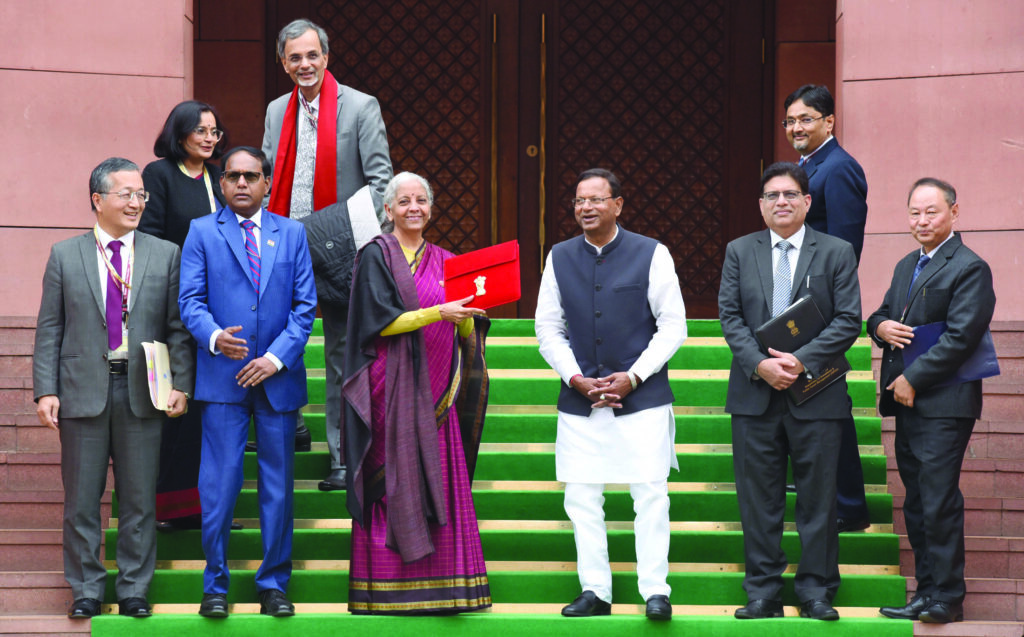
Finance minister Nirmala Sitharaman en route to present her ninth consecutive Budget: no breakthrough ideas
Within three weeks, if not three days, after the Union Budget 2026-27 was presented by long-tenured Union Finance Minister Nirmala Sitharaman on February 1, it has been forgotten. That’s because it is bereft of any big breakthrough ideas that can hoist the economy onto the double digit growth highway, a necessary precondition of achieving the Viksit Bharat and $30 trillion GDP goals set by Prime Minister Modi. Sitharaman seems unaware that because it was cabined, cribbed and confined under the yoke of socialism for almost half a century until the milestone economic liberalisation and deregulation of 1991, India’s real annual GDP growth rate has to rise above 10 percent to make up for the 3.5 percent growth averaged between 1947-1991. This static annual rate of growth plunged high-potential independent India into the ranks of the world’s poorest nations (per capita income: $2,600 cf. China’s $13,600 and USA’s $86,000).
Deriving comfort from a “high rate of (GDP) growth of around 7 percent”, Sitharaman said this has “helped us make substantial strides in poverty reduction and improvement in the lives of our people”. But although this rate of GDP growth is the highest of all major nations, as regularly trumpeted by Prime Minister Modi and leaders of the incumbent BJP/NDA government, voted into its third term in office at the Centre in 2019, some policy breakthroughs are necessary for the Indian economy, which grudgingly hosts the largest child and youth population worldwide (600 million citizens are under 24 years of age), to leapfrog onto the double digit growth highway. Unfortunately, Budget 2026-27 is bereft of any such ideas.
To be sure, there are some positive aspects of Union Budget 2026-27. First, there is continued emphasis on infrastructure-led growth. Building public infrastructure — high-speed highways, roads, bridges, rail connectivity — is of great importance as it improves ease of doing business. If corporates, farmers and an estimated 63 million MSMEs (micro, small and medium enterprises) can get their inputs quickly and are able to speedily dispatch their output to market, the entire economy will benefit. The BJP/NDA government’s sustained focus on building public infrastructure has yielded visible benefits. Expansion of highway networks, freight corridors, airport infrastructure, metro systems, and digital connectivity have improved logistics efficiency and reduced transaction costs across several sectors of the economy.
India’s relatively quick recovery from the economic disruption caused by the Covid-19 pandemic owes much to sustained public investment in public infrastructure. By continuing to prioritise capital expenditure even during periods of fiscal pressure, the government has ensured continuity in long-term infrastructure creation. Therefore, the budget’s provision of Rs.12.2 lakh crore (out of a total budget expenditure of Rs.53.2 lakh crore) for infrastructure capex reflects right priorities and good thinking. Provided the Central and state governments let businessmen, especially MSMEs, get on with their businesses without harassment from the neta-babu brotherhood (government officials). Government simultaneously needs to accelerate regulatory reforms to facilitate the ease of doing business for which despite liberalisation, India has a rock-bottom global reputation.
In this connection, it’s pertinent to note that industry and commerce continue to be governed by 860 Acts of Parliament and state governments, 1,450 filings and 8,600 compliances, with non-compliance often inviting jail terms. In her budget speech, the finance minister acknowledged the vital importance of MSMEs which employ 60 percent of the country’s industrial workforce and account for 45 percent of exports revenue, and has introduced several schemes towards “creating champion SMEs”.
Yet if she really wants to re-energise India’s 63 million MSMEs — it’s instructive to note that fast-track MSMEs are a prime factor behind neighbouring China’s emergence as the world’s manufacturing powerhouse — she should have resuscitated the forgotten single window clearance scheme for them. Doing so would shift the onus of getting MSMEs up and running in quick time and obtaining regulatory clearances from entrepreneurs and businessmen — who have to “run from pillar to post” to procure numerous clearances, permits and permissions from myriad government ministries and agencies — to bureaucrats. But there are no such breakthrough ideas in the Budget 2026-27. Without ease of doing business, sustained investment in building public infrastructure won’t result in sufficient bang for the buck.
Another positive feature of Budget 2026-27 is the finance minister’s evident effort to reduce the fiscal deficit, critical for containing inflation. In discharge of Sitharaman’s promise in previous budget speeches to progressively reduce it to 3 percent of the GDP as stipulated by the Fiscal Responsibility Act, 2008, it has been reduced to 4.3 percent of GDP from 4.4 in 2025-26. Although ex facie this seems a minuscule reduction, it must be borne in mind that the deficit of Rs.16.95 lakh crore is against a substantially higher GDP. Yet continuous reduction of the fiscal deficit from the Covid pandemic years reflects a sustained break from continuous deficit financing stretching back to the early 1950s which sent prices soaring and severely damaged the Indian economy.
However while incremental investment in hard infrastructure is critical for stimulating ease of doing business, it has to be complemented by adequate investment in ‘soft’ infrastructure — public education and health, aka human resource development. Construction and maintenance of roads, bridges, railway networks, power plants, and digital infrastructure require competent engineers, skilled workers, trained administrators, and innovative researchers to build, operate and maintain them. Without adequate investment in education and skills, infrastructure is not only in danger of damage and poor maintenance, it is inevitably under-utilised resulting in sub-optimal productivity and growth.
Economic Survey: sage advice ignored
Unfortunately, as repeatedly lamented by your editors, education and skills development has been a blindspot of post-independence India’s omniscient central planners and successive governments for more than half a century. Decades of neglect of education has cost the Indian economy dearly in terms of low farm, factory, government and judiciary productivity. The continuous imbalance between provision for hard and soft infrastructure — failure to break with the past — is also evident in Budget 2026–27.
The data-rich Economic Survey published every year by the Department of Finance of the Union finance ministry on eve of presentation of the Union Budget, is an invaluable document that reports on progress and performance in all sectors of the economy in the year past. The 687-page Economic Survey 2025-26 has this to say about the importance of education, especially K-12 education: “School education forms the foundation of human capital and is central to shaping the nation’s growth path towards Viksit Bharat @ 2047. Experiences from (sic) fast-growing Asian economies clearly demonstrate that consistent investments in education, skills development and technology can significantly enhance productivity, foster innovation and accelerate economic transformation. Strengthening school education today is not just a sectoral reform, but an investment in India’s future prosperity, productivity and leadership in the decades to come…”
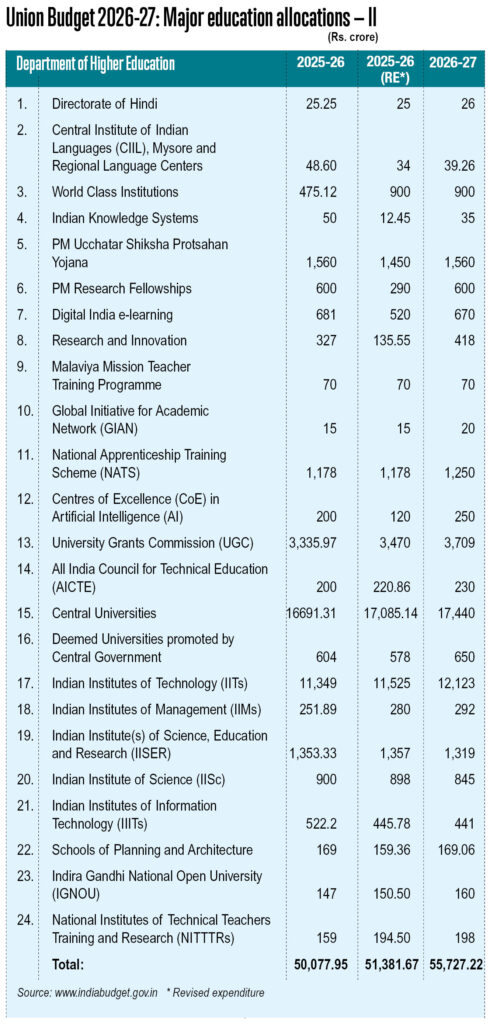
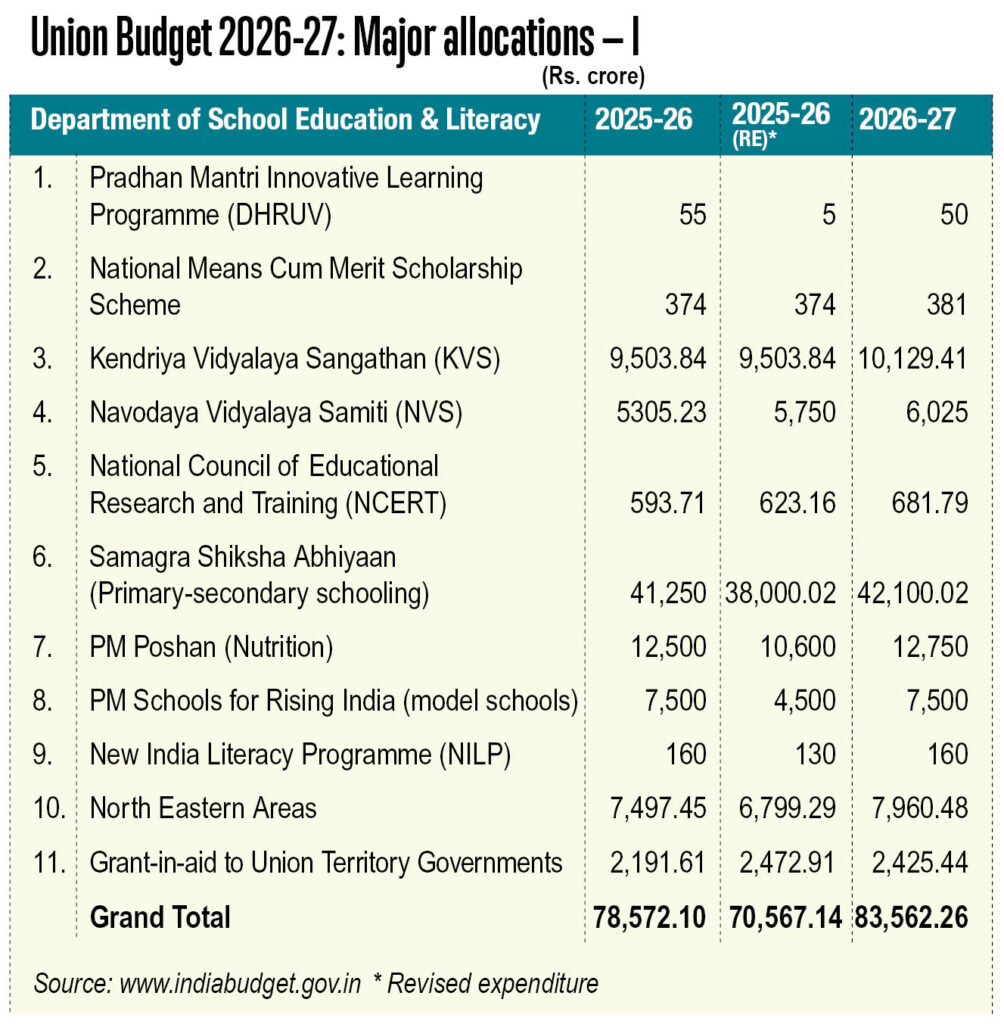 Evidently, finance minister Sitharaman has ignored this sage advice generated within her own ministry. This year’s budget provides a paltry Rs.1.39 lakh crore for education, a sum equivalent to 2.5 percent of the total budget (Rs.53.47 lakh crore) and 0.35 percent of GDP (Rs.393 lakh crore). Of this outlay, Rs.83,562 crore is allocated to the Department of School Education and Literacy, and Rs.55,727 crore for public higher education.
The imbalance between school and higher education — the latter is too heavily subsidised and urgently requires targeted means tested subsidisation — aside, this sum is totally inadequate to fund India’s 1.10 million government schools and 5,676 aided colleges plus 57 Central universities as also the University Grants Commission, which sometimes doles out tiny capital grants to government and aided higher education institutions.
Admittedly, the greater share of the obligation to fund public schools, colleges and universities is of the country’s 28 state governments, as education is listed in the Concurrent List of the Constitution. Nevertheless, the lead to upgrade the country’s shambolic public school system defined by crumbling buildings, multigrade teaching and pathetic lack of libraries, laboratories and lavatories, has to be taken by the Central government by increasing its investment in education from the current 0.35 percent of GDP to at least 3 percent to attain the never attained national target of 6 percent of GDP set by the Kothari Commission way back in 1967, and upped by the Kasturirangan Committee (2019) to 10 percent of government expenditure.
 Under the Kasturirangan Committee’s recommendation, the Centre’s outlay for education should have been Rs.5.3 lakh crore instead of the miserly Rs.1.39 lakh crore provided. If all states together maintain their current spending (Rs.14.30 lakh crore), the national outlay for education would aggregate to Rs.19.64 lakh crore, equivalent to 5 percent of GDP. Although this provision is likely to startle finance ministry babus, it is lower than the 6 percent recommended by the Kothari Commission and necessary to make up for the past 75 years when the annual outlay for educating the world’s largest child and youth population averaged 3.5 percent of GDP.
National investment in education of this magnitude is necessary because learning outcomes in public — especially rural — schools are illusory. For several decades, the Annual Status of Education Report (ASER) of the independent Pratham Education Foundation has been faithfully reporting that over 50 percent of class V children can’t read class II texts and half of class VII children can’t read class III texts or solve simple sums. This because rural schools are provided barely any infrastructure. Children have to normatively endure multigrade teaching because of routine teacher truancy, lack of drinking water, lavatories, let alone laboratories and computers in this AI age. Consequently of the 260 million enthusiastic children who enrol in primary schools nationwide at the start of every academic year, only half stay the course to complete higher secondary school of whom a mere 10 million enter collegiate education.
Union education minister Dharmendra Pradhan: steadfast conversation denial
Nor are learning outcomes better in higher education because the vast majority of recklessly promoted children enter college/university with weak K-12 foundational learning. India has a higher education GER (gross enrolment ratio) of only 28 percent, i.e, only 28 percent of youth in the 18-24 age group are enrolled in HEIs. This suffers in comparison with most middle income and developed countries – Korea has 94 percent; USA 88 percent; China 60 percent; Japan 64 percent and Indonesia 45 percent. And the tertiary education they receive less than enthuses corporate India.
Of India’s 52,000 undergrad colleges and 1,276 universities, some established more than 150 years ago, none is ranked among the world’s Top 200 universities in the league tables of the London-based varsity rating agencies QS and Times Higher Education, while neighbouring China has four ranked among the Top 50. The poor quality of education dispensed by India’s higher education institutions explains EW’s familiar lament that not a single global game-changer product or service such as the internet, smartphone, electric automobile etc has been invented by Indian scientists and engineers.
 According to a report of Aspiring Minds, a Gurgaon-based recruitment and consultancy firm, 85 percent of liberal arts and 75 percent of engineering graduates are unemployable by Indian and foreign multinationals. Quite clearly, huge resources need to be mobilised and canalised to reform and contemporise the country’s moribund education sector. When confronted with incontrovertible evidence of the sorry condition of post-independence India’s calamitous neglect of education and human resource development, the standard response of successive governments at the Centre and in the states is budgetary constraints.
Drawing upon the prudence of ordinary middle class householders, the Union government can and must slash expenditure and/or increase revenue to fund children’s education.
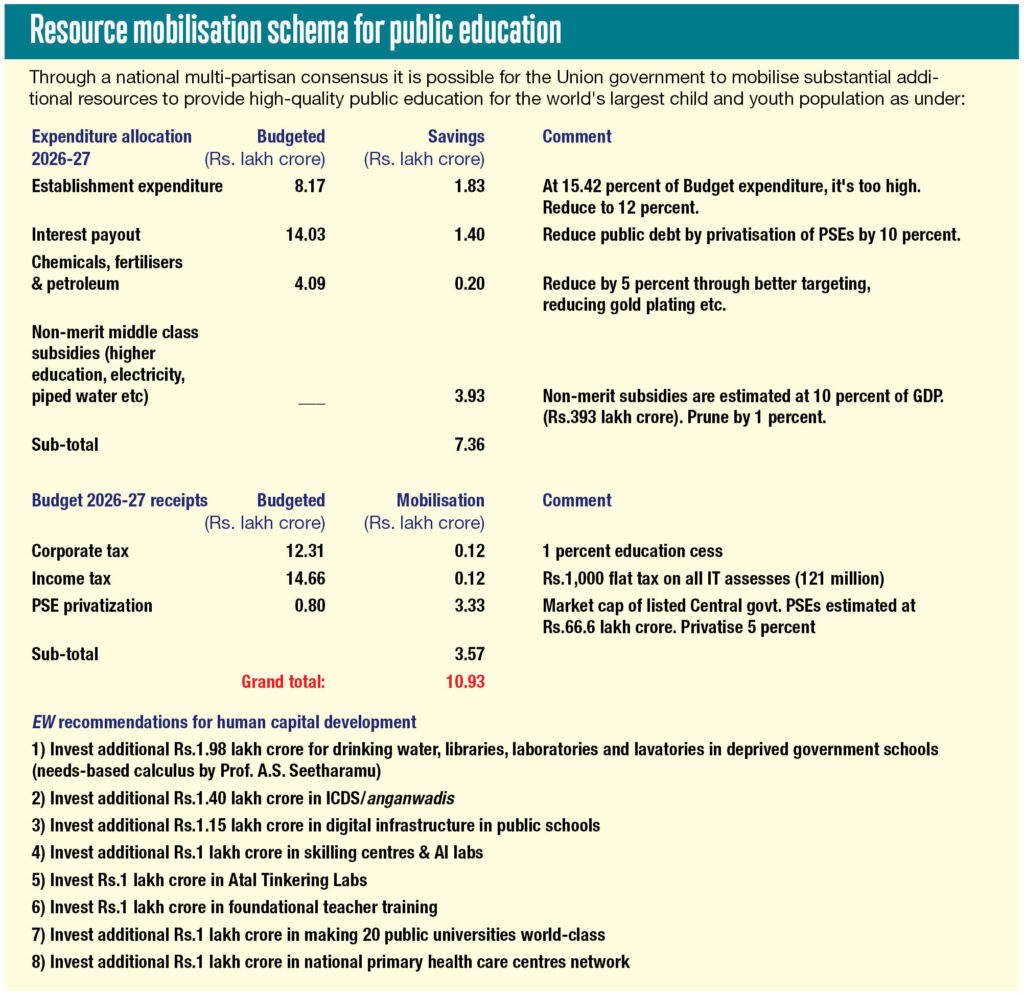
Under the head of expenditure, there are options to reduce establishment expenditure which necessitates curbing ministerial expense on extensively refurbishing homes; private jet and helicopter travel; sweeping through the landscape in huge motorcades; reducing wasteful subsidies including hidden middle-class subsidies (water, power, higher education etc). Under the revenue head, governments can monetise public sector enterprises with part of the proceeds utilised for reducing its huge interest payments burden (Rs.12.74 lakh crore last year and budgeted at Rs.14.03 crore in 2026-27) and also by levying a modest Rs.1,000 flat tax on all income tax assessees.
To this end for the past decade, conterminously with presentation of the Union Budget, your editors have been publishing a schema that would enable the Central government to mobilise an additional Rs.7-8 lakh crore for investment in education and developing the capabilities of the world’s largest child and youth population. Curiously, although this schema has been presented to over a dozen of the country’s most reputed economists inviting critique, none of them has responded.
Moreover despite EducationWorld (estb.1999) having established itself as India’s premier education news magazine with a transnational reputation, like his predecessors in office, for the past four years since his appointment, Union education minister Dharmendra Pradhan has steadfastly ignored repeated requests for a “conversation” (not interview) to discuss ways and means to develop the country’s abundant, high-potential human resource. This makes one wonder about his awareness of the social contract in a democratic nation. True, Pradhan provides access to selected non-specialist media and print publications. But he and his minions in the ministry repeatedly decline to provide access to your editors equipped with domain knowledge, despite our assurances that we intend to engage in constructive conversation — rather than hostile interview — to discuss ways and means to develop the sole factor endowment of the nation — the world’s largest child and youth population.
However even though disappointed with unwarranted lack of official cooperation, we intend to steadfastly pursue our mission statement to “build the pressure of public opinion to make education the #1 item on the national agenda” in the belief that public opinion will compel recalcitrant governments to become more accountable. Meanwhile we believe that through prudent management of the Union budget — modestly reducing expenditure under some heads and mobilising additional resources under others — it is indeed possible for the Central government to raise an additional Rs.10-11 lakh crore annually for improving the public education infrastructure and capabilities of 240 million in-school children and 28 million youth in institutions of higher education.
In the unlikely event of this advice being followed by the Centre, state governments are likely to follow suit and raise their budgetary allocation for development of India’s foolishly neglected human capital. If this level of expenditure is sustained for three years, our human resources will be on a par with OECD countries and neighbouring China.
It’s high time India’s establishment and ‘educated’ middle class grasp and digest the import of the ancient Chinese proverb that rather than give fish to the poor, it’s more constructive to teach them fishing.











Add comment