






Valuable but limited
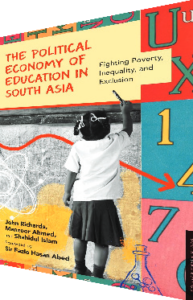 The political economy of education in south asia: fighting poverty, inequality & exclusion
John Richards, Manzoor Ahmed, and Shahidul Islam
University of toronto press
Rs.256
Pages 1,435
The authors review different models of learning outcomes, especially literacy and numeracy across India, Pakistan, Sri Lanka, Nepal and Bangladesh
The book under review examines, at a narrow level, the relationship between investment in education and learning outcomes and, at a broader level, the relation between educational planning, governance, and human development across South Asia.
The authors, each with a long-standing engagement in educational research and policy, begin from the premise that the capacity of a nation to provide a decent quality of life and an aspirational path to the largest sections of its population is closely tied to the investment it has made in education.
Educational outcomes in the book are defined largely through learning outcomes, especially literacy and numeracy, and the authors review different models of assessment across India, Pakistan, Sri Lanka, Nepal, and Bangladesh. Their comparative analysis points to the lack of common standards across these contexts and to the difficulty of arriving at any stable consensus on what ‘quality education’ might mean in such diverse national settings. This absence of standards is treated not merely as a technical problem of measurement but as a symptom of a deeper crisis within education itself.
The “learning crisis” is such that “expansion in access (to education) has not kept pace with learning outcome” and “large segments of the population in the developing world… are not benefitting in terms of well-being and prosperity, from strong learning outcomes,” as Sir Abed notes in his Foreword.
The overall picture that emerges is one of poor performance in almost all the national contexts under discussion, with Sri Lanka the main exception. Most students who enrol in school do not acquire age-appropriate literacy and numeracy skills, and for the authors, this has implications that exceed schooling narrowly conceived. Foundational literacy is linked to economic growth, poverty reduction, health outcomes, and social development more generally. At the same time, better performance in learning outcomes does not erase internal inequality, social division, or exclusion, as the Sri Lankan case demonstrates.
The second part of the book focuses on teachers: their quantitative and qualitative status, their training and recruitment, and the institutional conditions under which their work is managed. Here the comparative detail is one of the stronger features of the book. Across the various national systems, the authors argue that any meaningful improvement in educational quality depends upon a professionally oriented teaching workforce equipped with autonomy, social recognition, and continuous support.
The third part gathers these strands together by asking what forms of intervention in the political economy of education might help reorient educational systems towards better learning outcomes. The overall thrust of the book is therefore not only concerned with diagnosing failure but with identifying pathways through which educational systems can be made more responsive, professional, and effective.
For comparative educators, the challenge has always been to hold together this tension between commonality and difference without allowing one to cancel the other out.
In many ways, Richards, Ahmed and Islam attempt to do justice to that problem. By using learning outcomes as a common comparative ground, they try to register national specificities without abandoning the possibility of regional comparison. In that sense, the book also makes a methodological intervention at a moment when the comparative impulse in educational research often appears to have receded in favour of ethnographic and case study approaches.
At the same time, the book can be understood not only through what it engages, but also through what it leaves out. Read symptomatically, these omissions become especially revealing.
The book does not seriously engage with the Covid-19 pandemic, except in passing, as though it were an event external to the education field that merely illuminated already existing inequities. It does not meaningfully address EdTech or AI, nor does it treat war, violence, migration, or climate catastrophe as central categories for re-thinking either political economy or education. While teachers’ professional development is rightly identified as a key driver of reform, the political economy of the teaching profession itself, amidst automation, deskilling, functional simplification of labour, and technological mediation, remains largely outside the frame.
The book is both valuable and limited. It is valuable because it offers a comparative account of the learning crisis, teacher professionalisation, and governance across South Asia. It is limited because its understanding of political economy remains too narrow to apprehend the wider forces that now shape educational life.
Therefore it’s best read not as a definitive account of the political economy of education, but as an important document addressed to those who continue to believe that educational crises can be solved through better governance, stronger professionalism, and more coherent institutional design. Whether that belief remains adequate to the present is the larger question the book leaves unanswered.
Manu V. Mathew
(The Book Review)










Add comment