






West Bengal: Dismal picture
– Baishali Mukherjee (Kolkata)
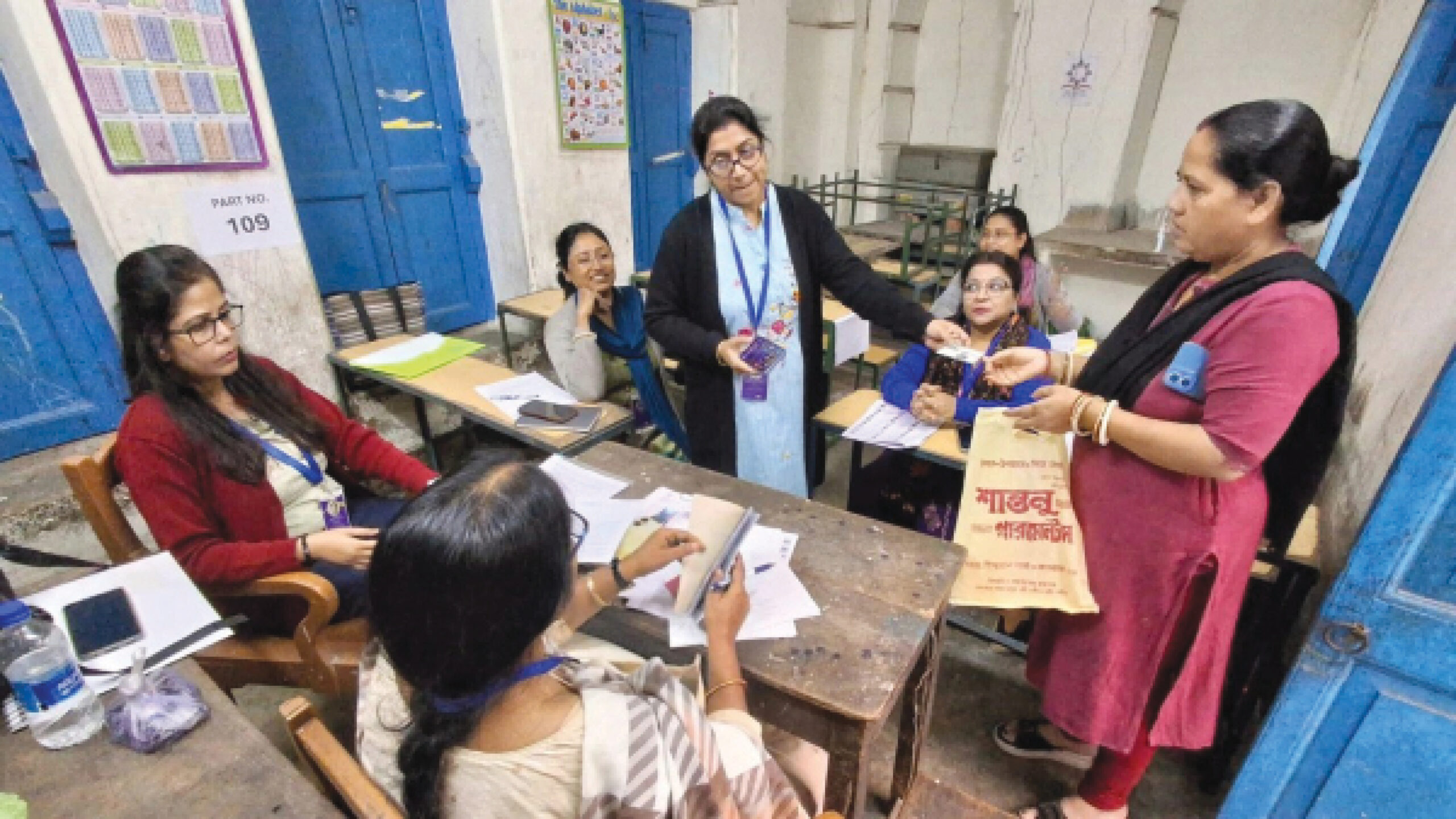
As the Mamata Banerjee-led ruling Trinamool Congress (TMC) party and the chief opposition BJP lock horns in a pre-election slugfest ahead of the May-June 2026 legislative assembly polls in West Bengal, the public education system of the state is being quietly gutted.
At a time when schools in Bengal are experiencing severe disruption due to an acute teacher shortage resulting from the multi-crore TET (Teacher Eligibility Test) scam which froze recruitment in Bengal’s 84,000 public schools, the Election Commission — which since 2014 has faced intensified scrutiny and allegations from opposition parties, civil society groups, and media questioning its impartiality and alignment with the BJP — launched the Special Intensive Revision (SIR) of electoral rolls on November 1. Consequently, thousands of government school teachers were deployed for door-to-door verification, hearings, digitisation, and data uploads without consultation with exam boards and schools. By forcibly deploying tens of thousands of teachers to serve as booth level officers (BLOs) for months, the SIR exercise has exposed a brutal truth: in contemporary Bengal, children’s education is dispensable.
With the Madhyamik exam (class X board exam) set to begin on February 2, uncertainty persists over the availability of teachers and education department officials engaged in the SIR exercise. According to an Election Commission notice published on December 12, BLOs will remain engaged in various SIR duties until February 14, the day of final publication of the electoral roll.
This year’s Madhyamik examination — one of the largest public examinations in the country — will test 971,340 candidates (969,425 last year) at 2,682 centres and requires an estimated 100,000 teachers as invigilators, officers-in-charge (OICs), centre secretaries and venue supervisors. But many of these personnel are currently serving as BLOs, Electoral Registration Officers (EROs) or Assistant EROs conducting SIR.
With over 80,000 BLOs — mostly government school teachers — engaged in SIR, West Bengal Board of Secondary Education (WBBSE) president Ramanuj Ganguly has repeatedly written to the Chief Electoral Officer and district magistrates across Bengal, seeking exemption of teachers from SIR duties during the class X exams (February 2-12), stressing that OICs must be present throughout exam days for confidential and logistical responsibilities. Despite these appeals, no written affirmation has been received.
In the absence of formal communication, the education ministry had made ad hoc arrangements for conducting board exams. Teachers from neighbouring schools are being deputed to exam centres, and in some districts, officials from BDO offices are being asked to replace school inspectors engaged as electoral officials.
Educators in Kolkata are alarmed that what’s unfolding in West Bengal is not merely administrative overlap. It is systemic deprioritisation of public education, with electoral processes classified as inviolable. However, systematic destruction of public education, began long before SIR — rooted in the TMC’s scams-ridden and ham-fisted governance that precipitated an acute teacher shortage, prolonged schools shut down during the pandemic, and a collapse of job opportunities in the state, steadily eroding students’ faith in a future within West Bengal. The consequences are not abstract. They are visible in deserted schools, skeletal staff rooms, and a generation of children quietly slipping out of the education system.
Bengal’s primary-secondary education crisis is manifesting in higher education. On July 30, 2025, the final day for undergraduate applications, only 3.59 lakh students registered on West Bengal’s centralised portal — down sharply from 5.3 lakh the previous year. Prestigious institutions are not immune either. In the highly reputed Jadavpur University, undergrad admission applications in core disciplines have nearly halved in 2025. In Vidyasagar University, 46 colleges offering over 74,000 seats have received just 24,000 applications. Academics cite pervasive loss of faith in the education-to-employment pipeline.
“When teachers are dragged out of schools en masse for election duty and children lose months of instruction year after year, and when faith in learning collapses, the damage extends far beyond exam halls. It distorts society,” comments Partha Pratim Ray, associate professor of Physics at Jadavpur University.
“West Bengal is staring at a generational rupture — one whose consequences will outlast any single policy, verdict, or election cycle. The question is no longer whether education is being hampered; that reality is already visible in empty classrooms, overburdened teachers, disrupted examinations, and steady erosion of public trust. The real question now is whether the state can afford to let its education system deteriorate any further, knowing that the cost will be paid not just by way of loss in learning outcomes, but in lost opportunities, widening inequality, and an entire generation pushed to the margins of the future,” rues political activist Swapan Mondal, and a teacher at Narikeldanga High School, Kolkata.
Evidently in latter day West Bengal, electoral democracy extracts a heavy price.









Add comment