






Creativity and student agency shape holistic learning at Navrachana International School
– Dr Gopika Jadeja, Head of School, Navrachana International School, Vadodara – IB
With a focus on creativity, collaboration, and student agency, students at Navrachana International School, Vadodara – IB (NISV–IB) are encouraged to learn not merely to carry information but to be in harmony with their being and with the world.
Rabindranath Tagore wrote about his childhood experience of learning to read in an essay titled “The Vision.” He described how words that initially appeared disconnected came together to create meaning when he encountered the poetry in the rhyming phrase “jal parey/pata narey” (the water falls/the leaf trembles) in a reading primer. Tagore noted that he was no longer a mere student absorbed in spelling lessons, but one whose mind opened to a rhythmic vision of the world that extended beyond information to harmony with one’s being. This experience of poetry helped shape Tagore’s ideas on education, particularly his belief that creativity and self-expression are essential for the personal and intellectual development of the child.
This perspective continues to resonate in contemporary educational systems, which increasingly incorporate creative and experiential learning into their curricula. Creativity is widely recognised as a core competency and one of the essential 21st-century skills. Studies conducted by the Programme for International Student Assessment (PISA) in 2022 indicate a connection between high achievement in languages, mathematics, and science and excellence in creative subjects in countries where governments embed creativity within their curricula. Although creativity is often viewed as an abstract concept, current educational research suggests that its integration benefits learning both in the classroom and in later life. Traditionally, the arts—visual arts, drama, and music—are seen as fostering creativity. While creativity is not limited to these disciplines, the arts provide an effective starting point.
At Navrachana International School, Vadodara – IB, creativity, collaboration, and student agency form an integral part of everyday teaching and learning. Beyond classroom instruction, the school’s emphasis on the practice of creativity and student agency is reflected in events held throughout the academic year, including the annual concert and participation in national initiatives such as the INTACH FILM IT workshop. The MYP and PYP exhibitions also serve as platforms showcasing creativity and collaborative learning.
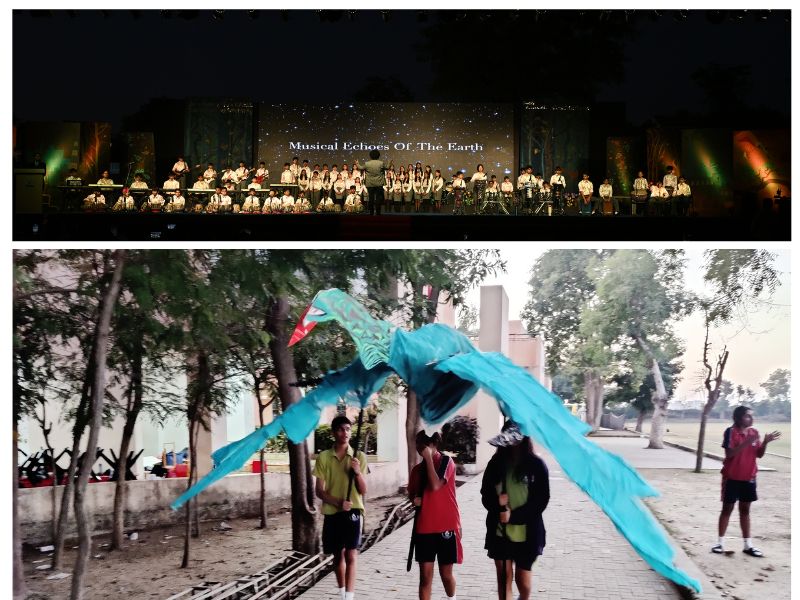
The school’s annual student-led concert has become a cornerstone of the academic year, fostering creativity, collaboration, and student agency. Learning from arts lessons, along with everyday classroom experiences, is expressed through the concert, which combines artistic expression with thematic exploration. A recent performance centred on the theme of sustainable futures, designed, scripted, and enacted by students under teacher guidance, demonstrated the transformative potential of creative practice. Students encountered real-world challenges such as meeting deadlines, managing technical constraints, making aesthetic decisions, and collaborating with peers who approached tasks differently or held diverse perspectives. They engaged in iterative problem-solving through planning, testing, revising, and adapting their scripts, props, and costumes. Active engagement and social interaction enabled students to develop confidence and grow into their roles, creating a transformative learning experience.
Another initiative that emphasises creativity and collaboration is the INTACH FILM IT workshop, where students engage with peers from other schools. Film as an art form integrates multiple artistic and technical elements. Through filmmaking workshops and the creation of films on tangible or intangible heritage, students are provided opportunities to conceptualise ideas, conduct research, write scripts, produce films, and edit and screen them before an audience. In addressing challenges such as identifying shooting locations, managing filming schedules, and working through multiple takes, students learn to view problems from new perspectives and develop innovative solutions. The focus on heritage enhances historical understanding and enables students to construct their own narratives, recognising their films as personal interpretations of the heritage they explore.
Through the sustained practice of creativity, collaboration, and student agency, students explore the world and their own heritage while expressing their understanding through performance and creative work. Their learning extends beyond the acquisition of information, enabling them to develop harmony with their being and with the world.
Also Read: Nurturing Well-Being: How CHIREC International School Cultivates a Culture of Care






Add comment