






United States: Alarming learning deficit
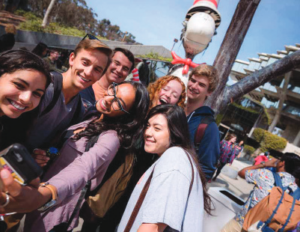
UCal San Diego students: duffers flood
In recent weeks, more than 1,800 maths and science lecturers at the University of California, one of America’s largest and best public university systems, signed an open letter detailing a tricky problem. First-year undergraduates, they say, are increasingly arriving without the basic skills they need to succeed. At the campus in Berkeley, they write, some 20-30 percent of students taking an early calculus course turn up displaying “severe preparation deficits”. The challenge has become so great, they add, that instructors are having to reteach middle-school mathematics.
The letter is the latest entry in a widening debate about post-secondary education, university admissions practices — and the acuity of America’s young. It follows a gobsmacking report last November at the California system’s San Diego campus. Academics there noted that the number of first-year students entering with maths skills below high-school level had increased nearly thirtyfold in five years, to almost one in eight. Some 70 percent of the lagging students they reported were not performing at the level expected of 14-year-olds.
Worries about undergraduate maths skills pair with long-running dismay at falling levels of literacy. Lecturers warn of literature students who seem incapable of finishing books. It is not just on the west coast, or in public universities, where these problems are reported. At Harvard some humanities and social-science professors say they feel compelled to shorten texts, according to a report released to faculty in October. Students are arriving at America’s most famous university “with less experience reading complex prose and less capacity for focus and sustained attention.” They “struggle with readings that students completed with ease just ten years ago”.
But observers seeking a sense of global trends — and America’s place within them — need not fly completely blind. At least some insight may be wrung from a once-a-decade test carried out by analysts at the OECD, a club of mostly rich countries. Its ‘Survey of Adult Skills’ aims to gauge how far citizens in dozens of countries have the literacy and numeracy necessary to thrive in the real world.
Some 160,000 people of all ages were tested in the last round (the results of which were published at the end of 2024). The Economist asked the OECD for data just of those under 35 who were enrolled in “tertiary” education at the time they took the tests. Many of them do very well — but a striking share perform abysmally. Across rich countries some 8 percent of students in tertiary education notch up a score in literacy no better than one might expect from a ten-year-old child. The share is about the same for numeracy. Worse, the share at or below this bar has risen since the tests were last run, a little over a decade ago. The share of very poor performers in literacy has more than doubled.
What is going on? In part, colleges and universities are inheriting problems that have originated in the world’s schools. One cannot overestimate the impact of the pandemic. Countries enforced national school closures lasting 20 weeks on average. Rota systems for in-person learning, and quarantines for “close contacts”, then disrupted lessons more.
Yet in many places schooling was already going backwards when the mega-lurgy hit. Scores in NAEP, America’s national reference test, reached a peak in the early 2010s and have been edging down since. Scores from PISA, an international exam taken by 15-year-olds, are drifting the same way in a swathe of other countries. Places with unusually deep, long-running declines include France, Germany, the Netherlands and New Zealand.
The causes of these trends are hotly debated. Rising migration is relevant: newcomers tend to be poorer than native-born students, and more likely to speak a foreign language at home. Meanwhile traditionalists accuse school reformers of watering down testing and accountability schemes. And of replacing time-tested syllabi with faddish curriculums that downplay learning concrete facts in favour of nice-sounding but vapid “soft” skills.
Claims that social media have been “rewiring” children’s brains bear strong echoes of past panics, such as over television and computer games. But there is not much doubt that screens of all kinds have displaced more nourishing hobbies: the share of nine-year-olds in America who say they read books for pleasure has fallen from nearly 60 percent in the 1990s to 37 percent now.
A major question for colleges and universities is not just how they will respond to a growing pool of underprepared applicants, but whether they are themselves prepared to continue enforcing high expectations. The open letter in California warns that with weaker students has come “growing pressure to dilute quantitative rigour”.
On top of all this now lands AI, which appears to be enabling rampant cheating. Some 94 percent of undergraduates in Britain report using AI to help with assessed work, according to a survey released in March by HEPI, a think-tank. In America during the 2023-24 academic year some two-thirds of learners in public universities were using AI, and an estimated 9 percent of those were using it to cheat, according to research published in May.
For some, AI has induced a sense of resignation. It is growing common to hear academics shrug that perhaps students no longer need strong basic skills, because so much of the work they do in future will involve tweaking things made by AI. That is not pragmatism; it is surrender.
ETS acquires ACT
One of the world’s biggest testing services has acquired one of its main rivals as universities continue to re-evaluate how to assess students’ readiness for higher education. ACT is set to become part of the Educational Testing Service (ETS) under a deal announced on June 30, combining the two firms’ roster of assessments, including university admission exams.
The takeover will help ETS strengthen and connect its presence across all 50 American states, says ETS chief executive Amit Sevak, who told Times Higher Education (THE) that ACT “brings a variety of state partnerships” to the table. “By ETS, which does tens of millions of tests, and ACT coming in with their 5 million tests, we are able to really serve more students across the country,” he says.
ETS is known for providing services including the Test of English as a Foreign Language (TOEFL) and the GRE, an assessment used for admission to advanced and graduate school programmes in the US. Meanwhile, ACT is known for its undergraduate college entry tests for high school students. ETS used to administer its rival, the SAT, which is now delivered by the College Board.
The ACT has experienced a dip in popularity in recent years. According to reporting by the Washington Post earlier this year, roughly 47 percent of US students who graduated high school in 2025 took the SAT, compared with 36 percent who took ACT. The company has also undergone a recent change in leadership, with chief executive Steve Tapp taking over from Janet Godwin in October last year. Godwin remains an adviser to the ACT board.
The company hailed its acquisition of ACT as uniting two operations with a “common purpose”.“This move combines the strengths of two mission-driven measurement organizations to address the significant challenges facing American education,” according to the announcement.









Add comment