






Apple Inc outsmarted
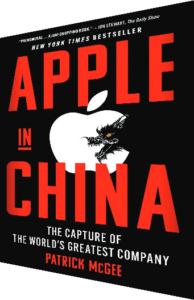 Apple in china: the capture of the world’s greatest company
Patrick McGee
Simon & Schuster
Rs.899
Pages 437
This book has a political angle to it. It recounts how the Chinese politburo rolled out the red carpet for Apple as part of a long-term plan
It sounds absurd, but it’s true. Three decades ago tech giant Apple Inc, the world’s most highly valued company (market capitalisation: $5 trillion (Rs.482 lakh crore)) was on the brink of bankruptcy. Although the company’s Macintosh computer (the iPod and iPhone were to come later) was highly innovative, overheads and wages were too high and America’s unique risk-taking investors were becoming nervous.
That’s when Steve Jobs and John Elliot who ran the company from its Cupertino (California) headquarters hit upon the idea of outsourcing manufacture of the Macintosh overseas starting with Japan and Taiwan. In 1984, Canon was tasked with manufacturing the computer board and Sony disk drives with components sourced from Taiwan and other Asian suppliers to produce LaserWriter — “the first major Apple designed, Apple branded product that was made by a third party”.
The outcome of this strategy was that the previously over-priced Mac combined with LaserWriter and its first “killer app” Pagemaker made desktop publishing possible and took the books, magazines and brochures publishing industry by storm. Thus began Apple Inc’s romance with “outsourcing manufacturing as a service,” which ultimately prompted Apple to outsource all its manufacturing to “supplier enterprises” in the People’s Republic of China (PRC).
This strategy took full advantage of rock-bottom Chinese wages and enabled Apple to dazzle the American stock market with its fantastic bottom line — hence the high valuation. But it also transformed the world’s most valuable company into a prisoner of China and enabled PRC to develop its own highly sophisticated — and competitive — mobile phones industry.
The fascinating story of how brilliant business strategists in Apple HQ in Cupertino were outmaneuvered by China’s political strategists led by President Xi Jinping and the politburo of the Chinese Communist Party (CCP) which rules in Beijing with an iron hand to become heavily dependent on China, is recounted in this engaging narrative. The infirmity of capitalism — pleasing Wall Street with continuously rising quarterly profit numbers — made Apple incrementally dependent on low cost semiconductor and components suppliers operating in distant Taiwan and China. To maintain the quality, innovation features ideated and designed in Cupertino, the American company had to train professionals and workmen of component suppliers in China. As a consequence of adopting this high-margins mode, according to Patrick McGee, a postgrad of SOAS, London and University of Toronto who served a long stint with the Wall Street Journal and as principal Apple reporter of the Financial Times, London (2019-23), Apple has trained “at least 28 million workers in China” on sophisticated machinery procured and often installed by the American company in supplier firms — including semiconductor chips manufactured by TSMC, Taiwan, “by far the world’s most advanced chipmaker”.
Under this low-cost offshore manufacturing model, Apple engineers in the US designed the company’s products with built-in innovation for which Apple is globally admired, in giant factories in China, also making heavy investment in training, machinery and equipment for 157 supplier factories. Unsurprisingly this humungous transfer of technology, equipment and training enabled the phenomenal market success of the Apple iPhone in the US (and China). But it also enabled the rise of a sophisticated mobile phones industry in China.
Yet the thrust of this page-turner book has a political angle to it. It recounts how the Chinese government rolled out the red carpet acceding to every Apple demand, as part of a long-term plan to transform China into a global leader in smartphone manufacturing, well aware of the value of this expertise in defence, commerce and industry applications. Therefore, Apple wasn’t required to have a local joint venture partner, and was exempted from a law requiring all companies — including supplier companies — to limit the number of migrant workers to ten percent. Moreover all minor rules and regulations imposed by local governments were waived in its favour.
Simultaneously the US government was not averse to this massive transfer of technology. Because the Obama and Biden administrations were convinced that admission of China into the WTO and unimpeded transfer of technology to PRC would transform communist China into a liberal middle income democracy which would be good for the world. However, President Xi Jinping and the politburo packed with communist hardliners were working on a Made in China 2025 blueprint to ramp-up self-sufficiency in advanced electronics, biomedicine and aerospace.
This book begins circa 2015 shortly after President Xi Jinping consolidated power within the all-powerful politburo. Suddenly government- controlled media started accusing Apple of ill-treating Chinese customers relative to American and Western purchasers, and of “incomparable arrogance” when it issued a mild denial. Suddenly it dawned upon the bosses in Cupertino that although with their brilliant strategy of locating 157 factories in China and taking advantage of its well-educated, low-priced, and reportedly forced labour, Apple had transformed into the world’s most profitable company — Apple has a 40 percent share of the global smartphones market but earns 85 percent of global profit — it has become dangerously dependent upon the goodwill of the omnipotent Xi Jinping and his packed politburo.
Moreover with Apple having nurtured hundreds of supplier companies and trained 28 million workers, modern China has a thriving domestic smartphones manufacturing industry. As a result the world’s most valuable company has been transformed into a genuflecting supplicant of the Chinese government. Politically it has been completely outsmarted.
For India’s two-steps forward policy formulators who devise byzantine rules and regulations for foreign investors, Apple in China has some important lessons: foreign investors don’t merely bring in capital and quest for profit but also advanced technology, knowhow and training skills. This enables a thousand indigenous flowers to bloom.
Dilip Thakore








Add comment