






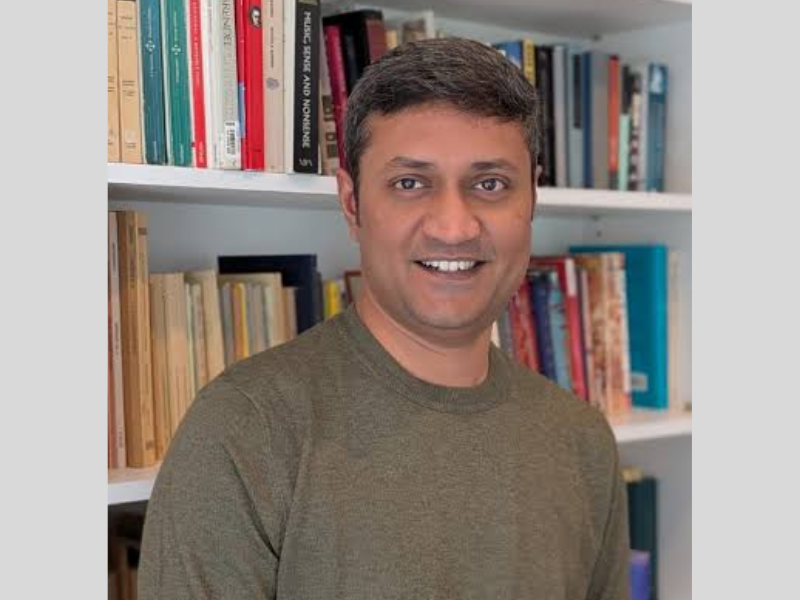
Staying Relevant in the AI Era Through Continuous Upskilling
– Arindam Mukherjee, Co-founder & CEO, NextLeap
AI is no longer technology limited to experts or technology firms. Instead, AI is making inroads into our daily activities in marketing, finance, operations, sales, human resources, design and beyond. In other words, as AI transforms the way we work, it is also transforming our concept of career development.
The challenge for professionals is not to ask whether AI will impact their careers, but rather whether they can keep up with the pace required to collaborate with AI.
This is not about all professionals becoming AI engineers. Instead, the key will be the combination of domain expertise and continuous learning.
From one-time learning to continuous upskilling
For years, career development followed a fairly predictable process. One would graduate from college, start working and slowly rise through the ranks by gaining experience. While one continued learning, education was considered the foundation for an entire career.
However, the speed of technological advancement is challenging this approach.
The tools, platforms and workflows associated with AI and automation are developing very rapidly. The skill that gives someone an advantage today may be taken for granted in the future. Thus, learning and upgrading skills are becoming matters of necessity rather than simply ways to accelerate one’s career.
In this regard, it is necessary to shift from “learn once, use for years” to constantly identifying skill gaps and filling them.
It is crucial to remember that the goal here is not to gather diplomas and certificates, but to develop skills that provide added value.
The rise of the practical learner
One of the most important changes in professional learning is the rising emphasis on applicability.
Being able to understand what generative AI entails is an important skill. However, the ability to apply AI to information analysis, automate routine work, improve communication and support decision-making is much more useful in the workplace.
This is where practical and project-based learning comes in.
People learn best when they are able to relate theory to actual work-related problems. A marketing professional may use AI to generate and test ideas for campaigns, while a finance professional might explore ways automation can improve workflows.
All this transforms theoretical learning into something applicable and tangible.
But this is not the only reason why such an approach to learning is important.
Hiring managers need to assess not just a person’s knowledge, but also their capabilities.
Industry alignment will become critical
The second major transformation that needs to be recognised is the need for learning to be closely aligned with industry requirements.
Changes brought about by technology are creating new expectations across nearly every field. Therefore, there may be a significant divergence between education offered in traditional learning institutions and professional experience in the workplace.
Learning aligned with industry requirements can help bridge this gap by emphasising the use of modern technology and addressing the challenges it brings.
However, this does not imply that foundational learning is becoming redundant; rather, the contrary is true. The combination of strong fundamentals and advanced technological know-how can enable professionals to remain highly adaptable.
The most valuable learners will be those who know not only why something needs to be done, but also how it should be done using new technology.
AI literacy will become a career advantage
It is likely that AI literacy will eventually become like digital literacy: something that distinguishes people at first, but then becomes a basic requirement.
Professionals do not necessarily have to understand the technical structure of every AI technology. They must, however, know what it can and cannot do, how to use it properly, how to interpret its results and how it can help them improve their work.
That represents a shift from simply being able to use AI tools to becoming an AI-first problem solver.
The ability to ask better questions, assess results more thoroughly and apply AI capabilities with human insight will be crucial.
Creativity, communication skills, critical thinking and subject-matter knowledge will continue to be vital, as these qualities cannot simply be replaced by AI.
Building a career around adaptability
Career growth will increasingly be about adaptation rather than acquiring a particular set of skills.
Individuals can start by determining which aspects of their jobs might become obsolete due to technological advances, identifying the skills emerging within their sectors and choosing training opportunities that allow them to practise these skills.
It will be useful to evaluate learning outcomes by asking whether you are able to solve problems more quickly, make sounder decisions, automate processes and contribute to initiatives you previously could not.
This will be a better measure of professional development than the number of courses attended.
The era of artificial intelligence does not have to be seen as a period of conflict between humans and machines. Professionals who possess the ability to integrate technology into their work will be better positioned than those who resist it.
Continuous upskilling, combined with practical experience and relevant knowledge, will enable individuals to stay employable, productive and ready for positions that are yet to be created.
In the future, career success will depend on one’s willingness to learn continuously.
Also Read: Beyond the Usual Destinations: Rethinking Global Student Mobility








Add comment