






Annamalai seeks delayed implementation of three-language policy
K. Annamalai, BJP Tamil Nadu’s leader on Tuesday appealed to the Centre to revoke its decision to enforce the three-language policy from the current academic year and instead implement it only after three years, as initially proposed by the Central Board of Secondary Education.
He sought that new CBSE notification issued on May 15, 2026 seeking implementation from current year be withdrawn and the plan to make three languages compulsory in Class IX, including two Indian languages, only after three years, from the 2029-30 academic year onwards, as originally announced be followed.
In a post on X (formerly Twitter), Annamalai stated that the abrupt move by CBSE had left parents — particularly those in Tamil Nadu — deeply concerned.
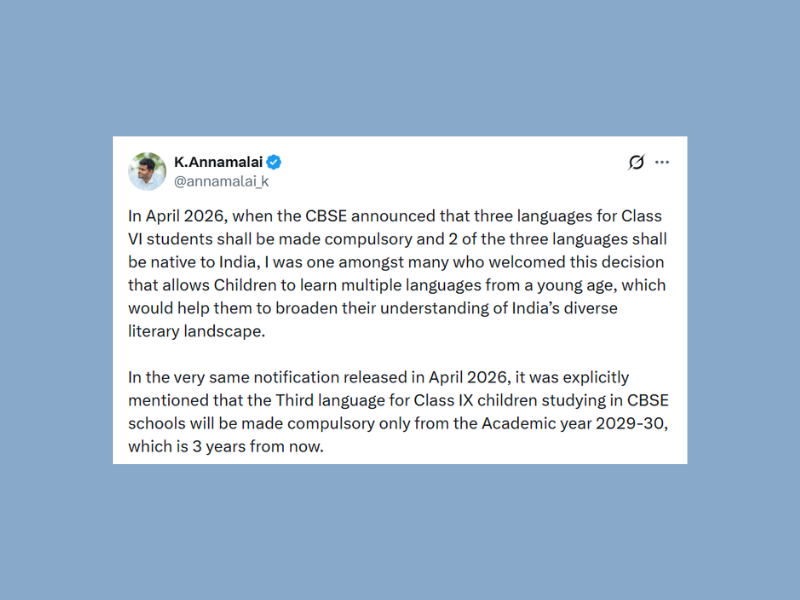
“In April 2026, when the CBSE board announced that three languages would be compulsory for students from Class 6 onwards, and that two of those three languages must be Indian languages, I was among those who welcomed the decision, as it would help children understand India’s diverse literary and cultural heritage from an early age. In the notification issued in April 2026, it was clearly stated that making the third language compulsory for Class 9 CBSE students would be implemented only after three years, from the 2029-30 academic year onwards,” he said in the social media post.
According to Annamalai, this revised directive contradicts the board’s earlier assurance that the change would only take effect from the 2029-30 academic year. He said the sudden rollout had created anxiety among parents, especially in Tamil Nadu, where many students had already selected their preferred language in Class 6.
“Through this, the CBSE board has gone against its earlier announcement that the rule would be implemented only from the 2029-30 academic year. This sudden announcement by CBSE has caused great shock to parents, especially to the parents of students in Tamil Nadu. This is because their children had already chosen the language of their preference in Class 6, but according to the newly issued notification, Class 9 students must now compulsorily study three languages, of which two must be Indian languages, and this will come into effect from July 1, 2026 itself,” he added.
He further argued that forcing students to pick up a new language within a limited timeframe would place undue pressure on them and could negatively affect their academic progress.
CBSE’s new third-language mandate for secondary students has triggered concerns among parents, students, and schools, particularly because it is being introduced mid-academic year. Under the revised policy, students must study three languages, including two Indian languages such as Hindi or Sanskrit, prompting fears of added academic pressure and disruption for those already studying foreign languages.
Also Read: Bengal govt puts cap on schoolbag weight










Add comment