






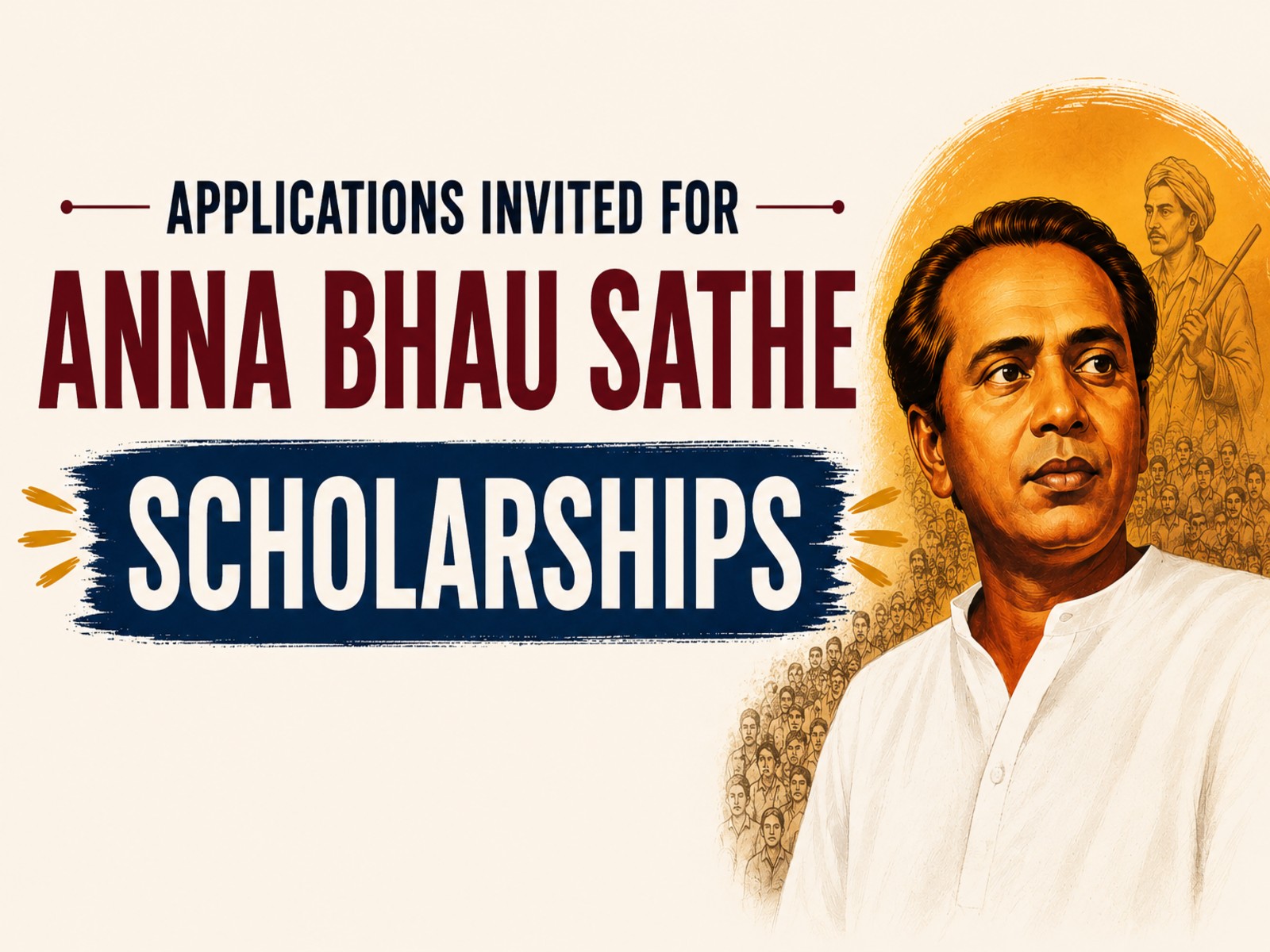
Applications invited for Anna Bhau Sathe Scholarship from Matang students
– Ronita Torcato
Applications are invited for the ‘Sahitya Ratna Lokshahir Anna Bhau Sathe Scholarship’ from students in Maharashtra belonging to the Matang Scheduled Caste community or its 12 related sub-castes. Selection is district-wise and students must score 60 percent or higher in board, undergraduate, diploma, or medical/engineering exams. The application deadline is July 24, 2026.
Tukaram Bhaurao Sathe, popularly known as Anna Bhau Sathe, was a pioneering Dalit writer, social reformer and poet who played a vital role in the Samyukta Maharashtra Movement with Dr Babasaheb R. Ambedkar and others.
Sathe’s work was inspired by the Russian Revolution and the Leftist movement.
On September 14, 2022, Maharashtra’s then deputy chief minister Devendra Fadnavis unveiled a statue of Annabhau Sathe at the All-Russia State Library for Foreign Literature in Moscow.
Maharashtra offers extensive caste-based scholarships (over 25 government scholarship schemes) for students from Scheduled Caste (SC), Scheduled Tribe (ST), Other Backward Class (OBC),Vimukta Jati and Nomadic Tribes (VJNT) and the Special Backward Class (SBC) category.
Students from these categories can apply under quotas in educational admissions and government jobs, as well as fee concessions, fee reimbursement, maintenance allowances and scholarship schemes. Applications for these scholarships are centrally managed through the Maharashtra government’s MahaDBT Portal.
Indian Dalits who convert to Christianity or Islam are legally denied Scheduled Caste (SC) scholarships and reserved quotas. This exclusion is rooted in the 1950 Presidential Constitution (Scheduled Castes) Order, under which SC status was originally restricted to Hindus and subsequently amended to include Buddhists and Sikhs.
Six Presidential Orders were issued between 1950 and 1978 for specifying Scheduled Castes in various States/Union territories. These Orders have been amended by multiple Acts of Parliament enacted between 1956 and 2015.
The Supreme Court maintains that SC status is not purely based on birth or caste stigma, but also requires a religious qualification. Though Sikhism and Buddhism theologically reject Hinduism’s caste system, only converts to Christianity or Islam lose their SC legal status and benefits of government-funded educational scholarships.
Advocates for Dalit Christians and Dalit Muslims argue this framework violates fundamental rights to equality and secularism as it creates a structural penalty, where individuals face both caste-based discrimination within society and the denial of state benefits due to their religious identity.
Writ petitions challenging the validity of the 1950 Order are pending in the Supreme Court which delivered multiple landmark rulings on reservation in early 2026.
Also read: IET India Scholarship Award extends application deadline
12 students receive Global Citizen Scholarships for senior secondary education in Singapore










Add comment