






Delhi: Supreme Court stays new equity regulations
– Autar Nehru (Delhi)
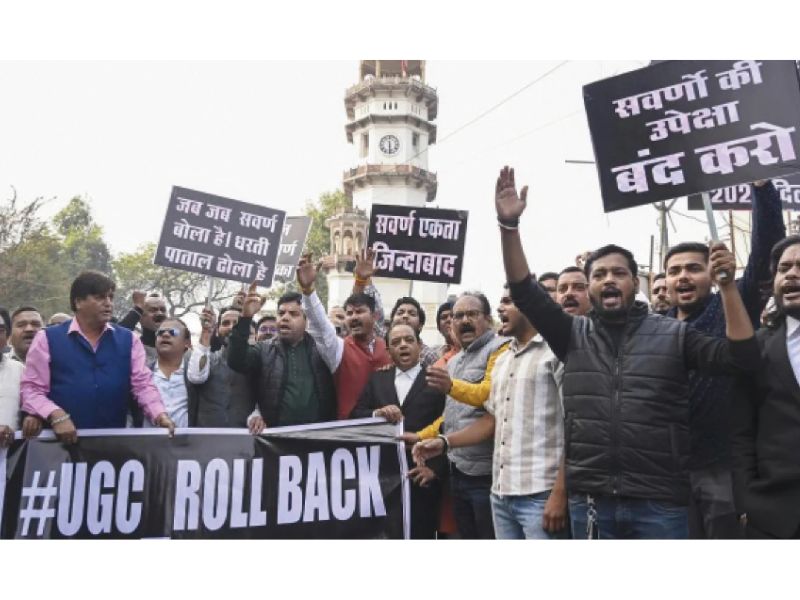
On January 29, the supreme Court of India stayed the University Grants Commission (Promotion of Equity in Higher Education Institutions) Regulations, 2026, following nationwide protests against the regulations. Meanwhile, the apex court has restored the previous 2012 regulations and posted the next hearing of the writ petition against the 2026 regulations on March 19.
The new Equity Regulations, inspired by the National Education Policy 2020’s commitment to “full equity and inclusion,” have broadened the ambit of the 2012 Regulations by holding institutional managements accountable for any and all discrimination against Scheduled Castes (SCs), Scheduled Tribes (STs), and other backward castes/classes (OBCs) and persons with disabilities. In particular, s.3 (c) of the new regulations prescribes heavy penalties against higher education institutions (HEIs) and students for discrimination against SCs, STs and OBCs.
The 2026 Regulations mandate every HEI to establish an Equal Opportunity Centre (EOC) with a faculty coordinator and an Equity Committee presided by the principal/vice chancellor; an Equity Squad to police discrimination, an Equity Ambassador, and a 24×7 Equity Helpline. Complaints of discrimination, harassment and caste slurs may be submitted online, or in writing to the EOC coordinator, with the option of anonymity.
Non-compliance with s.3 (c) provisions invites stringent penalties against HEIs ranging from disqualification from UGC schemes and academic programmes (including ODL and online modes) to removal from the UGC-recognised list under Sections 2 (f) and 12B of the UGC Act, 1956, plus other punitive action as decided by the Equity Committee.
The new 2026 equity regulations differ from the 2012 regulations in being more comprehensive and punitive. Coverage is extended to OBCs, gender minorities and persons with disabilities. Discrimination practised against specified castes is extended beyond students to cover teaching and non-teaching staff as well as online and distance learners. Moreover institutional penalties, which were mainly advisory in 2012, are now explicit, well-defined and enforceable.
The new equity regulations, which replaced the UGC (Promotion of Equity in Higher Educational Institutions) Regulations, 2012, were notified on January 13 and effective immediately, have raised an outcry from general category (‘upper caste’) students and faculty who highlight that discrimination is not defined which permits SC, ST and OBC students to allege caste discrimination by non-protected (upper caste) students in cases of mildest disagreement or contention. Moreover, complaints can be filed in the Equity Committee anonymously. In such cases, the committee is obliged to demand an explanation from targeted students and faculty. With the possibility of merit category/upper caste students transforming into “targeted minorities” on HEI campuses, a huge burden has been imposed on students accused of discrimination.
Unsurprisingly, campus India responded with massive protests countrywide reviving fear of protests of the mid-1980s, when several students immolated themselves after the V.P. Singh government based on the findings of the Mandal Report (1980) decreed an additional quota of 27 percent in government jobs and HEIs for OBCs.
Against the backdrop of massive protests breaking out countrywide, several writ petitions were filed in the Supreme Court seeking a stay on the new equity regulations. A bench comprising Chief Justice Surya Kant and Justice Joymalya Bagchi, ordered that the regulations be kept in abeyance, observing that prima facie some provisions of the impugned regulations were ambiguous and subject to misuse. The bench further noted that the 2026 regulations “raised several constitutional and legal questions” that required further judicial scrutiny.
“The poorly drafted 2026 regulations have generated valid apprehensions. In haste, without applying their minds, the UGC bureaucracy
neglected to define discrimination and provide guardrails to prevent misuse of the sweeping provisions of the regulations. They seem unaware that student-to-student discrimination — harassment in hostels, classrooms, canteens, and other public spaces — is already covered by the Anti-Ragging Regulations 2016. Institutional discrimination, however, is subtle, indirect, and occurs in private interactions, assignments, and evaluations, and needs greater clarity which the new regulations should have provided. Prevention, not punishment, should be the objective, and awareness of details of institutional discrimination is missing,” says Prof. (Dr.) Raj Kachroo, founder of Aman Trust, an anti-ragging NGO, and member of the National Taskforce on Mental Health.
Clearly, UGC’s new equity regulations holding HEIs accountable for discrimination against historically oppressed castes are warranted. But UGC babus should have accorded due care and diligence to drafting the regulations which are now obliged to suffer the law’s delay. Yet at bottom, the greater tragedy is that caste discrimination and prejudice is pervasive in the country’s highest institutions of learning, where the rule of reason and knowledge should be paramount. Tea leaves predicting the future don’t read well.











Add comment