






Telangana: Rising Scepticism
– Priyanka Edupuganti (Hyderabad)
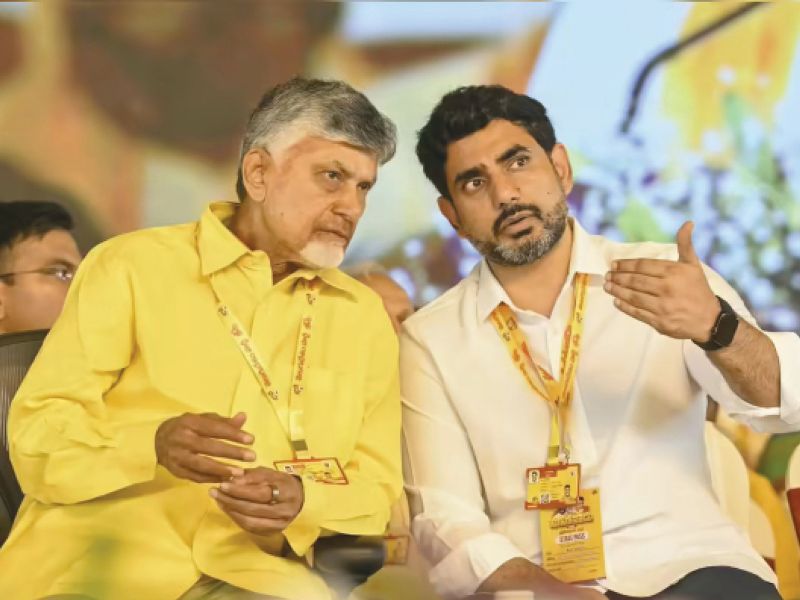
The telugu desam party (tdp) government led by veteran chief minister Chandrababu Naidu, which returned to power with a decisive mandate last year, seems determined to reposition Andhra Pradesh not merely as an administratively efficient state, but as a national leader in science, technology, and innovation.
Widely credited for developing Hyderabad into an ICT (information communication technologies) hub rivalling Bangalore, Naidu suffered a setback when Andhra was divided into the two states of Telangana (pop. 35.2 million) and Andhra Pradesh (pop. 49.4 million) in 2014, with Hyderabad awarded to the former. Moreover in the first new Andhra Pradesh election, Naidu — a three-time chief minister of undivided Andhra Pradesh — was ousted from office. Now he seems intent on carrying on from where he left off and transforming Andhra Pradesh into a national leader state in education, technology, and human capital development. In this endeavour, he is enabled by his son, the go-getting Nara Lokesh, an alum of America’s blue-chip Stanford and Carnegie Mellon universities, who is serving as education minister.
Simultaneously with launching of a massive Rs.50,000 crore project to construct a new administrative capital for Andhra Pradesh — a monumental endeavour in which the father-son duo has the advantage of TDP being allied with the BJP/NDA government at the Centre and hence the latter’s financial support — the state government launched two ambitious projects in the education space. Last July, Lokesh synchronised a mega Parent-Teacher Meeting (PTM) 2.0 in which 22 million parents, students, teachers and public representatives participated to discuss and debate ways and means to strengthen parent-school partnerships; transparency and accountability; and promote life skills through co-curricular education. According to Lokesh, the event which convened simultaneously in 13 cities and towns statewide, was the largest PTM in Indian history.
Subsequently in October, the TDP government launched an ambitious LEAP (Learning Excellence in Andhra Pradesh) programme to revolutionise K-12 education statewide through technology, innovation, and inclusion. Under the LEAP framework, the state government is overhauling and re-building AP’s school education system on five pillars — curriculum reform, teacher training, infrastructure improvement, digital learning, and assessment. According to Lokesh, LEAP is closely aligned with the National Education Policy (NEP) 2020 and introduces AI-driven evaluation tools, play-based learning in early years, and digital content modules designed to nurture children’s creativity, communication, and problem-solving skills.
Now the latest TDP initiative is establishment of AP FIRST (Andhra Pradesh Futuristic Innovation and Research in Science & Technology), a high-impact science and technology ecosystem to be developed in Tirupati in collaboration with IIT-Tirupati and the Delhi-based Indian Institute of Science, Education & Research (IISER). The objective is to promote research in the emerging fields of artificial intelligence, aerospace engineering, cybersecurity, semiconductors, biotechnology, green energy, and advanced manufacturing. In contrast to traditional research parks, AP FIRST will be built around an ecosystem model — academic research, startup incubation, applied innovation, and skills development — all combined into a single structure.
“AP FIRST is not designed as an individual programme, but a platform that will bridge the divide between higher education and employability. The aim of the state government is to make sure that Andhra students are not mere degree holders, but also well versed in frontier technologies that will shape the growth of India in the next three decades,” says a senior official in the ministry of higher education.
If implemented as planned, AP FIRST will be a turning point in the history of Andhra Pradesh — turning the state into a reservoir of talent, ideas, innovation, and intellectual property. Similar to how Kerala has long been considered a fully literate state, and Karnataka a leader in the field of IT, Andhra Pradesh now seems to be making a claim to become India’s premier science and deep technology state.
However on the downside, there’s growing scepticism that Naidu pere et fils are acquiring a reputation for announcing grand projects, but are reticent about detailing their implementation progress. “Media access of independent press to the chief minister and education minister who call all the shots in Andhra Pradesh, is tightly controlled and limited. It’s all very well to announce grand projects, but information about their progress and financial feasibility is scarce,” says a media veteran, who preferred to remain anonymous because “the Naidus are not enamoured with independent journalists”.











Add comment