






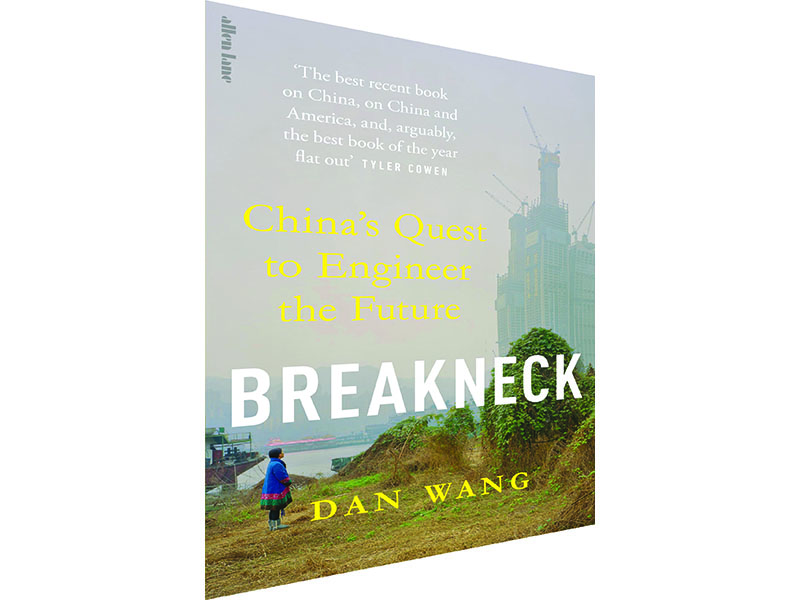
Engineering nation
 breakneck: china’s quest to engineer the future
Dan Wang
Allen Lane
Rs.1,499
Pages 260
A stirring account of how enthusiastic engineers and go-getting entrepreneurs driven by strong government built an ‘engineering state’ in record time
An amazing, globally unprecedented economic resurgence is happening in our neighborhood of which most Indians are blissfully unaware. Even as India’s complacent political leaders are expressing satisfaction that contemporary India is “the world’s fastest growing major economy”, a less than six hours direct flight from Delhi to Beijing or Kolkata to Shanghai is likely to transport them into a new 21st century nation that has taken centrestage as the world’s most powerful economy, challenging America’s supremacy established after World War II.
In 1949 Chairman Mao Zedong — after the comprehensive defeat of the Kuomintang army under Generalissmo Chiang-Kai Sheik retreated to Taiwan — unfurled the flag of the People’s Republic of China in Tiananmen Square, Beijing and announced to the world “China has stood up.”
The stirring story of how and why since then The People’s Republic of China (PRC) has transformed into the world’s economic powerhouse second only to America, is recounted in this revealing book authored by Dan Wang, a research fellow at Stanford University. Before writing this insights-rich labour of love, Wang spent six years in Hong Kong, Beijing and Shanghai, often bicycling through remote provinces of the country to study this “engineering state” built in record time by enthusiastic engineers, go-getting entrepreneurs and strong government.
On the other hand after two centuries of leading-edge industrial and economic growth, America has transformed into a “lawyerly society” in which starting new projects immediately invites objections from influential NIMBY (not in my backyard) citizens quick to object on environmental damage and other grounds.
A telling statistic that’s come to light recently is that the $300 billion oil refinery proposed to be built by our own Reliance Industries will be the first greenfield oil refinery in the US in 50 years. In sharp contrast PRC is believed to have constructed 12-16 large greenfield petrochemical refinery complexes in the new millennium, most of them built after 2010.
The point the author belabours is that “China is an engineering state which can’t stop itself from building.” In 1978 Secretary-General Deng Xiaoping launched radical reforms to modernize China after the “mayhem of the Mao years”. Bearing in mind that China had several millennia of free enterprise traditions and history, he set PRC firmly on the capitalist road and gave China’s merchants and businessmen free rein. Simultaneously he promoted engineers into the top ranks of government. As a result, writes Wang, by 2002 all nine members of the Politburo’s Standing Committee – the apex coterie of the Communist Party of China (CPC) — were qualified and trained engineers.
This preference for engineers-builders continues. When President Xi Ping — a chemical engineering graduate of China’s top-ranked Tsinghua University — began his third term as Secretary General in 2022, he filled the politburo with executives from China’s aerospace and weapons ministries. And what do engineers like to do? “Build,” says Wang who evidently hasn’t heard of time-serving engineers in India’s 256 public sector enterprises and equal number in the states. According to the Union ministry of Statistics and Programme Implementation data, of 1,392 large public sector projects countrywide, 430-450 are behind schedule with delays of 12-36 months common in railways, roads and irrigation projects and five-10 years not uncommon in mega projects.
On the other hand Wang has this to say about the speed and efficiency of Chinese engineers. “Since 1980 when Deng’s reforms began, China has built an expanse of highways twice the length of US systems, a high-speed rail network twenty times more extensive than Japan’s, and almost as much solar and wind power capacity as the rest of the world put together. It is not only government that is fixated on production; the corporate sector is made up of overactive producers too. As a rule of thumb China produces one-third to one-half of nearly any manufactured product, whether that is structural steel, container ships, solar voltaic panels, or anything else,” writes Wang. To this list one can add Ganesh statues, mangalsutras and cookware commonly used in Indian kitchens as noted by Ananth Krishnan in his revealing book India’s China Challenge (2020).
In Breakneck, the author is focused on promoting greater cooperation, if not a rapprochement between the Top 2 powerhouse nations (“I am sure that no two peoples are more alike than Americans and Chinese”). India is mentioned only once in a book which although featuring detailed notes relating to every chapter, doesn’t offer a subjects index. Nevertheless there is much our snail-paced economic development policy formulators, risk averse businessmen and ivory-tower academics can learn from this revealing study of modern China.
First, the importance of building public infrastructure (including affordable housing). To its credit the BJP/NDA government at the Centre, even if not state governments which prefer to distribute scarce resources as freebies, has understood the importance of public infrastructure. For several years since it was swept to power in 2014, it has sustained sizeable expenditure on public infrastructure — highways, roads, bridges, ports, electricity — even if quality leaves much to be desired.
However as lamented ad nauseam by your editors, soft infrastructure — public education and health — the necessary complement of hard infrastructure — has remained the blindspot of India’s policy formulators and the establishment for over seven decades. There is minimal awareness that roads, bridges, rail tracks need to be robustly constructed, operated and maintained, for which highly qualified engineers and a vocationally trained workforce are necessary. Although Wang has little to say about PRC’s education system, the very premise of this book that modern China has millions of excellent engineers busily constructing infrastructure, promoting hi-tech engineering businesses and giant firms manufacturing for most of the world at furious speed, implies that its education system is robust. Although investment in education seldom exceeded 3 percent of GDP in any given year, much of is invested in foundational primary education. As a result PRC has been a fully literate nation since the early 1970s.
Conversely, 30 percent of post-independence India’s education budgets are allocated for higher education. Therefore, India’s 1.10 million government primaries defined by crumbling buildings and non-existent infrastructure have consistently recorded rock-bottom learning outcomes, with more than half of class VII children unable to read class III texts and solve simple sums.
Moreover unlike India, in PRC only the best school-leavers who pass the highly competitive school-leaving gaokao exam enter universities, with the majority streaming into high quality vocational education and training institutions which produce skilled shop-floor and blue collar workers.
Meanwhile, China’s universities which set the bar high for academic excellence and certify high-quality engineers and scientists, who, as Wang convincingly illustrates in Breakneck, have transformed China into an economic colossus. India’s tragedy is that the good that it does by building hard public infrastructure is undone by its consistent neglect of developing human resources.
In this tortoise versus hare race, the hare is way ahead and is likely to remain so for the foreseeable future.
Dilip Thakore










Add comment