






EW Foundation Viksit Bharat Research Study: Saving India’s Collapsing Justice System
Even if belatedly, awareness is dawning not only within the bench and bar fraternity but also within the political leadership that reform and resuscitation of the comatose legal system needs to move to near top of the development agenda if the goals of Viksit Bharat and $30 trillion economy by 2047 are to be achieved
Kartikeya Chandra Sen & Dilip Thakore
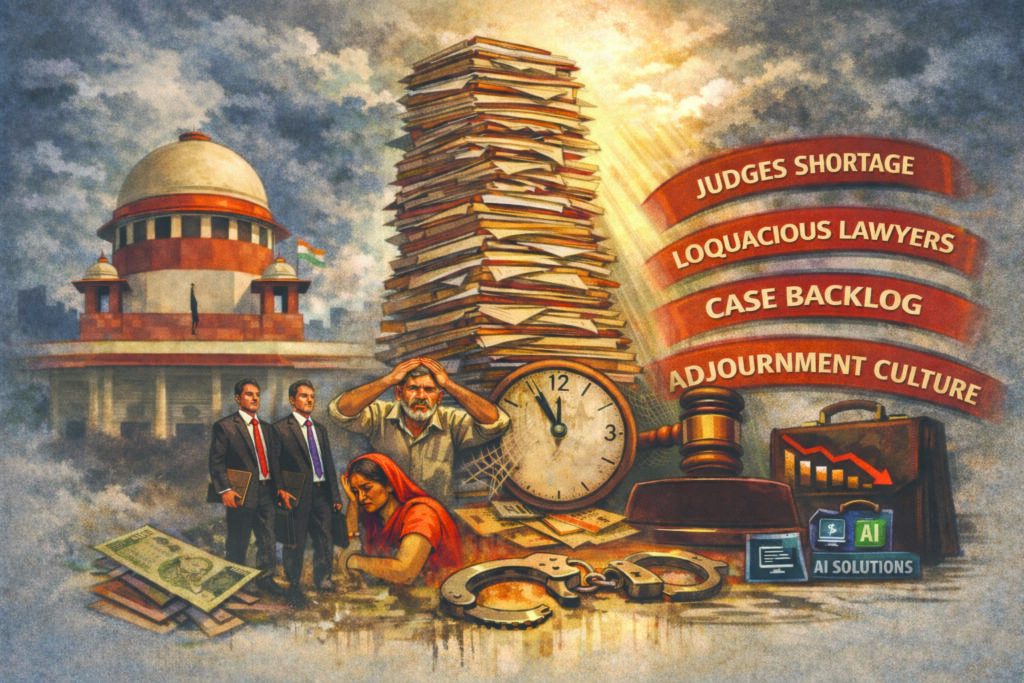
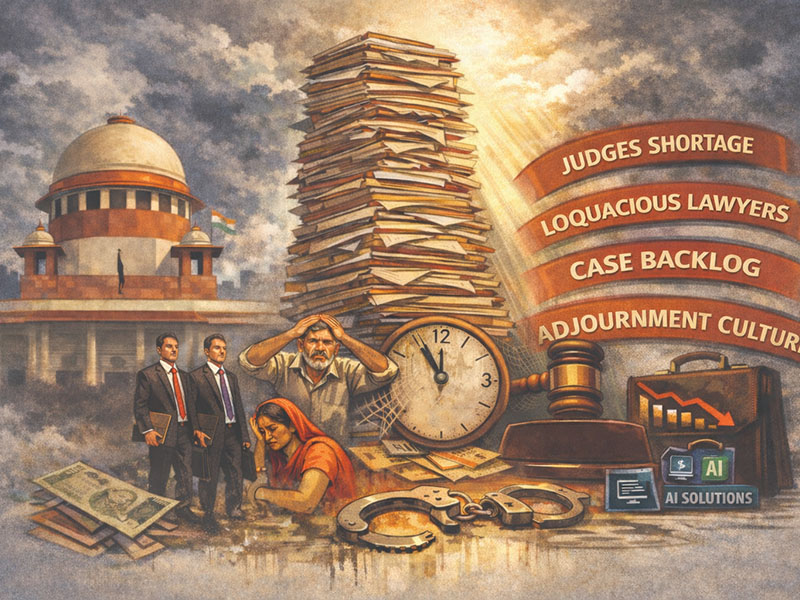
AI generated visual of the law’s exasperating delay: 50 million cases backlog
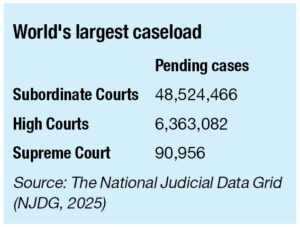
The Indian judicial system has attracted global attention for all the wrong reasons. Its mountainous backlog of 50 million pending cases is shaking public faith in the judiciary with the country’s legal system racing towards the precipice. At this juncture the recent elevation of the reform-minded Justice Surya Kant as the new Chief Justice of India has aroused a flicker of hope about accelerating case disposal in India’s overloaded legal system.
In learned judgements and public utterances, the Supreme Court of India has waxed eloquent about the high value the apex court accords to easy access and speedy dispensation of justice, even ruling that it is an integral part of the fundamental right to life under Article 21 of the Constitution. In Hussainara Khatoon v. State of Bihar (1979) reaffirmed in Hussain v. Union of India (2017), the apex court emphatically pronounced that access to justice and timely disposal of cases are constitutional guarantees.
But 75 years after the Constitution of India, replete with noble egalitarian ideals repeatedly endorsed and expanded by the Supreme Court, was adopted, the sheer scale of the judicial backlog and the law’s unbearable delay are fast eroding public confidence in the judicial system. Across the country vigilante justice dispensed by exasperated policemen, hysterical mobs and kangaroo courts has become popular. According to the India Justice Report 2025 published by the Mumbai-based Tata Trusts, the proportion of long pending cases has become worse in recent years. In 16 states and Union territories, the share of cases pending for more than five years has increased during the past two years.
In the Indian legal system, ‘subordinate’ courts (district, sessions and magistrates) are the most crucial forums of justice delivery. Yet the total sanctioned strength of judges in these courts is merely 25,771, which translates into a mere 18 judges per 1 million citizens. In district courts, the ratio is 15 judges per 1 million citizens. (India Justice Report 2025)
The situation in the higher courts is not much better, despite their having to adjudicate only a sliver of the country’s litigation. In 25 high courts countrywide, the total pendency of cases is 6.3 million, of which more than 2.8 million are older than five years. Likewise, pendency in the Supreme Court has reached an all-time high of 90,956 cases, of which approximately 20,000 cases are more than five years old, despite the apex court operating at the full sanctioned strength of 34 judges.
Mazumdar: process as punishment
“There is considerable substance in the claim of communist and extreme Left parties that India is a ‘bourgeois democracy’. Access to law courts and the justice system is mainly restricted to the upper middle class because of structural composition of the economy characterised by vast income disparities. In the absence of a functional legal aid system and the huge cost a daily wage worker or small farmer would incur to access courts — which also levy court fees in civil cases — for the overwhelming majority of citizens, approaching courts of justice is a daunting proposition. Moreover, India’s judicial system is highly procedural and process-oriented rather than outcomes oriented, which makes adjudication delays inevitable. This encourages wealthy individuals to embroil the less privileged in prolonged litigation, thus transforming the process into punishment,” says Dr. (Prof.) Surajit Mazumdar, an alum of Delhi’s show-piece, high-ranked Jawaharlal Nehru University (JNU, estb. 1969) where he is currently professor of economics.
Widespread inconvenience and massive time and financial loss inflicted upon litigants countrywide apart, India’s case arrears mountain and snail-paced justice system has inflicted huge hidden costs upon the economy by way of business and domestic and foreign investment loss.

Sanjeev Sanyal
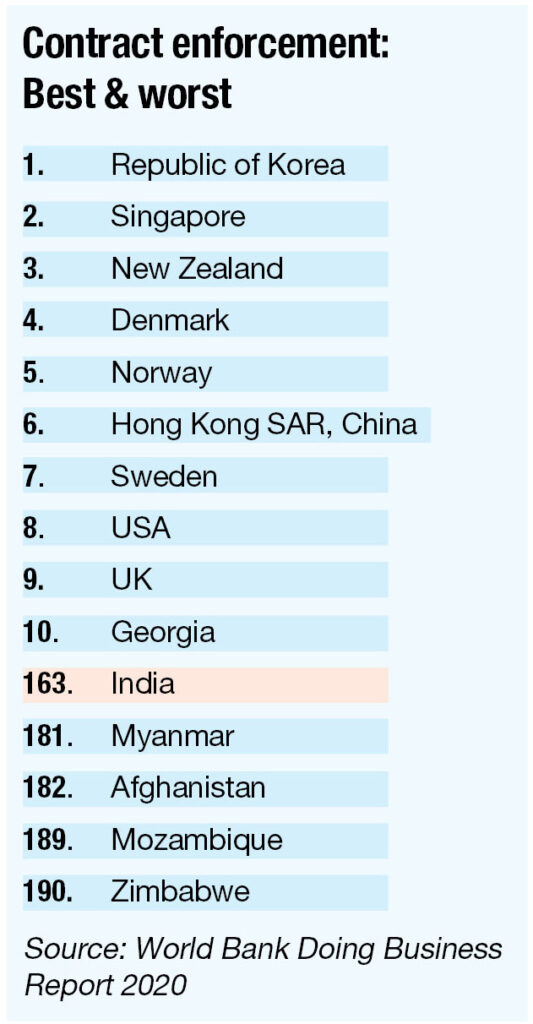
Sanjeev Sanyal, a member of the Prime Minister’s Economic Advisory Council, believes that India’s lackadaisical, time-agnostic judicial system is a major hurdle to attaining the Viksit Bharat and $30 trillion GDP goals for 2047 — the year in which India will celebrate its centenary of independence from foreign rule — set by Prime Minister Modi. Addressing a Nyaya Nirman Conference in Delhi last September, Sanyal said: “The judicial system and the legal ecosystem in particular is in my view the single biggest hurdle to becoming Viksit Bharat and growing rapidly,” identifying slow disputes resolution and weak enforceability of contracts as special impediments.
This is confirmed by a State of Tribunals Report 2025 of DAKSH, a Bengaluru-based legal think tank. According to the report, Rs.24.72 lakh crore — a sum equivalent to 7.48 percent of India’s GDP — is tied up in 2.5 lakh disputes pending before under-staffed commercial tribunals. Insolvency cases often take an average of 752 days (cf. the statutory limit of 330 days) to resolve, and over 85 percent of debt recovery cases exceed the 180-day norm. An additional 2.11 percent of GDP is consumed by backlogs in tax tribunals. All this is symptomatic of a larger judicial malaise that is slowing economic decision-making and growth and eroding investor confidence.
 Indeed, time agnosticism — which defies the spirit of the maxim “justice delayed is justice denied” — seems to pervade not only the legal ecosystem but government as well. Chronic deficits in judicial capacity, inadequate infrastructure, financial resource constraints pervade the system. Unfilled judicial vacancies exist at all levels. The India Justice Report 2025 says that high courts are functioning with 33 percent vacancies overall. Sixteen out of 25 high courts have one in four judges unappointed, and five high courts record vacancy levels above 40 percent which includes the Allahabad high court where judicial vacancies have touched 51 percent. Subordinate courts continue to operate with 21 to 22 percent vacancies. The situation has not moved an inch on this front for years despite these courts being beset with 90 percent of India’s pending caseload.
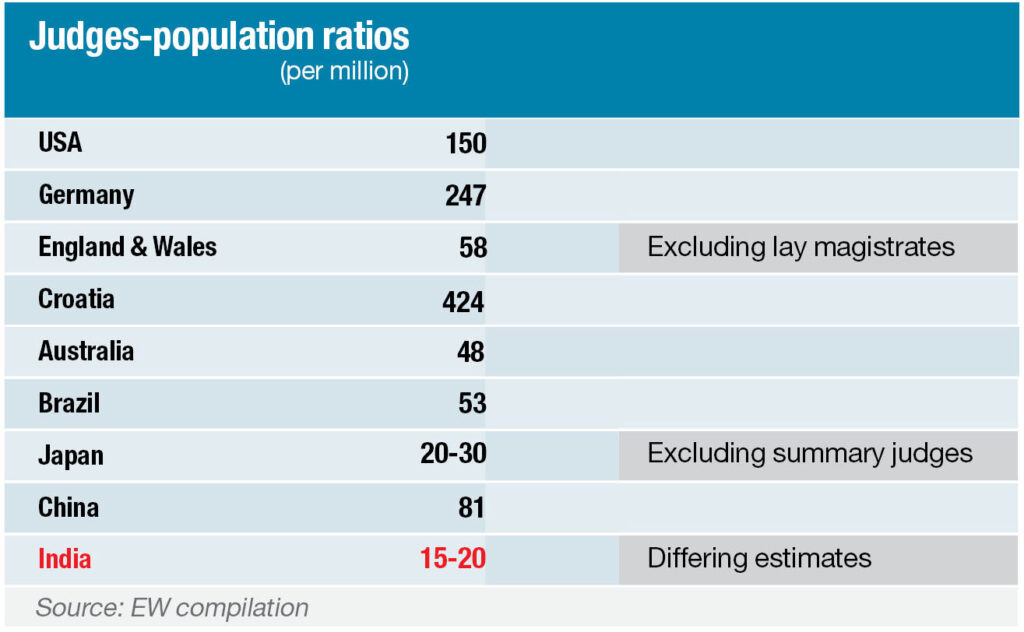
Vacancies in the country’s 25 high courts sit atop the original sin of a hugely adverse judges to population ratio — a rock-bottom 15.9 judges per million people (India Justice Report, 2025). This is far below global standards. The United States has 150 judges per million and the European average is approximately 220 per million. Dilapidated, inadequate infrastructure compounds the problem. India has only 22,045 usable court halls available for seating its 25,000 judges. A 2023 report published by the New Delhi-based Centre for Research & Planning, based on a survey of judicial/non-judicial personnel, found a majority of interviewees opined that the existing justice system infrastructure is inadequate. This because between 2011-12 and 2015-16, annual expenditure on the judiciary and justice system averaged a mere 0.08 percent of GDP. Although the 13th and 14th Finance Commissions (2010-15 and 2015-20) recommended higher allocations, their suggestions have been largely ignored.
Unsurprisingly, the World Justice Project’s Rule of Law Index (2025) ranks India below Indonesia, China, and Vietnam on overall justice system delivery. On the specific indicator of judicial efficiency and timeliness, the highly-respected London-based weekly The Economist ranks India #131 of 142 countries, behind Pakistan and even civil wars-ravaged Sudan.
Doyens of the Indian Bar — several of whom file income tax returns of Rs.50 crore per year, profiting from a legal system everyone hates — seem unaware that in the US Supreme Court, plaintiffs and defendants are obliged to limit oral arguments to 30 minutes each. The rationale for this convention is that judges can read and comprehend written pleadings which set out the facts and legal arguments of contending parties. Nevertheless, even written pleadings are limited to 13,000 words, a sharp contrast with the Indian legal system which tolerates — indeed encourages — repetitive contentions and pleadings.

Sengupta: insulated system
It’s not that intelligent solutions for cleansing the Augean stables of India’s legal system, which is extracting a huge cost from the economy by way of discouraging foreign and domestic investment and by way of human suffering — on February 19, the Allahabad high court acquitted Khunni Lal imprisoned on a murder charge for 37 years — are not available. “Developed during the days of the British Raj, India’s justice system was designed for perpetuating imperial rule, not for the benefit or needs of India’s people. Focused on procedure and process, the legal system remains insulated with neither the judiciary nor lawyers accountable to the public for the law’s delay and massive cases backlog. Moreover, in the absence of no substantial push from the public, judicial reforms are episodic and uncoordinated,” says Arghya Sengupta, an alum of the National Law School of India University, Bangalore and Oxford University (UK) and Founder-Research Director of the Delhi-based Vidhi Centre for Legal Policy.
Registered in 2013 as a not-for- -profit research-based think tank to aid and abet the Central and state governments to write better laws and improve legal governance, Vidhi Centre which comprises over 90 academics and researchers, has quickly established an excellent reputation as a nationally reputed legal think tank that has persuaded the Central and several state governments to repeal 119 archaic and obsolete laws and establish a bankruptcy laws ecosystem.
“An important reform urgently required is to substitute the registries of Supreme and High Courts — currently managed by district court judges — with business management professionals working under the guidance of the judicial leadership. This will enable judges to focus on justice dispensation and management professionals to administer and accelerate the justice system,” says Sengupta.
To a large degree, the law’s delay and inertia of the system is because governmental litigation is clogging the system. Plea bargaining in criminal cases and out of court settlements by government agencies which would free up the courts, are almost unknown in India. Government, by its own admission, is the largest litigant in the country and mainly responsible for clogging the judicial system with inessential legal filings and routine appeals. In this connection it’s also important to note that the costs of government-initiated litigation — often recklessly and without sufficient cause — are borne by government, whereas in the absence of a meaningful legal aid system, accused in criminal cases and defendants in civil litigation have to bear their own legal expenses. Moreover, when aggrieved citizens file civil suits, they are obliged to fork out ad valorem court fees which could rise from thousands to crores and even if plaintiffs win, costs awarded against patently frivolous and vexatious plaintiffs, are derisory.
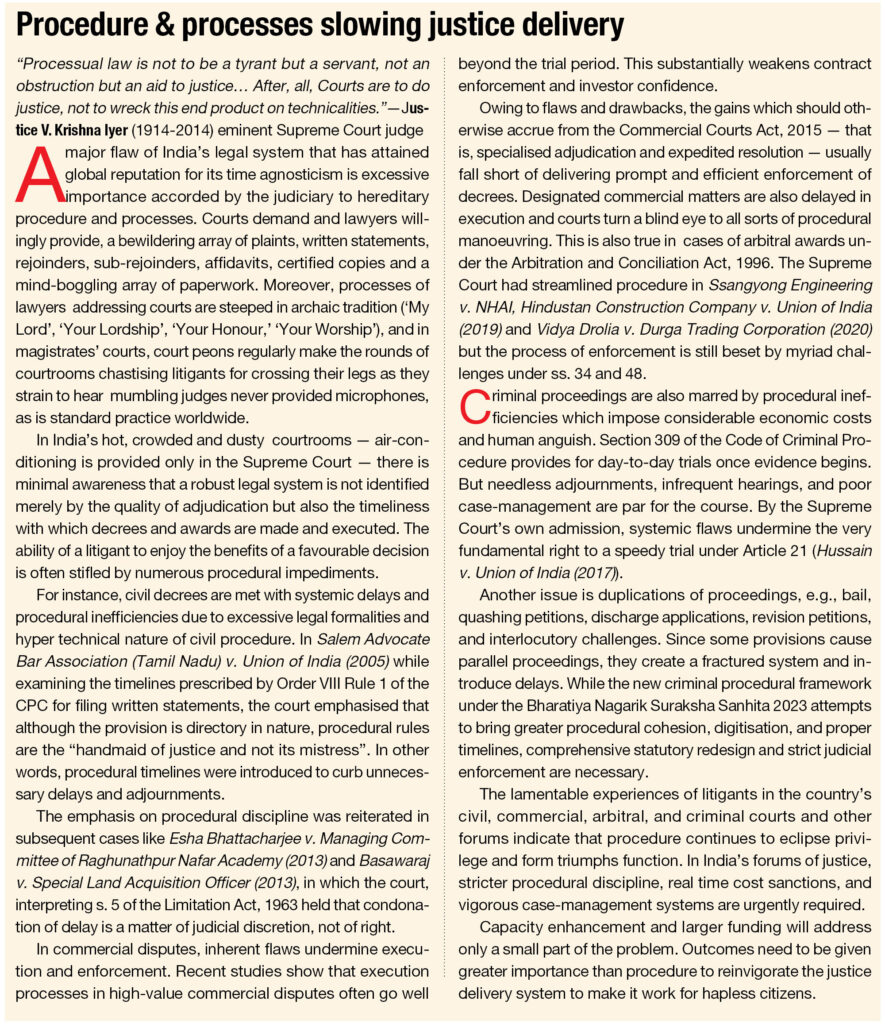
 Over the decades, in response to PIL (public interest litigation) writs, the Supreme Court has issued directions to improve salaries, infrastructure, and service conditions of the district judiciary. But they have been couched in the language of advisories rather than clear directives, leaving final decisions at the discretion of cash-strapped governments. Within the academic, if not legal, fraternity there is a rising sentiment of opinion that given the separation of powers and independence of the judiciary, the latter should direct the Central and state governments to set aside a fixed or minimum share of the annual budget for the expansion and maintenance of the judicial system. But thus far the apex court has not exercised this power.
In 2021, a Supreme Court bench refused to entertain a writ petition praying for the court to issue a mandatory annual budgetary allocation for the judiciary. This was notwithstanding submissions that government spending on the critically important judiciary aggregated to less than 1 percent of their annual budgets. “The country’s venal politicians and bureaucrats have a vested interest in ill-drafted laws, procedural complexities and prolonged justice-dispensation delays because they can weaponize the law to terrorise the public and extort bribes and illegal-gratification. That’s why despite the recommendations of dozens of Law Commissions and brazenly inadequate judges-people ratio, they not only clog the system with litigation, but also neglect to build additional courtrooms and fill sanctioned vacancies. Their imperviousness to public suffering and good governance is driven by the oppression of citizens to which they have become accustomed,” says a senior counsel of the Bombay high speaking on condition of anonymity because the “long arm of government” may reach out to him.

Prasanna: lower courts focus plea
Although theoretically the separation of powers between the legislature, executive and judiciary, empowers the Supreme Court to direct the executive (government) to make sufficient budgetary provision for building more courtrooms and appointing additional judges, Alok Prasanna, an alum of NALSAR, Hyderabad and Oxford University (UK) who practiced law in the Supreme Court and Delhi high court for five years before he co-founded (with Arghya Sengupta quoted above and others) the not-for-profit Vidhi Centre for Legal Policy in 2013, warns such action by the apex court is inadvisable.
“Contrary to popular belief, the Constitution doesn’t mandate just separation, but also balance of powers between the judiciary, legislature and executive. Therefore any such pre-emptive action by the Supreme Court would upset this constitutional balance of power. Instead, since the overwhelming majority of India’s pending cases backlog is in district courts which are funded by state governments, a better course of action would be for Chief Justices of the high courts to persuade state governments to upgrade the judicial infrastructure of the district and lower courts and appoint more judges in the states. This will also have the beneficial outcome of attracting more investment in industry and business in the states,” advises Prasanna.
 Meanwhile there’s rising awareness within the judiciary that push has come to shove in the country’s legal system that has been overwhelmed by a mountainous cases backlog, adverse judges to population ratio, and unfilled vacancies which have made the justice system seem very uninviting for hapless citizens. Since he assumed office as Chief Justice of India on November 24, Justice Surya Kant has opined that India’s backlog of cases is a symptom of deeper structural failure encompassing adjudication, administration, and enforcement. Speaking at a convocation ceremony for the graduating batch of the National Law University, Jodhpur CJI Surya Kant said that the legal system “must function as a forum where citizens must question authority, assert rights and resolve differences through reasoned dialogue” and that the Constitution “was designed as a living framework with each generation expanding its personal liberty and privacy to substantive equality,” according to a Times of India news report (February 23).
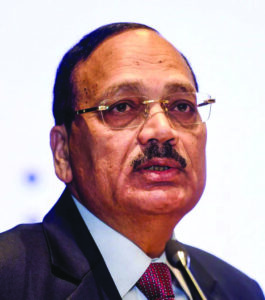
CJI Surya Kant: inspiring words
These are inspiring, uplifting words. However, it’s pertinent to note that they have been uttered before. CJI Surya Kant’s predecessor, the Harvard Law School alum Justice D.Y. Chandrachud aroused great hope that he would initiate root and branch reform of the snail-paced legal system. But like many of his determined predecessors, despite best efforts, he failed to initiate any meaningful judicial reforms. The law’s delay, insolence of office and proud man’s contumely continue to weigh heavily on the citizenry and public. It’s also the co-author’s (Dilip Thakore) experience that alarm about the imminent breakdown of the justice system and the need for urgent repair and reform were expressed by CJI Chandrachud’s father CJI Y.V. Chandrachud when he interviewed him for Business India half a century ago.
Quite clearly, although post-independence India’s learned judges and legal eagles have established global reputations for legal acumen and forensics system management, reforms ideation and implementation seem to be beyond their capabilities.
However, the enthusiasm with which Bench and Bar have embraced new digital technologies are cause for optimism. India’s e-Courts programme, online filings, electronic cause lists, and improved access to case information hold out promise of better days ahead. The Union ministry of justice’s e-Courts Phase III vision envisages a shift from digitisation to decision-support systems, end-to-end paperless courts, integrated case-flow management, and advanced analytics for efficient cases disposal. Moreover, within the top echelons of Bench and Bar, the new era of AI (artificial intelligence) is being welcomed as a “productivity multiplier”. Preliminary policy analyses suggest that incremental use of AI-assisted tools will aid and enable automated cases classification, intelligent scheduling, precedents and citations mapping, and compliance monitoring, thus significantly reducing the time judges spend on mundane administrative functions, particularly in commercial, tax, and regulatory disputes.
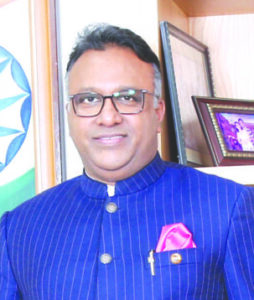
Raj Kumar: mindset change call
Against the unfolding scenario of the upper judiciary proving surprisingly adaptive to new digital and AI enabled technologies, Dr. (Prof.) C. Raj Kumar, the polymath (alum of Madras, Delhi, Oxford and Harvard universities) Founding Vice Chancellor of O.P. Jindal Global University, Sonipat which since it admitted its first batch of students in 2009 has been repeatedly ranked India’s #1 private law and liberal arts university in the annual EducationWorld India Higher Education Rankings (EWIHER) and several other international ranking league tables, is cautiously optimistic that a consensus has emerged within government, Bench and Bar about ways and means to resuscitate India’s legal system before mountainous case pendency inflicts grave damage on the economy.
Dr. Raj Kumar believes that the country’s slow-paced, procedure-focused justice delivery system can be swiftly modernized using newly-emergent digital and AI technologies. Among his suggestions: rapidly reducing the massive pending cases backlog by introducing a digital cases management system driven by AI-based scheduling; institutionalizing ADR and arbitration with firm timelines; improving contracts enforcement through establishing fast-track commercial courts; clamping down on the adjournments culture; reforming the civil and criminal procedure codes; making justice accessible to all through promoting mobile and e-courts in the lower judiciary; hearing cases in vernacular languages; universalizing access through revival of the National Legal Services & Aid program enabled by a substantial corpus and expeditious digitization of land titles as “most litigation is related to land and property disputes”.
 “Investing resources in modernizing the legal system should not be viewed as expenditure but as investment in economic development. A smoothly functional legal system impacts all sectors of the economy and provides significant long-term benefits. A societal mindset change is required to understand this,” he says.
Fortunately, even if belatedly, awareness is dawning not only within the fraternities of Bench and Bar, but also within the political leadership, that reform and resuscitation of the comatose legal system needs to move to near top of the national development agenda if the goals of Viksit Bharat and $30 trillion economy by 2047 are to be achieved.
The case that a smoothly functional law and order and justice system is a precondition of the double-digit annual GDP growth that is required to attain these goals has been established beyond all doubt. Now the onus is on the legal fraternity to make common cause with the Central and state governments to pull out all stops to get India’s legal system back on the rails.











Add comment