






India’s Top 200 Private B-Schools 2026-27
The annual EWIHER ranks the country’s 200 most well-reputed private B-schools. It serves a useful purpose inasmuch as it beams a searchlight on easily accessible B-schools which don’t receive the coverage and publicity of the IIMs- Dilip Thakore
 As Founding-Editor of Business India and BusinessWorld — India’s first business news magazines which planted the seeds of liberalisation and deregulation of the Indian economy after 30 years of licence-permit-quota raj strangled Indian industry at birth — I recall being very excited by the prospect of writing about the Indian Institutes of Management (IIMs), especially the high-profile IIM-Ahmedabad. Over 40 years ago, I duly wrote detailed cover stories on IIM-A, IIM-Bangalore, IIM-Calcutta, dutifully recording the great productivity leaps they were planning to vault Indian industry into the orbit of developed western nations. But now almost half a century later, although the number of IIMs — endowed by taxpayers with huge 100-acre state-of-the-art campuses hosting only 500-600 highly-subsidised students — has multiplied to 23, I can’t recall any of them having ideated a headline-grabbing innovation or project to vault India or any corporate into the league of OECD nations.
I expected their learned research-oriented professors and students to come up with something like mass affordable housing, a massive food processing industry and the like, which would enable India Inc to mine the fortune at the bottom of the social pyramid as the late and forgotten Prof. C.K. Prahlad reminded us is available for the taking. Undoubtedly, IIM professors and graduates have conceptualised plans and programmes that have marginally improved productivity of India Inc and the Central and state governments, but one is still waiting for breakthrough ideas that will enable a quantum leap in the crawling-along Indian economy to emerge from the shady bowers of the country’s 23 IIMs for whom a provision of Rs.292 crore has been made in Union Budget 2026-27.
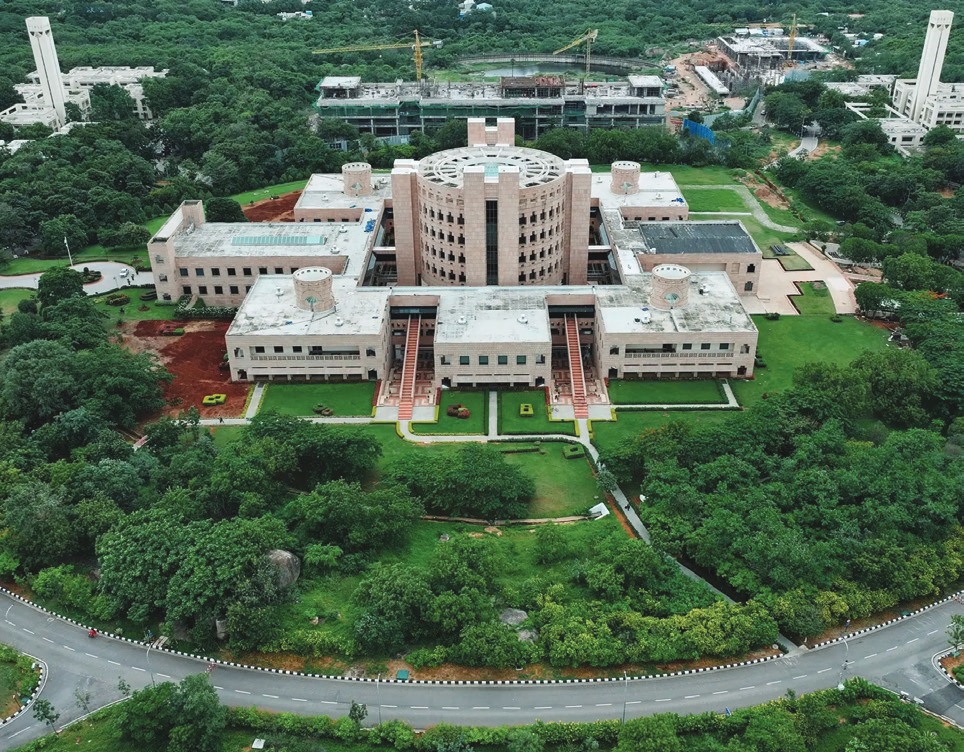
ISB, Hyderabad: #1 for a decade
However, the insolence of office of IIM directors is in inverse proportion to their big ideas record. On numerous occasions, we have written appropriately supplicatory letters to directors of IIMs soliciting interviews for cover stories to assess their contribution to the growth and development of Indian industry, only to be informed that their busy schedules don’t permit. This despite your editors having sprung to their defence a decade ago when former Union education minister Smriti Irani made a backdoor attempt to dilute their autonomy and pack their boards with (BJP) party favourites. Even though we didn’t get a word of thanks, we believe our cover story outing and condemning this initiative saved the IIMs (see https://educationworld.in/hostile-takeover-bid-2-0/).
Be that as it may, for reasons of inaccessibility and because the IIMs routinely top all media league tables ranking the country’s most admired B-schools, in 2016 your editors resolved to eliminate IIMs from the annual EWIHER survey of B-schools, and restrict our league tables to private B-schools where admission chances of aspirants are better. However, the insolence of office discernible within the IIMs seems to have rubbed off on Dr. Madan Pillutla, incumbent director of the Indian School of Business (ISB), Hyderabad, ranked India’s #1 private B-school in the annual EWIHER for a decade.
Although his predecessor Dr. Rajendra Srivastava was more willing to share the success secrets of ISB established in 2002 on a sprawling 250-acre state-of-the-art campus in Gachibowli in suburban Hyderabad, despite numerous pleas, Pillutla has not deigned to respond to your editor’s emails and phone calls. This is a loss to the country’s estimated 5,000 B-schools because by all yardsticks, ISB is perhaps the sole Indian B-school on a par with the IIMs. And although in Indian media, IIM-A and IIM-B are often higher ranked, in the latest global B-schools survey of the authoritative Financial Times, London, ISB at #12 is ranked well above IIM-A (27) and other B-schools. Pity that Pillutla, who is undoubtedly well-versed in marketing and brand building, failed to avail ISB and himself this free-of-charge brand reminder opportunity.
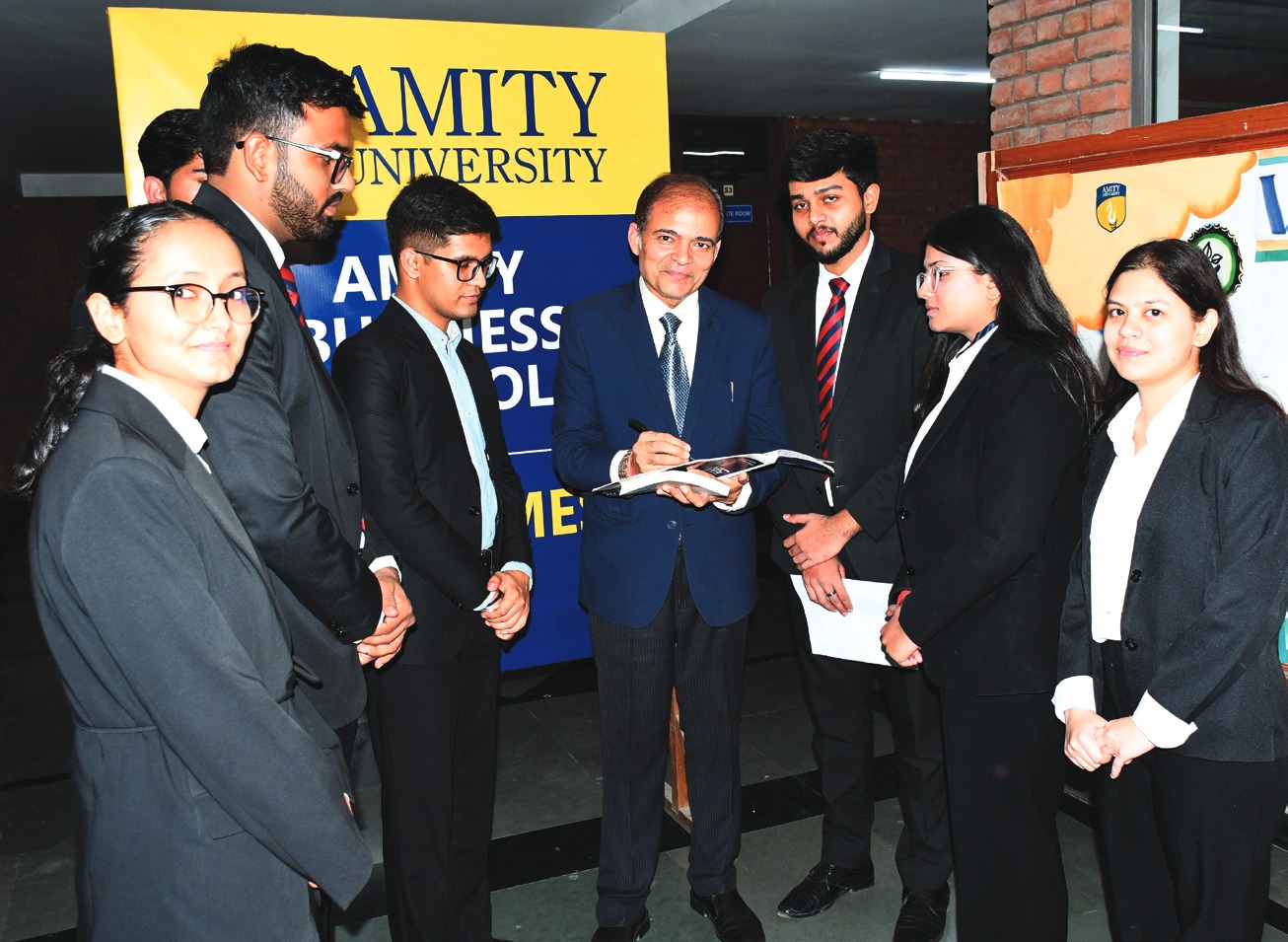
Amity B-school’s Sanjeev Bansal: motivational promotion
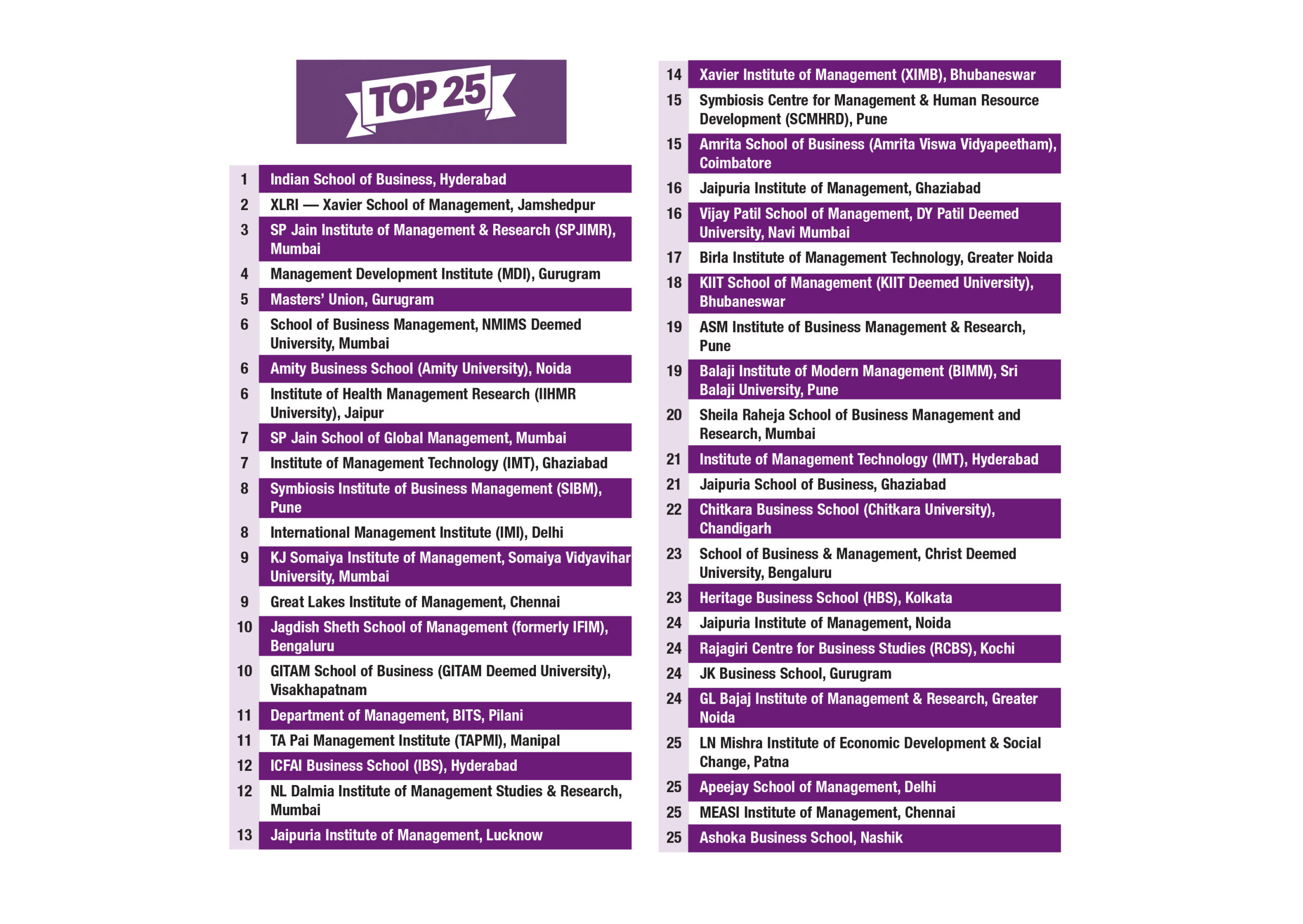
In EW’s 2026-27 league table of India’s most admired private B-schools, ISB is followed by XLRI, Jamshedpur which has retained its #2 rank of the past quinquennium; S.P. Jain Institute of Management & Research, Mumbai is promoted to #3 (from #5 in 2025-26); Management Development Institute, Gurugram #4 (4); Masters’ Union, Gurugram #5 (3); School of Management, NMIMS University, Mumbai #6 (6) jointly ranked with Amity Business School, Noida (9) and the Institute of Health Management Research, Jaipur (8).
These B-schools are followed by the S.P. Jain School of Global Management, Mumbai awarded a big promotion to #7 (11) and jointly ranked with the Institute of Management Technology, Ghaziabad (7). The Pune-based Symbiosis Institute of Business Management #8 (9) is co-ranked with the International Management Institute, Delhi (12) awarded a big promotion. Further down the Top 10 table, the K.J. Somaiya Institute of Management, Mumbai (9) is co-ranked with the Great Lakes Institute of Management, Chennai at #9 (24) with the latter awarded a huge promotion by this year’s sample respondents. The Jagdish Sheth School of Management, Bengaluru (14) and the GITAM School of Business, Visakhapatnam (28) complete the Top 10.
Dr. Sanjeev Bansal, Director of Amity Business School (ABS), is “gratified and elated” that this year’s 2,175 knowledgeable sample respondents have promoted Amity Business School to India #6 and Uttar Pradesh #1. “This big promotion will motivate us to re-double our efforts to meet the rising expectations of our students and stakeholders,” says Bansal.
Bansal is especially pleased by the high scores awarded to ABS under the parameters of competence of faculty, research and industry interface which are “intimately connected’ and proof that “this B-school is providing its students industry-aligned business management education”. Moreover, he is thankful that the sample respondents have acknowledged the heavy investment that the Amity Group management has made in developing ABS’ infrastructure and awarded it top score under this parameter. Evidently, he has no patience with the popular contention that investment made in excellent infrastructure is mere window-dressing.
“Enabling infrastructure is the hallmark of an excellent business school. It’s not about attractive buildings and layout. Enabling infrastructure must include smart classrooms, case study set-ups, simulation labs which replicate business ecosystems that facilitate knowledge transfer and collaborative culture and also comprises breakout rooms, incubation centres and co-working spaces that encourage teamwork. It also enables integration of technology which plays a pivotal role in smart enterprise resource planning, contemporary management systems, and knowledge creation and absorption. The quality of hostels, libraries, cafeterias, and sports complexes is also important for enjoyable and holistic development of aspirant business professionals. By providing our students excellent infrastructure, we are enabling them to learn, develop and grow in Amity Business School,” says Bansal.
Likewise, Dr. Sridevi Varanasi, Dean of the Jagdish Sheth School of Management (JAGSOM, formerly IFIM, estb.1995) which has impressed this year’s sample respondents who have awarded it a big promotion from #14 in 2025-26 to the Top 10 table and #1 in Karnataka/Bengaluru, is “deeply gratified” by JAGSOM’s re-entry into the Top 10 table.
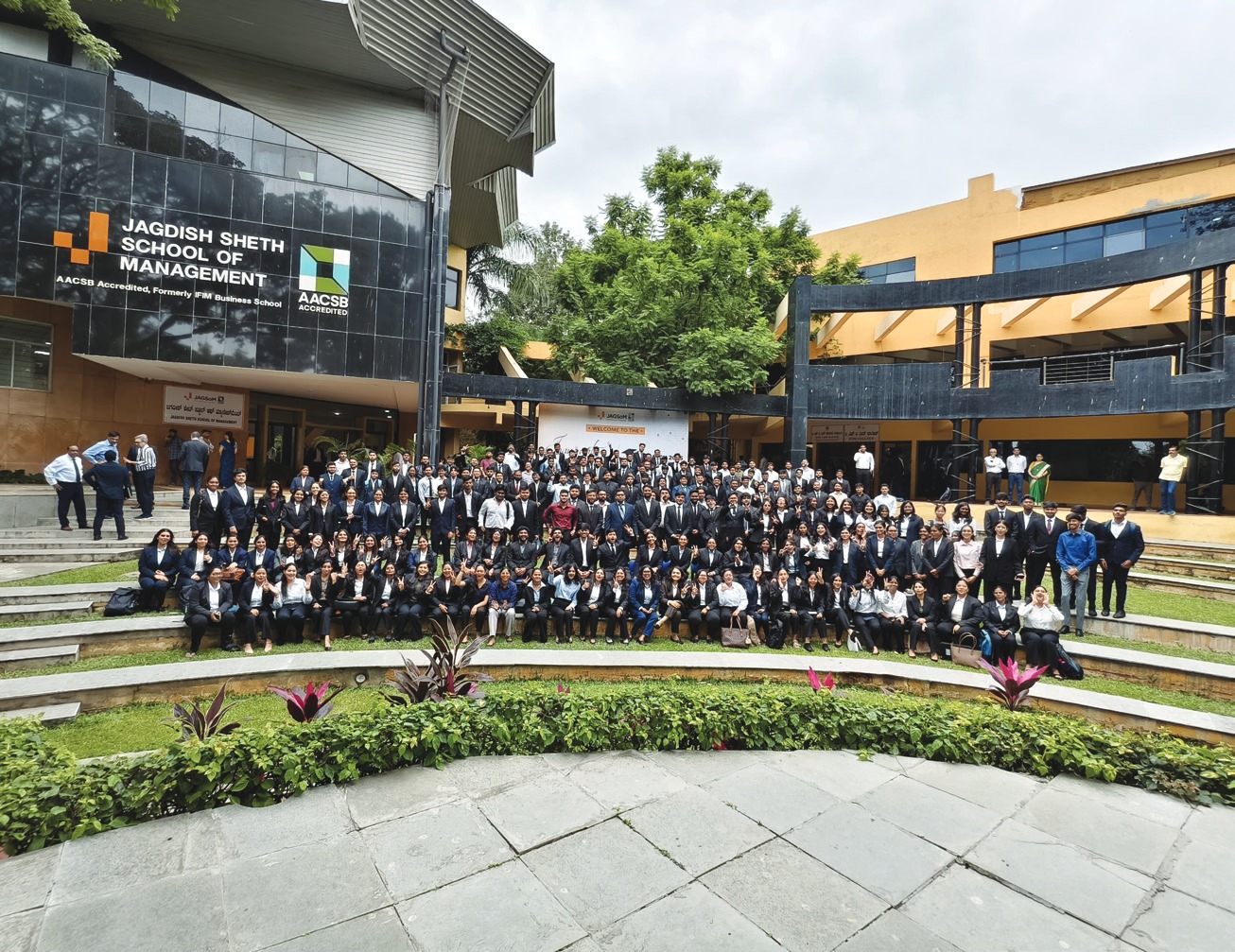
JAGSOM outdoor auditorium: Top 10 re-entry. Inset: Sridevi Varanasi
“For years we have operated with the conviction that most institutions quietly avoid: the best measure of a B-school is not the quality of students it admits, but the distance it moves them. The EW 2026-27 ranking tells us this conviction is now visible to the public. But we are also clear-eyed that our entry into the Top 10 is a starting point, not a destination,” says Sridevi, a commerce postgrad of Osmania University, Hyderabad which awarded her a Ph D in finance, after which she signed up with IFIM in 2006. After a long career with this progressive B-school, she was appointed Dean early this year.
Although JAGSOM has been awarded above-rank scores under several parameters of business management eduation excellence — faculty competence, research, industry interface, infrastructure and leadership — Sridevi values its above-rank score under faculty competence the most. “Teaching a room where one student holds a postgrad degree and another brings three years’ experience of the shopfloor and moving both of them forward meaningfully, demands scholarly depth, pedagogical range and professional credibility to make every concept comprehensible. Our faculty do this daily. Everything else follows,” adds Sridevi. Currently, JAGSOM has 520 postgrad students mentored by 36 highly qualified faculty on its muster rolls.
Albeit the country’s 23 IIMs, the first of whom was established in 1961, are the most well-known and reputed, it’s encouraging that an estimated 5,000 private B-schools of varying degrees of competence and reputation have also been promoted in their wake. This is eminently in national interest because the total factor productivity of Indian industry — including MSMEs (micro small and medium enterprises) — is poor by global standards. Therefore, the annual EWIHER which ranks the country’s 200 most well-reputed private B-schools serves a useful purpose inasmuch as it beams a searchlight on easily accessible B-schools which don’t receive the coverage and publicity of the IIMs.
Consequently, it is informative that there are numerous relatively unsung private B-schools which are rising in the esteem of the informed public. Among them: the Great Lakes Institute of Management, Chennai which has been given a big promotion to India #9 (from #24 in 2025-26) and #1 in Tamil Nadu; GITAM School of Business, Visakhapatnam to #10 (28) and #1 in Andhra Pradesh; Department of Management, BITS-Pilani #11 (23); Dalmia Institute of Management & Research Studies, Mumbai # 12 (15); Jaipuria Institute of Management, Ghaziabad #16 (36); KIIT School of Management, Bhubaneswar #18 (54); ASM Institute of Business Management, Pune #19 (31); Balaji Institute of Modern Management, Pune #19 (43); and the previously unranked Sheila Raheja School of Business Management & Research, Mumbai at #20.
Even beyond the Top 20 there is considerable churn in the 221-strong EW league table 2026-27 of India’s best private B-schools with several previously unranked institutions — Apeejay School of Management, Delhi; Calcutta Business School, among others — making impressive debuts.
Moreover, readers aspiring for business management education should also bear in mind that B-schools modestly ranked in the national league table, may well be heavyweights in their host states and cities. For instance the Xavier Institute of Management, Bhubaneswar (XIM-B) India #14 is top-ranked in Odisha; Chitkara Business School, Chandigarh ranked India #22 is #1 in Punjab and Heritage Business School, Kolkata India #23 is #1 in West Bengal. Therefore, readers who don’t wish to venture far from home in pursuit of business education should also check out state and city rankings.
 “In most national rankings, we are placed #1 or #2 among private business schools in India. So, our #3 rank in EWIHER is not a “big promotion”. That said, we view such visibility as an outcome rather than an objective. It reflects sustained work by our faculty, participants, and alumni, and reinforces our commitment to remain focused on our mission while continuing to evolve in response to a changing world. Over the past year, we have focused on strengthening academic rigour, deepening industry engagement, and investing in areas such as responsible leadership and technology-led innovation.
Equally, our faculty’s growing thought leadership and the achievements of our students and alumni have helped carry our voice into wider conversations, reinforcing credibility over time. Our high scores under the parameters of curriculum and pedagogy and career readiness/placements are affirming, because these are areas, we have consciously prioritised. Our approach has been to design learning that is both rigorous and reflective, while ensuring that students are prepared not only for their first role but also for long-term relevance and impact. Strong placement outcomes are a natural consequence of this alignment between what we teach, how we teach, and what the world of practice demands.” — Dr. Varun Nagaraj, Dean of S.P. Jain Institute of Management & Research (SPJIMR), Mumbai









Add comment