






Parents! End control-command culture now!
Even in this new age of smartphones, social media, dating sites, AI, economic liberalisation, rising higher education levels and greater social mobility, the vast majority of sub-continental parents demand unquestioning obedience from their children and expect to control their lives through childhood, adolescence and adulthood
Punita Malhotra
This June-July, as Gen Z took to the streets under the banner of the newly formed Cockroach Janata Party (CJP), demanding accountability for the NEET-UG 2026 exam paper leak, another Gen Z story was gripping the country for entirely different reasons.
On June 23, Siya Goyal (20) was arrested by Pune police for allegedly pushing her wealthy businessman fiance Ketan Agarwal off a precipice near Lonavala with aid and assistance from her lover. As noisy prime-time TV anchors debated the motive and Instagram sleuths investigated the cause, there was unanimity about one detail: Siya couldn’t persuade herself to decline a marriage her parents were set upon, even though she didn’t love Ketan. She chose to conspire a murder rather than risk her parents anger and displeasure.
 The revelation that a young woman could be more afraid of defying her parents than of risking a murder charge has sparked an intense national debate about Indian parenting and its obsession with control, command, authority and obedience. Even in this new age of smartphones, social media, dating sites, AI, economic liberalisation, rising higher education levels and greater social mobility, the vast majority of sub-continental parents demand unquestioning obedience from their children and expect to control their lives through childhood, adolescence and adulthood. It’s common for parents to dictate their children’s higher education streams, career pathways and brides and grooms.
“From biscuits to brides, Indian parents want to decide everything for you, how you will live life, what you’ll eat or drink, how you’ll pray, what you’ll wear, who you’ll date (nobody), whom you’ll marry (the person we chose with three-factor authentication of caste, community and religion), when you will copulate and when you’ll produce offspring… Free will, liberty or agency over one’s own life is a fundamental human need. When will Indian parents understand this?” queried best-selling author Chetan Bhagat in an essay titled ‘Why Siya couldn’t say no to marriage’ (Times of India, June 30).
For decades, the Asian-style authoritarian parenting model — famously eulogised by Chinese-American author Amy Chua in her best-selling Battle Hymn of the Tiger Mother (2011) — was admired worldwide for producing disciplined, high-achieving and obedient children who excelled academically and professionally. But that parenting style is becoming increasingly discordant with the zeitgeist of the 21st century. These days influenced by the freewheeling, independent lifestyles young people are enjoying as depicted on social media and the worldwide web, Indian youth — Gen Z (born after 1996) and Gen Alpha (after 2010) — are beginning to question authority in public and at home. Social media has transformed social norms and exposed young people to a far wider range of lifestyles, aspirations and ideas about personal identity and freedom. In particular, Gen Z and Alpha are increasingly questioning legacy notions of duty, authority and conformity and demanding a greater say in decisions that shape their lives.

Dr. Shekhar Seshadri
“In India, parents’ relationship with children tends to be constructed around expectation, instruction, control and obedience and not on the basis of a culture of conversation and discourse. This culture of instruction and control is hostile to children and denies them their, personhood. Children are not a metaphor of parents unresolved issues and expectations nor a continuation of lineage and legacy. Children are individuals in their own right and the role of parents is to enable them to develop into socially responsive and responsible individuals through deep, abiding, unconditional love and not on expectations that are rigid and uncompromising,” opined Dr. Shekhar Seshadri, former professor of child and adolescent psychiatry at the top-ranked National Institute of Mental Health and Neurosciences (NIMHANS), Bangalore, in a podcast interview with PW Managing Editor Summiya Yasmeen discussing India’s child mental health crisis (https://educationworld.in/decoding-the-educationworld-is-indias-child-mental-health-crisis-a-ticking-time-bomb/).

Gurpreet Kaur
Jaipur-based parenting coach, Gurpreet Kaur, concurs that for generations, in Indian families, good parenting has meant directing all aspects of children’s lives, well into adulthood. “I’ve decided, you follow, is literally the only template we were handed, and millennial parents are just carrying it forward. Being fully involved in children’s lives is seen as a marker of good parenting. Liberal parents are widely viewed as negligent, permissive and uncaring. There is also a larger social dimension. In Indian society, children’s choices reflect upon the family, whether it is the marks they score, the careers they choose, and the person they marry. The perceived social and reputation costs of individual decision-making are very high if they are at odds with parental and societal expectations. That’s why the tendency of Indian parents to regulate all aspects of their children’s lives,” says Kaur.
This over-parenting aka helicopter parenting, in which parents micromanage virtually every facet of their children’s lives without fear of contradiction deprives children of the very experiences through which autonomy, resilience, judgement and self-confidence are developed. A systematic review of 74 research studies, cited by Psychology Today, found that over-parenting is associated with poor psychological, behavioural, social, academic and career outcomes among young adults.

Saakshi Singla
According to Saakshi Singla, a Delhi NCR-based child and family counsellor, most parents’ inability to let go and tendency to interpret a child’s disagreement as disrespect, defiance or ingratitude, is deeply connected with their own insecurities and in how central their children have become to their identity. “When children become a parent’s prime source of purpose and emotional fulfilment, allowing them to chart their own lives feels like a personal loss. Such parents repeatedly remind children of the sacrifices they have made for their education and welfare. This can make children feel obliged to reciprocate their parents’ demands. In such cases, independence feels like disloyalty. Children fear disappointing their parents and experience anxiety about making choices that can be interpreted as selfish and irresponsible. Contradicting parents is not only uncomfortable, it feels dangerous with acquiescence and silence being the safer option,” says Singla.
Moreover, culturally, arguing with or disagreeing with elders, including parents, is widely regarded as disrespectful. Respect is often equated with deference: children are expected to listen when parents speak, accept their advice without argument and avoid openly questioning their decisions. The familiar injunction “listen to your parents, they know better” leaves little room for a child to say, “I understand what you are saying, but I disagree”. A child who challenges parental opinion is labelled stubborn, arrogant, rebellious and ungrateful, rather than as someone who is developing critical and independent thinking skills.
Singla says this culture of deference and unquestioning obedience needs to change. “Parents need to create a home culture where questions and children disagreeing are not seen as challenges to parental authority, but as opportunities for conversation. Learning to respectfully disagree helps children develop critical communication, independent thinking, negotiation and decision-making skills. If we want children to become independent adults, we have to first become comfortable with their independence and that means learning to hear disagreement from them,” says Singla.
Perhaps nowhere is the Indian parent’s difficulty with disagreement more evident than in matters of marriage as the Ketan-Siya murder case illustrates. For most parents, marriage is an alliance between two families for advancement of social status, family honour involving caste, religion and business alignment between families. Consequently, a child rejecting a prospective match is tantamount to denying advancement of the entire family. “But why is it so difficult for an Indian parent to hear the word ‘no’? I will not marry the man you have chosen. And why must the relationship threaten to break down over this refusal? Is it because parents see themselves not only as the biological creators of their children but also as lifelong architects of their fate?… The sooner parents learn to accept that a son or daughter saying no is not a personal rejection but evidence of adulthood, the more room there will be for real love. It is in recognising the otherness of the other person that we arrive at our own individuation: this is where I end, and you, my child, begin. Every boundary is not a wall but a window. It allows two people to truly see one another, rather than consuming each other whole,” wrote Siddharth Dhanvant Shanghvi, a Mumbai-based author (The Last Song of Dusk) in an essay titled ‘There’s no space for no in the Indian family’ (Times of India, September 11).

Kritika Mattoo
But the traditional control-and-command parenting model is increasingly being questioned by Gen Z and Gen Alpha, coming of age in a digital, hyper-connected world where information is abundant, authority is questioned and alternative ways of thinking are constantly visible. With smartphones and social media placing information and opinions within easy reach, parental authority can no longer rely solely on knowledge imbalance. Children can fact-check information from on high, access perspectives their parents may never have encountered, and form opinions independently. “Gen Z and Alpha have access to all information within easy reach. As a result, ‘because I say so’ carries less weight. Children are more likely to question, seek alternative opinions and challenge authoritative decisions. While online information is not always accurate, easy access means parents increasingly need to explain their directives, listen to their children’s perspective and negotiate boundaries,” says Kritika Mattoo, a Delhi-based clinical psychologist.
The new AI age mandates Indian parents to evolve from control-and-command to collaborative parenting, respect children’s opinions and choices. In a world where chatbots are feeding children information, perspectives and expert opinion, effective parents have to learn to listen, debate and guide their children patiently if they are not to antagonise them. “Parents need to recognise the child as an individual with preferences of her own from early age. If we want our children to be able to stand up to the world, we have to allow them to stand up for themselves at home. Allowing children to express a different opinion does not mean removing boundaries. Parents still have a duty to advise safety, structure and limits. The challenge of modern-day parenting is knowing which boundaries are essential and where there is room for discussion. For instance, a parent may set mutually agreed limits about digital screen viewing or insist that a young child wear a helmet while cycling, while allowing the child to decide which games to play, what to wear or how to organise their free time. Good parenting is not about giving children unlimited freedom; it is about giving them increasing ownership of their lives as they grow and supporting them in making important decisions about their own lives including choosing their careers and marriage partners,” says Harpreet S. Grover, Mumbai-based founder of The Curious Parent, a research-based parenting education platform.
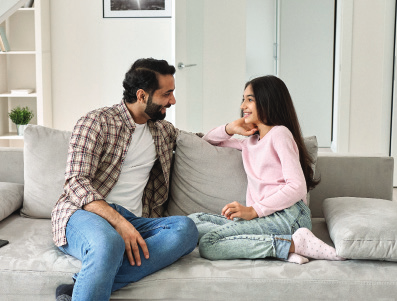 The challenge, therefore, is for parents to strike the right balance between giving children and young adults agency to make their own decisions, learn from their mistakes and experience the consequence of their choices, while continuing to protect and guide them. As children grow, so must the nature of parenting evolve. In early childhood, parents necessarily make most decisions, setting rules, providing structure and ensuring children’s safety. As children enter adolescence, the balance gradually shifts: parents must explain the reasoning behind rules, involve children in decisions, and allow greater choice. By young adulthood, the relationship needs to evolve further — from deciding for them to advising them, from giving instructions to having conversations, and from requiring permission to offering guidance.
“Parents need to understand that parenting cannot remain frozen in the same mode from childhood to adulthood. As children grow into young adults, the parent-child relationship must evolve — you cannot use the same controls to parent an adult that were appropriate when the child was five years of age. Young children need parental help to make many decisions because they don’t have the skills to assess risks or understand consequences. As children grow into adults, the parent’s role must gradually shift from deciding to guiding. An adult doesn’t need a parent to make her decisions, she needs a sounding board for decisions and informed guidance from experience. Unfortunately in India, many parents continue to parent their adult children as though they are infants, mistaking lifelong responsibility for lifelong authority and guidance for right to decide,” says Saakshi Singla.

Harpreet Grover
Kritika Mattoo advises parents to invest in building a democratic home environment where children are encouraged from early age to put forward arguments, reason things out and express viewpoints which may differ from their parents. “Decision-making is like a muscle. If a parent is constantly making decisions from early childhood, children’s muscles will atrophy. Children should therefore be encouraged to make age-appropriate decisions and choices. Moreover, instead of authoritative prohibition, parents should explain reasons, discuss them with their children and encourage them to participate in finding workable mutually agreed solutions. Disagreement then becomes a conversation rather than confrontation, teaching children to weigh risks, consider different perspectives, negotiate and find solutions,” says Mattoo.
The Ketan-Siya murder case is a wake-up call for Indian parents to evolve beyond the traditional control-and-command model towards a household culture where conversations, disagreements and dissent are not only permitted but respected. Gen Z and Gen Alpha are growing up in a world radically different from the one their parents inherited, and cannot be silenced with fear, guilt or the old refrain of “because I say so.” Enlightened parenting requires listening as much as instructing, negotiating as much as directing, and trusting as much as protecting.
Transitioning from control-command parenting to a conversation culture
We present curated advice from three experienced psychologists and counsellors on how parents can nurture a democratic culture of dialogue, conversation and respectful disagreement at home while drawing boundaries, structure and guidance that children need.
 Gurpreet Kaur: Make it safe to speak up
- Set mutually agreed guidelines relating to sleep, meals, screen viewing and family time.
- Negotiate phone-free family time when everyone is fully present to discuss above matters.
- Make conversation a daily habit: encourage children to share one positive highlight and one challenge of the day.
- Encourage children to talk about their fears, regret, anger and mistakes without judgement or ridicule.
- Solicit children’s opinions — “What do you think?”, “What would you do?”
- Recall your own childhood dilemmas to illustrate that difficult emotions are normal.
- Make truth safer than secrecy. Let children know they can always confide in you even when they have made a mistake.
Saakshi Singha: Let children have lives of their own
- Don’t make your happiness contingent upon children’s behaviour.
- Address your own loneliness, frustrations and relationship difficulties independently.
- Don’t guilt children for leading their own lives and developing relationships and priorities.
- Build your own friendships, interests and support systems.
- Make it clear to children that their increasing independence is not parental abandonment.
Kritika Mattoo: Build independence early
- Encourage growing independence. Assign children age-appropriate responsibilities such as tidying their room, folding clothes, carrying their school bag, etc.
- Let children take increasing responsibility to manage homework, care of possessions and manage social commitments without constant reminders and supervision.
- Encourage children to be adventurous, learn from failure and find alternative ways when things don’t work. Learning from failure is essential for developing independence and resilience.
- Develop their decision-making skills by allowing them to make age-appropriate choices and encourage them to attempt to solve problems independently before turning to parents.
- Help them make choices based on their own interests and values, rather than choosing options likely to please you.









Add comment