






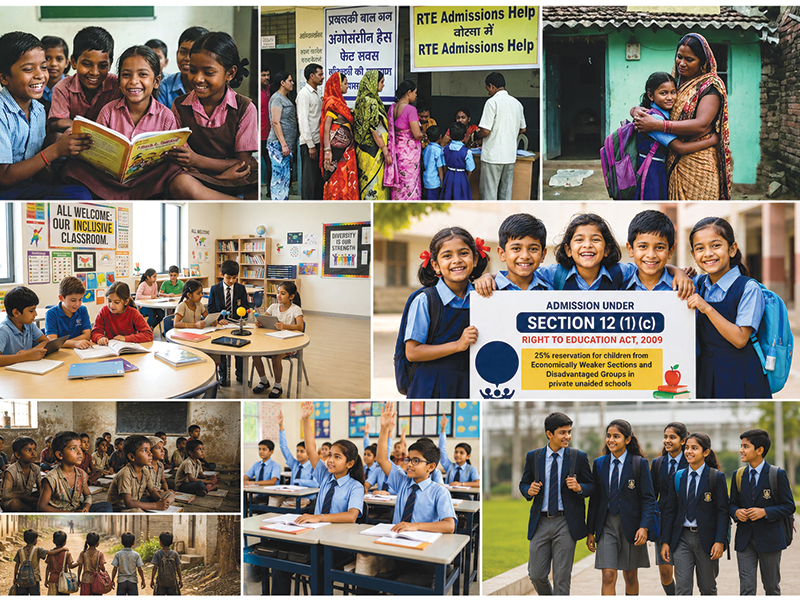
Right of Children to Free and Compulsory Education Act, 2009: Why all schools must respect S.12 (1) (c)
In this EW exclusive feature, the authors highlight challenges to the implemenation of s. 12 (1) (c) and explain why all private unaided schools should comply with this constitutional promise in the interest of social integration, inclusion and student body diversity – Ayushi Khare, Karthika Annamalai & Mansi Middha
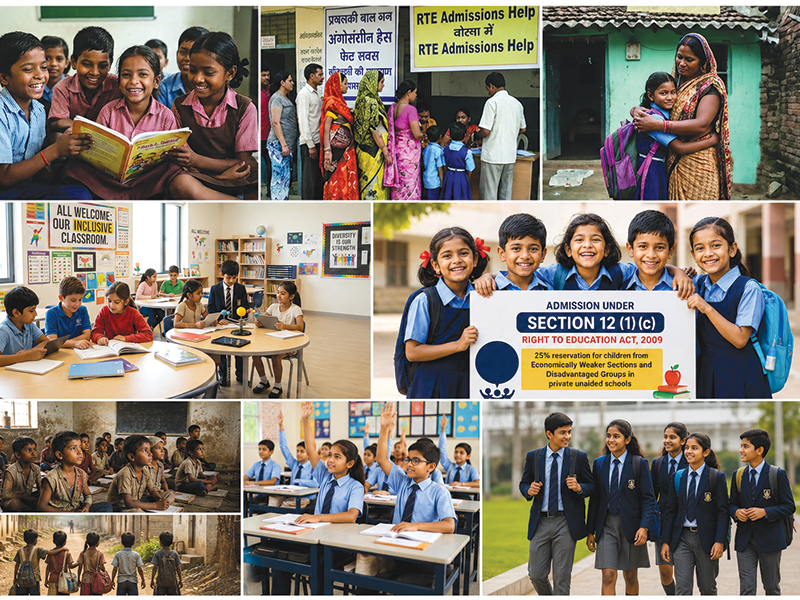
On April 1, the landmark Right of Children to Free and Compulsory Education (aka RTE) Act, 2009, which makes it mandatory for the State (i.e, Central, state and local governments) to provide free and compulsory elementary education (class I-VIII) to every child between 6-14 years of age and prescribes minimum infrastructure, teacher-pupil ratios and other norms for all schools, marked its 16th anniversary.
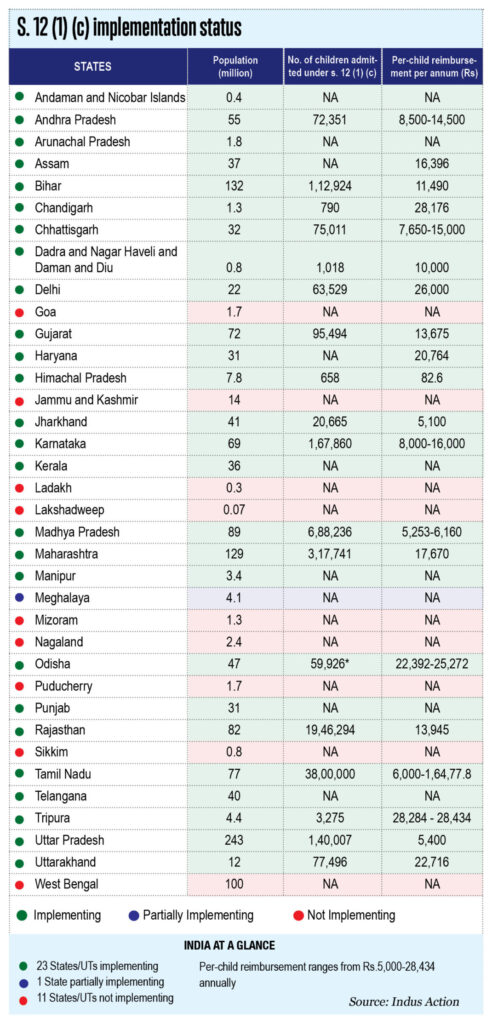
Sixteen years after it came into force on April 1, 2010, implementation of the RTE Act has been piecemeal and inchmeal by state governments confronted by financial constraints, implementation complexities and teacher shortages that routinely burden government schools. According to a 2023 report of the Union education ministry, only 25.5 percent of RTE norms have been implemented by schools nationwide — official admission of the wide gap between legislative intent and on-ground implementation.
Even as implementation of the RTE Act in the country’s 1 million government schools has been snail-paced, the nation’s 418,932 private schools have been struggling to meet the mandate to provide subsidised elementary education to children from impoverished households in their neighbourhood. Under s.12 (1) c) of the Act, private schools are obliged to reserve 25 percent capacity in class I for disadvantaged children in their neighbourhoods and provide them free-of-charge education all the way up to class VIII. The tuition fee of children from EWS (economically weaker sections) and disadvantaged groups admitted into private schools under s.12 (1) (c) is to be paid by the State (i.e, the Central and local governments). The Central and state governments are obliged to jointly reimburse tuition fees equivalent to the per student expenditure incurred by the state government in its own schools (s.12 (2)).
S.12 (1) (c) was challenged by private schools in the Supreme Court for “partial backdoor nationalisation” and violating private school promoters’ fundamental right to “carry on any business, trade or profession” without excessive government interference. Delivering its judgement on April 12, 2012, in Society for Unaided Schools of Rajasthan vs. Union of India, a three-judge bench of the Supreme Court upheld constitutional validity of s.12 (1) (c) by a 2-1 majority inter alia on the ground that although the RTE Act mandates the State to provide free and compulsory education to children in the age group 6-14, it did not require it to provide it directly. It also held that the quota for disadvantaged children residing in the neighbourhood of schools was a reasonable restriction of promoters’ right to carry on the profession of education. However, it exempted minority and boarding schools from the applicability of s.12 (1) (c).
Subsequently, in other cases, this most litigated provision of the RTE Act has been upheld by most courts. Most recently, in Dinesh Biwaji Ashtikar vs State of Maharashtra (January 2026), the Supreme Court reaffirmed the purpose of s.12 (1) (c) as a “national mission” for social inclusion to break entrenched barriers of caste and class through inclusive education.
However, despite the courts reaffirming the constitutional validity of s.12 (1) (c), private unaided schools have resisted its implementation, with some schools resorting to claiming minority-status exemption and/or prevailing upon state governments to introduce neighbourhood-based restrictions that reduce its applicability. In this EW exclusive feature, Ayushi Khare, Karthika Annamalai & Mansi Middha of Indus Action, a policy-implementation non-profit, assess the implementation status of s.12 (1) (c) nationwide, highlight challenges to its implementation and explain why all private unaided schools should comply with this constitutional promise in the interest of social integration, inclusion and student body diversity.
Most conversations about education access begin with the usual questions: who is admitted into classrooms, who teaches them, and which children are most deprived of education? What is rarely discussed is which children get to learn together with each other, and which children are shut out of schools where socio-economically privileged citizens educate their children.
This question matters because it determines whether underprivileged children can enter classrooms where social currency permeates and social circles that inherit power. Access is about entering a classroom. Equality is about ensuring that classrooms are not divided by class, caste, income, or social background. S.12 (1) (c) of the RTE Act, 2009 was designed to close that gap, even if partially.
Under this provision, private aided and unaided schools are obliged to reserve 25 percent of entry-level (nursery or class I) seats for children from economically weaker sections (EWS) in their neighbourhood. This is an access provision. It opens the doors of private schools to children from EWS and disadvantaged backgrounds who cannot afford private education. Its deeper constitutional purpose is social integration: to ensure that children don’t come of age in educational environments divided by class, caste, income, and inherited privilege.
In a January 2026 judgement in Dinesh Biwaji Ashtikar vs State of Maharashtra, the Supreme Court reaffirmed this purpose in evocative terms. The court observed that s.12 (1) (c) enables “the child of a multi-millionaire or even of a Judge of the Supreme Court of India to sit in the same classroom and at the same bench as the child of an autorickshaw driver or a street vendor.” In upholding s.12 (1) (c), the apex court reaffirmed that this provision is more than a school-admission mechanism — it is a legal mandate to give teeth to the constitutional mandate of equality (Article 14) by creating shared learning spaces for children.
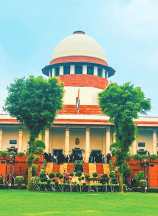
Supreme Court: evocative endorsement
The positive impact of this social inclusion provision is reflected in the experiences of households that have benefited from the RTE quota. In Pipili (Odisha), Payal was admitted into class I at the Sunshine Public School under the RTE Act’s s.12 (1) (c). Her father is employed as a cook in Bhubaneswar, earning Rs.10,000-12,000 per month. After completing the RTE application and document verification process with the support of an Indus Action partner organisation, the family received a message confirming Payal’s admission. Today, she attends class regularly, her family participates in parent-teacher meetings to track her progress, and her dream of qualifying as a medical practitioner is realisable.
Stories like Payal’s are often recounted as narratives of opportunity — of a child learning in a school previously out of reach. But the real promise of s.12 (1) (c) is larger. It is about whether she studies, plays, learns, and grows alongside children whose lives may otherwise have remained totally distant from hers. At stake is not simply where a child studies, but whether the circumstances of birth continue to determine the boundaries of a child’s educational and social worlds.
Not a Retreat from Public Education
S.12 (1) (c) is often misinterpreted as promoting private schooling and/or permitting the government to outsource its duty to provide good quality public education. Critics express apprehension about declining government school enrolment and rising numbers of private schools. However, such criticism is misplaced for three reasons.
First, s.12 (1) (c) recognises that a child born into one world should not be condemned to live within the boundaries of that environment. Families from economically weaker sections and disadvantaged groups often seek admission into private schools for the same reasons as better-off households: superior facilities, better peer networks, English-language learning, greater discipline, and better career opportunities. When such access is available to privileged households through purchasing power but denied to poor families in the cause of protecting public education, the result is not the defence of the public system, but the preservation of social segregation.
Second, s.12 (1) (c) recognises a more uncomfortable truth: that private unaided schools are not just a marginal feature of the Indian education system but share centrestage with the public system. A universal right to education that stops at the gates of private schools that educate almost half (48 percent) of India’s school-going children is iniquitous and necessitates state intervention, even as its obligation to build and upgrade public schools remains non-negotiable. In this interim, the State’s responsibility extends to protecting children’s rights to access education beyond public institutions. Nothing in this provision imagines private schools replacing public institutions.
Third, growing parental preference for private schooling predates the RTE Act. The Annual Status of Education Report (ASER) 2006 had already documented a significant shift of students into private schools “at the expense of government school enrolment,” years before s.12 (1) (c) came into force. This shift is rooted in age-old anxieties about weak infrastructure, low teacher-pupil ratios, poor learning outcomes in public/government schools, parents’ English-medium aspirations, and the perceived quality and social value attached to private schooling. Advancing declining numbers in government schools as an argument against s.12 (1) (c) amounts to penalising children for systemic failure they didn’t create.
The better response is to pursue both commitments together. India must strengthen government schools with urgency, while also ensuring that private unaided schools comply with their statutory obligation under s.12 (1) (c).
Integration evidence from the Ground
Since its rollout, s.12 (1) (c) has enabled over 5 million children to enter educational spaces that were previously out of reach, with retention rates averaging over 90 percent. This is not a marginal achievement. It demonstrates that when the provision is implemented with administrative capacity, children from economically weaker sections and disadvantaged groups are not merely admitted into private schools; they remain, participate, and progress within them until the completion of primary education (class VIII).
For instance, in Delhi, where s.12 (1) (c) is being implemented seriously, class-agnostic classrooms are functioning quite smoothly. They also contradict the assumption that social inclusion disrupts school environments. Research (Rao, Gautam, 2019) indicates that mixed classrooms with diverse student cohorts stimulate generosity, reduce discrimination, and strengthen students’ pro-social attitudes, without adversely affecting academic outcomes or classroom discipline. In other words, integration does not adversely impact learning. In fact, it deepens the broader social purpose of education.
Research data also indicates that the benefits of inclusive education are not limited to children admitted under s.12 (1) (c). Benefits also flow to children from diverse social and economic backgrounds, jointly exposing them to a wider range of lived experiences. For children from privileged backgrounds, diverse learning spaces challenge inherited assumptions about poverty, caste, class, and capability. For underprivileged children, private schools provide access to better infrastructure, improved teaching-learning, social capital, peer networks, English-language exposure, and new social and career aspirations.
In several states across the country where s.12 (1) (c) is being seriously implemented, exposure to centralised admissions, online MIS systems, transparent admission lotteries, and streamlined reimbursement processes under s.12 (2) have reduced discretion and improved accountability. They are proof that when properly designed, this provision can protect EWS families from arbitrariness and make social integration a routine feature of schooling rather than exceptional act of charity.
The Implementation Challenge
However, there is no denying that in several states, implementation of s.12 (1) (c) presents formidable challenges. In laggard states, the provision has been weakened by repeal, restrictive rules, uneven administrative design, poor outreach, delayed s.12 (2) reimbursements, and weak grievance redressal machinery.
The most visible challenge is interpretation of ‘neighbourhood’ to reduce the ambit of s.12 (1) (c) by some states. For instance, Karnataka, acknowledged for creating a transparent, centralised, lottery-based RTE admission system, changed its RTE Rules in 2019 to introduce Rule 4. Under this rule, private unaided schools are exempt from the applicability of s.12 (1) (c) if a government school exists within a radius of 1 km of the residence of a poor household. The impact of this Rule is that s.12 (1) (c) admissions declined from 116,273 in 2018-19 to 1,795 in 2019-20. Similarly, in Telangana, where s.12 (1) (c) was operationalised after judicial intervention, the state government amended the RTE Rules to the effect that the 25 percent quota provision in private unaided schools will be implemented only in areas where there is no government or local body school within a 1 km radius of an applicant child’s residence.
Some states face other implementation challenges. For instance, Assam has amended its RTE Rules in 2021 under which only vernacular-medium, non-minority private unaided schools are required to reserve 25 percent of entry-level seats for EWS children. English-medium private schools are not covered by the current implementation framework. In other states, where online RTE admissions portals are non-functional or limited to school registration, admissions often remain offline and arbitrary. This produces nominal implementation: the legal framework exists, but the pool of participating schools and applicants is too narrow to meaningfully realise the entitlement to its full potential.
 A further challenge is decentralised and inconsistent implementation. Some states haven’t established centralised state-wide frameworks. Instead, the process is managed at the district level, leading to variation in timelines, eligibility verification, and application procedures, as well as ineffectively run lotteries, without a grievance redressal mechanism. Such decentralisation may be administratively convenient, but it creates unequal access to a statutory right. A child’s eligibility to benefit from s.12 (1) (c) should not depend on the district in which she resides or the efficiency of a local office. At a minimum, states require uniform admission calendars, standardised applications, transparent lottery systems, school-wise seat disclosure, reimbursement tracking, and accessible grievance forums.
Short, poorly publicised RTE admission application time windows pose another major barrier. Most states reportedly open admission registration windows for very brief periods, leaving little to no time for awareness campaigns. For families facing barriers of digital access, documentation, language, mobility, and awareness, such small windows are not meaningful opportunities. They are procedural hurdles disguised as administrative timelines. A statutory entitlement for EWS and disadvantaged groups cannot assume that every eligible household has immediate internet access, updated documents, prior awareness, and the ability to navigate online systems without support.
Eligibility thresholds also require careful design. Some states prescribe parental income limits that exclude families who remain economically vulnerable despite earning marginally above the threshold. Others adopt thresholds so broad that middle-class households are included in the EWS category. The answer is not to make eligibility punitive, but to ensure that criteria are rational and periodically updated with appropriate prioritisation for the most disadvantaged applicants.
Reimbursement of fees under s.12 (2) to private schools remains a persistent fault line. Private schools frequently resist admitting students whose fees are reimbursed by state governments. In some states, reimbursement amounts have remained unrevised for years despite rising costs. In others, schools must repeatedly submit documentation, follow up across departments, or wait long periods before receiving reimbursement. Although these failures do not justify resistance to admission, they create conditions for resistance on one pretext or another. A serious implementation framework must therefore include transparent tracking, clear documentation standards, and predictable fee reimbursement timelines.
Equally important is accessible grievance redressal. Families often have no effective remedy when admission applications are rejected, documents are disputed, schools deny admission, informal fees are demanded, or children face exclusion after enrolment. The smooth implementation of s.12 (1) (c) requires helplines, complaint portals, time-bound escalation systems, district and State-level accountability, and public reporting of grievances and outcomes.
These challenges are real, but they do not weaken the case for implementation of this access provision. They clarify what it will take to make the provision work. A law designed to alter the social composition of classrooms cannot depend on private schools’ goodwill. It requires clear implementation architecture: uniform and reasonable application and admission timelines, transparent online admission lotteries, school-wise seats disclosure, adequate application windows, proactive community outreach, predictable fees reimbursement cycles, and accessible grievance redressal machinery.
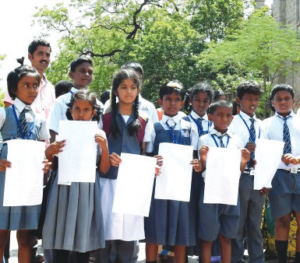 The eastern seaboard state of Odisha is a leader in designing a robust s.12 (1) (c) admissions system. The state adopted Indus Action’s RTE-focussed Digital Public Good, the RTE-PARADARSHI portal, which streamlines admissions, reduces duplication, and guarantees reimbursements for private schools. It also provides a toll-free number for grievances and support. Field experiences from Odisha indicate that families receive SMS confirmations after lottery selection, receive support during document verification, and engage at the school level through homework, assignments, and parent-teacher meetings. These are not minor administrative details. They are the difference between a formal right and one from which impoverished households can benefit.
The lesson, therefore, is not that s.12 (1) (c) is too ambitious. It is that ambition must be matched by design. Restrictive rules, short application time windows, delayed fee reimbursements, weak grievance systems, and passive outreach don’t negate this constitutional imperative. They highlight procedural implementation failures. The response should be to address those failures, rather than narrow the entitlement.
The Supreme Court’s recent reaffirmation of s.12 (1) (c) — as a “national mission” — is a reminder that equality must not remain confined to legal texts but be experienced in the everyday lives of children. Its promise is that all children from diverse socio-economic backgrounds should not grow up in separate worlds, encountering each other only as adults across lines of service, labour, and hierarchy.
At the same time, rigorous implementation of s.12 (1) (c) cannot be an excuse for neglecting public education. The two commitments must move together. India needs well-funded, high-quality government schools and meaningful inclusion within private unaided schools. One guarantees universal access; the other advances social integration.
Govt. s. 12 (1) (c) pending dues
Under s.12 (1) (c) of the RTE Act, 2009, private schools are mandated to allocate 25 percent capacity in classes I-VIII to poor children in their neighbourhood. To compensate private schools for providing free-of-charge education to poor children, s.12 (2) of the Act directs the State (Central and state governments) to pay private schools the equivalent average per-child expense incurred by government in its own schools.
However, many cash-strapped state governments have routinely delayed their obligation to make timely payments under s.12 (2) to private school managements. The amounts owed to private schools by major state governments for over 90 days under s.12 (2) are set out below.
(Rs. crore)
Karnataka 350
Maharashtra 2,930
Rajasthan 900
Telangana 200
Haryana 10
Tamil Nadu 450
Uttar Pradesh 846
Source: EW compilation
S. 12 (1) (c) & relevant provisions of the Consitution
Article 15 (1). The State shall not discriminate against any citizens on grounds of religion, race, caste, sex, place of birth or any of them.
Article 15 (5). Nothing in this article or sub-clause (g) Article 19 shall prevent the State from making any special provision, by law for the advancement of any socially or educationally backward classes of citizens or for the Scheduled Castes or the Scheduled Tribes insofar as such special provisions relate to their admission to educational institutions whether aided or any unaided by the State, other than the minority educational institutions…
Article 19 (1) (g). All citizens have the right to practice any profession, or to carry on any occupation, trade or business.
Article 21A. The State shall provide free and compulsory education to all children of the age six-14 years in such manner as the State may, by law, determine.
Article 30 (1). All minorities whether based on religion or language, shall have the right to establish and administer educational institutions of their choice.
Article 45. The State shall endeavour to provide early childhood care and education for all children until they complete the age of six years. (Inserted by the Constitution (Forty-second Amendment) Act, 1976).
Source: EducationWorld
(Ayushi Khare is Senior Lead, Government Relations, Karthika Annamalai is Consultant, Right to Education, and Mansi Middha is Lead, Research and Impact at Indus Action, Delhi)
Edited by Summiya Yasmeen








One comment
Sanjay Gupta
All bullshit. RTE should be destroyed and the tool to do that is Article 30 (linguistic/Jain).